
This is a condensed and edited transcript from the radio interview.
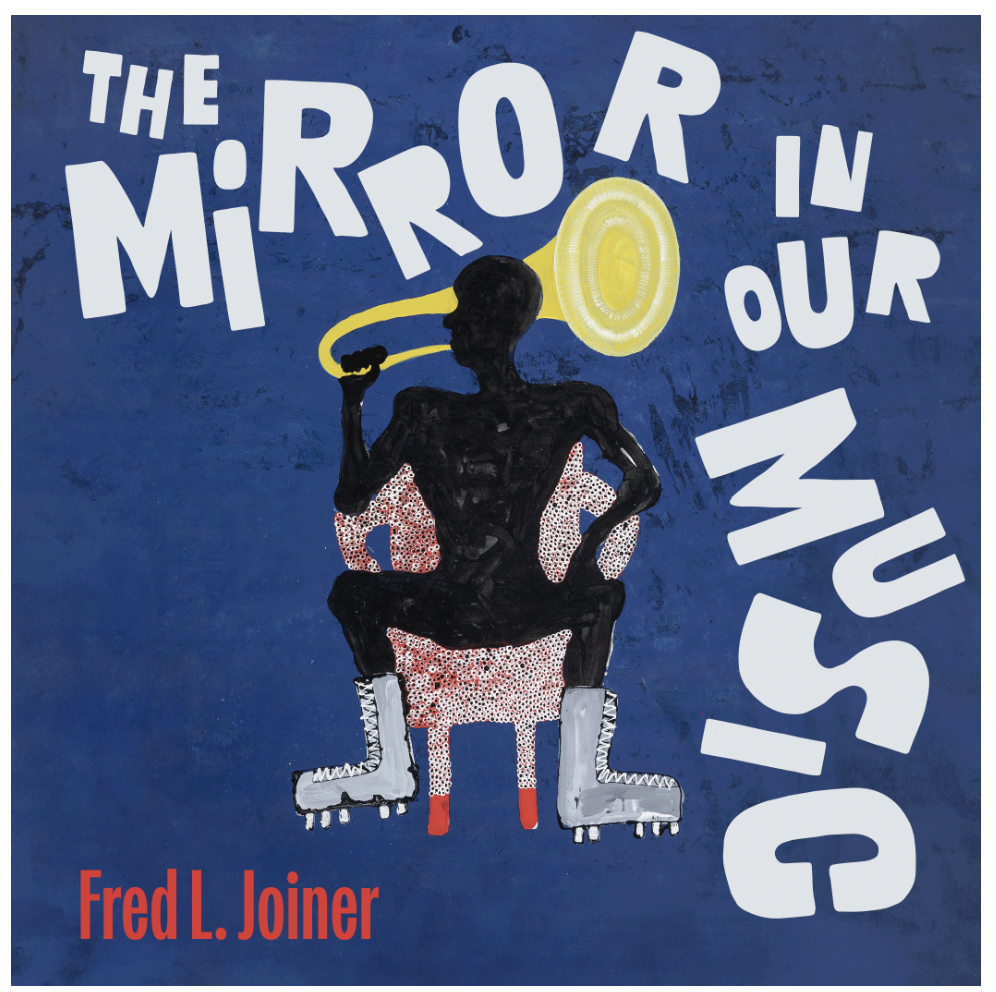
On August 3, Carrboro Town Council Member and former Poet Laureate Fred Joiner visited The Carrborean Radio Hour on WCOM 103.5 FM, along with two student poets, Aija Jerome and Alys Traylor, and we talked about his new book, The Mirror in Our Music. The conversation ranged from Washington, D.C. in the 1990s to West Africa and Belfast, from gentrification and grief to jazz, hip hop, and photography, reflecting Fred’s deep roots in tradition, community, and experimentation.
What is The Mirror in Our Music and where can people find it?
Fred Joiner: It’s a collection of poems written over roughly two decades, drawn from many places I’ve lived and traveled—Washington, D.C., West Africa, Belfast, and North Carolina. You can request it at any bookstore; locally, Epilogue has copies, and shops like Golden Fig and Flyleaf can order it. You can also order it directly from my publisher, Birds LLC, by searching the title online.
How did this book come together and why publish it now?
Fred: I’d been quietly working on a manuscript since I finished my MFA in 2015, tweaking and adding to it. The turning point was a reading at the North Carolina Book Festival in February 2020. Afterward, poet and publisher Chris Tonelli (Birds LLC) asked if I had a manuscript. I sent it, he wanted to publish it, and that planted the seed.
Before that, my friend Enzo Silon Surin had asked for a manuscript years earlier. I wasn’t ready then, but that request made me start thinking seriously about a book. Many of the poems are tied to my time in North Carolina and in D.C.; the oldest pieces are close to 20 years old. The book only felt ready once that long arc of experience had a shape.
You’ve lived and worked in many places. What experiences most shaped the poems in this collection?
Fred: A lot begins in Washington, D.C., where I moved in 1993. There was a vibrant ecosystem of writers, musicians, and artists all in conversation with each other. Being in an international city also sharpened my interest in the African diaspora—travel, culture, and how Black people across the world are connected.
I later lived four years in West Africa (Mali), and did peace and conflict resolution work in Belfast, Northern Ireland, using photography and poetry with young people and adults. I’ve traveled across the U.S. and the African continent; many poems come out of those journeys, plus news events, personal and family histories, and specific places with compelling stories.
Gentrification appears as a theme in your work. How does it show up in the book?
Fred: Some poems address gentrification directly, especially what I witnessed in D.C.: houses being torn down, poorer or less-resourced people pushed out, wealthier people moving in—and now even some of those original “gentrifiers” getting priced out. The poems are a way of looking at these transformations in real time, and asking what happens to communities when money reshapes who belongs where.
Aija asked about the many acknowledgments in his book. “Why was it so important for you to name and honor other people on the page?”
Fred: I come from people who honor tradition, legacy, and lineage. I don’t take poetry as just a hobby; it’s a tradition I’m fortunate to participate in. My work exists because teachers, peers, elders, and co-creators poured into me.
Those notes and acknowledgments are, first, about honor—saying: “I didn’t get here alone.” Second, they’re about education. I hope readers will Google those names, learn who they are, and see the lineages my work is in conversation with.
Sometimes I’m even trying to “write like” those poets, which is bound to fail because everyone’s voice is unique. But even that failure is another way of honoring them. You learn craft by emulating people whose work you love; you absorb techniques by doing, not just by analysis.
Alys raised the idea of “generational weight” and grief in his book. “How do you think about grief in your poetry?”
Fred: In the traditions I come from, memory is a way of keeping people alive. Your ancestors and elders live as long as you speak their names and tell their stories. So part of my work is remembering—for my blood family, my chosen family, and all the artists and ancestors who cleared a path for me.
There are poems that are explicitly elegies—for example, one for my uncle who played saxophone. But grief is broader than death. You can grieve:
- A job that was more like a calling (like when my wife lost her global health job at USAID in a harsh, political way).
- A vocation or sense of purpose.
- A transition—not necessarily losing something but watching it change form.
I often experience grief as intertwined with celebration. Celebrating someone or something is a way of mourning its loss or its change, because you’re insisting on its value. I try to capture that complexity—the mix of loss, love, memory, and transformation—on the page.
What about public discussions of grief—on podcasts, from spiritual leaders, etc. How do you see poetry’s role in that broader conversation?
Fred: We live in a world that moves too fast and often robs us of our humanity. There’s little space to fully feel or process anything. Poems, by design, slow you down. They ask you to look at language differently, think more carefully, excavate what you really feel.
Sometimes a poem doesn’t even give you answers; it just changes the tempo of your thinking long enough for something real to surface. In that sense, poetry can be a powerful tool for engaging grief honestly, rather than numbing ourselves with constant motion and distraction.
Aija asked how music influences his poetry and what he’d want a music lover who’s new to poetry to take away from his book. “How do you see that connection?”
Fred: Historically, poetry, music, dance, and visual art weren’t separate. They were part of one ritual and creative practice. People chanted or sang with drums; the words carried layered meanings; movement and sound were integrated.
A lot of our poetic forms—meter, rhyme, forms like the sonnet, villanelle, pantoum—grow out of the idea that poems should sing. They should be pleasurable to say and to hear.
I’m the son of a musician and come from agricultural people who worked with their hands. When you’re doing physical labor, rhythm helps you get through it; there’s music in the work itself. For me, poems are inseparable from that musical impulse.
To someone drawn in by the musical elements, I’d say:
- You don’t have to choose between art forms.
- You can be a musician and a poet, a songwriter and a photographer.
- Forms like rap and hip hop have made it impossible to deny that poetry and music belong together—they’re poetry with beats, breath, and bass.
I hope they come away knowing poetry is not distant from the music they love; it’s embedded in it.
Alys mentioned his work with photography. “How do photography and poetry interact in this book?”
Fred: The book is physically structured like a record with two sides:
- Side A (blue side): photography and some visual art.
- Side B (flip the book): photography and poems in conversation.
One set of images comes from my friend Ewané Nja Kwa, a Cameroonian French photographer known primarily for music photography; another set is vernacular photographs from the Ackland Art Museum in Chapel Hill.
For me, photography is another portal into the poem. People sometimes say photography is “poetry with light.” I think of two kinds of poetry:
- small-p poetry: the poems on the page
- big-P Poetry: the creative impulse that shows up in any art form—or in any human activity done with real presence and invention
When you see someone doing something they’re brilliant at—whether it’s playing football, cooking, or improvising music—it can feel poetic. The root of “poetry,” poesis, means “to make.” Photography is just another way of making, another way of catching a moment or a feeling. I don’t want rigid genre lines to limit that.
You’ve said you deliberately waited before publishing this book. What advice do you have for young poets and artists about timing and “having a product”?
Fred: We live in a culture obsessed with products: publish quickly, post constantly, monetize everything. I’d tell younger artists: resist that pressure.
Take time to:
- Gather experiences and influences
- Digest what you’re reading, seeing, and hearing
- Study other artists deeply, across disciplines
- Experiment—including failing at writing like your heroes
The more you absorb and live, the richer your work becomes. You don’t have to abandon other art forms to be “serious” about one. Bring it all with you. Let the book (or the project) arrive when the work, and you, are actually ready.
Finally, what do you hope readers and listeners carry away from The Mirror in Our Music?
Fred: I hope they feel:
- The continuity of tradition—that this work comes from many people, places, and art forms.
- Permission to honor their own lineages and griefs, whether they’re about people, callings, or places in transition.
- A renewed sense that art—poetry, music, photography—is not separate from everyday life and struggle; it’s a way to remember, resist, and celebrate all at once.
If the book slows someone down long enough to really feel something—about themselves, their community, or their history—then it’s doing its job.
*Otter.ai was used to produce a condensed transcript from the audio file of the radio conversation. A human edited the transcript.