The Carrborean exchanged email with Eric Sommer. Here are his lightly edited answers to our questions.
- What sparked the idea for the Carrboro Songwriters Festival?
I’ve been running The GRIT Diaries for almost three years, and it has grown to the point where our Quarterly series is consistently packed. Clearly, there was an appetite for another, more formal outlet for songwriters. Nobody seemed to be addressing that need, so I created the Festival idea with my co-conspirators, Miss Gretchen and Betty Fulton.
The idea was simple: create a place where songwriters could bring their songs, their stories and their experiments into the light — without having to fit themselves into somebody else’s idea of what a songwriter is supposed to be.
2. Why Carrboro — what makes this town the right place for a songwriters’ festival?
Convenience, mostly — but also community and opportunity. There is a remarkably large and active songwriting community here. Rather than move the Festival to New York or Chicago and become a minnow in a sea of audience-stealing sharks, I decided to bring it to Carrboro.
Here, we can be noticed. We can be supported. We can build something that belongs to the community rather than simply becoming another event competing for attention in a much larger market. Carrboro feels like a natural fit.
3. What gap in the local music ecosystem does this festival fill?
There is a huge gap — a crater on the songwriting moon.
There are plenty of musicians, performers, and music venues, but songwriting itself often gets treated as the thing that happens before the “real” performance. I think songwriting deserves its own spotlight.
The organizations that might ordinarily be expected to help make something like this happen haven’t, for whatever reason, stepped up to fill that space. That’s not me, and it certainly isn’t the songwriters I know. So, we decided to stop waiting and build something ourselves.
4. How do you define a great song — and how does that shape the festival’s programming?
I’m not sure there is a definition — and that is something I take issue with.
There are songwriting courses everywhere that, in my view, sometimes teach people how to follow a formula or a format rather than how to discover their own voice. The result can be an audio and lyrical solution that is technically competent but the antithesis of authenticity.
A great song, to me, has to contain something that could not have been written by just anybody. It has to sound like somebody had something they absolutely needed to say — and found a way to say it that nobody else would have found.
We are much more interested in the creator than the formula.
5. What kinds of stories or songwriting styles are you hoping to spotlight?
We honestly have no idea — and that’s part of the fun.
We’re hoping to find songs that shock, songs that reveal, and audio creations that shake the foundations of the songwriting community. Songs that lift you up. Songs that knock you down. Songs that wither and die and then are magically resurrected by an unexpected, diminished chord or an out-of-place flattened 5th, 9th, 11th or 13th.
We welcome the uncommon. The strange. The beautiful. The thing that takes a left turn when everybody else is going right.
We’re leading with our chin.
6. Is there a moment in your own songwriting life that inspired this festival?
There is one moment I think about all the time.
Years ago, I was in Boston at The Catacombs when John Lee Hooker was playing in front of the J. Geils Band. After the show, I found him and asked what kind of guitar I ought to get if I wanted to follow in his lane.
Here’s the thing: he looked at me and said, “It ain’t never the guitar, son. It’s always the player.”
I’ve thought about that for years.
Gretchen and I have been creating events for a long time — starting with the Georgetown Film Festival, then the Wonderland Outdoor Film Series, the Adams Morgan Film Festival and the Johnson City Folk Festival. They all came from the same impulse: always be the player. Always be the creator. Bring something new forward.
That’s really what this Festival is about.
7. How do you see this festival reflecting Carrboro’s creative culture, especially considering its coinciding with the West End Poetry Festival?
Is it? We actually had no idea that was happening — but it doesn’t matter at all. We welcome it.
If Carrboro’s poets want to bring a poet or two over, we embrace and support those efforts as if they were our own. Poetry and songwriting have been neighbors forever, and there’s no reason they can’t share some creative oxygen.
I’m not worried about Carrboro running out of creative juice anytime soon. In fact, the response we’ve received suggests that maybe we’re kicking the somnolent in their collective rears a little bit — urging people forward with the promise of stage time, attentive audiences and a place to try something new.
8. What role do you hope the songwriting festival plays in the community long-term?
This is our first year, so the future is wide open. Anything can happen — and probably will.
At the very least, we’re putting a flag on the songwriting summit and saying: Join us here. Be part of this wonderful effort.
If this becomes an annual gathering where songwriters know they can come to Carrboro, hear something unexpected, meet other creators and find an audience, then we’ll have accomplished something important.
9. How are local musicians, venues, or businesses involved?
We’ve funded this ourselves. It’s difficult to persuade people to take sponsorship positions when you don’t yet have a track record or meaningful metrics, but the venues have been wonderfully supportive.
People like our amazing sound engineer, Jace, have also been incredibly supportive while providing professional services at the highest level. Quite a few local musicians and songwriters have been involved in the planning and programming, and the doors are always open to anyone who wants to participate.
This is very much a community-built event.
10. What can participants expect — intimate sets, storytelling, workshops, collaborations?
Whoa! What can’t they expect?
There will be intimate sets, storytelling, workshops, collaborations and songwriter panels, so opportunities to step up, jump in and make a difference are everywhere.
This is not the time to be shy or demure.
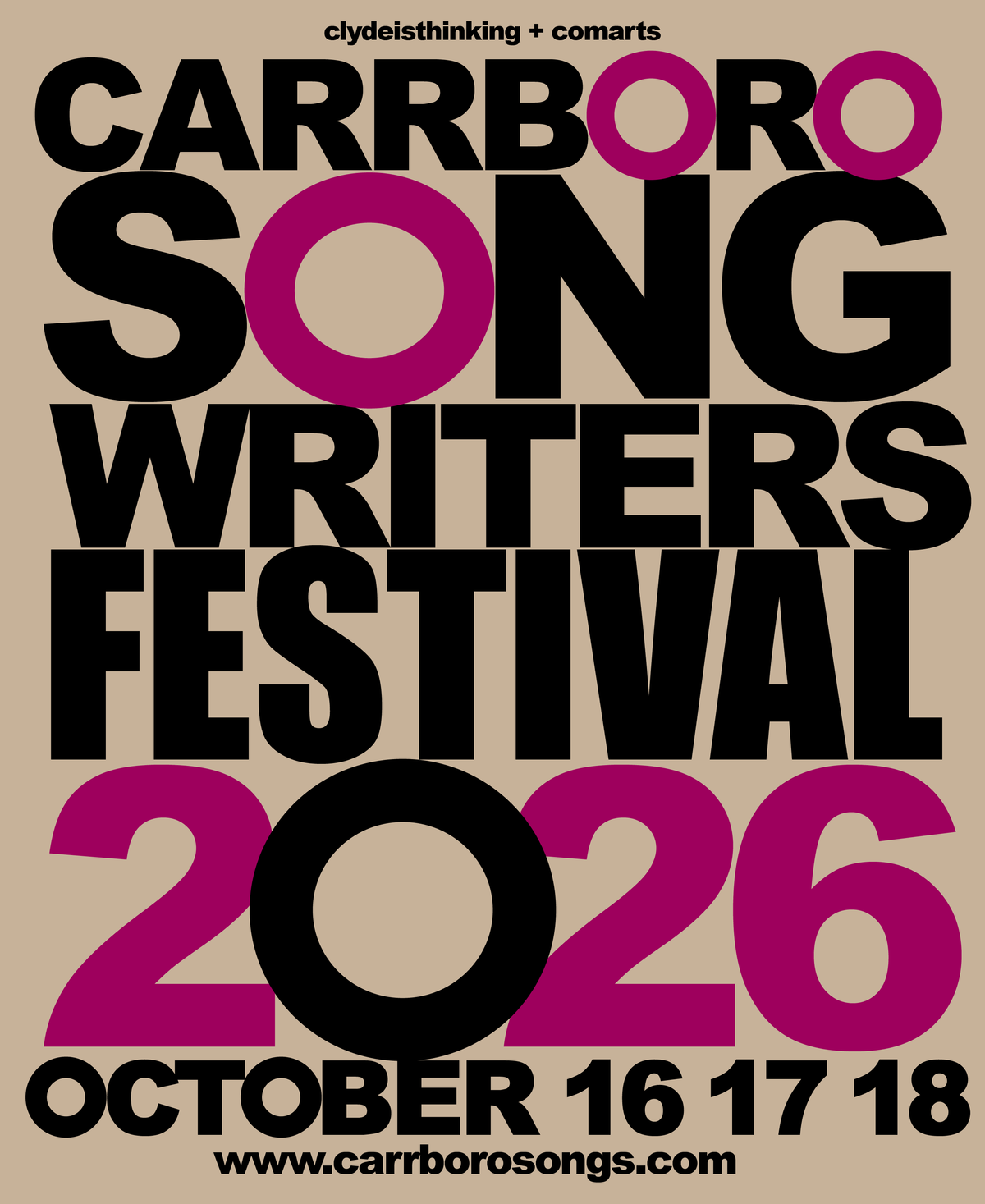
We’re still putting the program together, so the specifics aren’t finalized yet. The deadline for submissions [was] October 4, and volunteer opportunities are available at www.carrborosongs.com.
11. Is there a role for audiences — people who aren’t participating as songwriters?
Whoa! Easy there, Sparky!
If you can hear it, you’re already involved.
And if you would like to see this happen again next year, come to the shows. Scream and holler for your friends’ songs. Clap and whistle for every performer. Show up with reckless abandon and uninhibited joy. Throw caution to the wind.
An audience isn’t passive. A good audience is part of the performance, and songwriters can feel the difference.
12. What’s been the biggest challenge in launching a brand-new festival?
It’s always a process. You line up the dominoes, figure out what resources are available, determine what’s needed, and then figure out what can be made rather than bought.
There is always the possibility of getting out over your skis, but we’ve got some experience doing this. It isn’t really that complicated.
In the end, it’s all about execution.
13. What’s been the biggest joy?
Creating something like this out of thin air is a harrowing but incredibly joyful undertaking.
The best part is watching an idea that existed only in your head begin to acquire a life of its own — other people start seeing it, responding to it, adding their own ideas and saying, “Yeah. Let’s do this.”
That’s the magic.
14. Was there a moment you realized, “This is really happening”?
We don’t start things we can’t pull off — sometimes by sheer determination.
There’s always that moment when you look around and realize there are venues, musicians, sound equipment, submissions, volunteers and an actual date on the calendar. At that point, there’s really no turning back.
One way or another, it’ll happen.
Ask Blondie.
15. What do you hope emerging songwriters take away from this weekend?
That their songs can be heard, too.
That they don’t have to wait for somebody to give them permission.
That there is an audience for the strange song, the beautiful song, the unfinished song, the song that doesn’t fit the formula and the song that only makes sense when they sing it.
Find the Festival schedule at www.carrborosongs.com.