
Soft Vase, a Mother-Daughter Art Exhibition
Kaidy Lewis, a painter and Madeline Lewis, a material and textile artist, at Muse Gallery through November 28
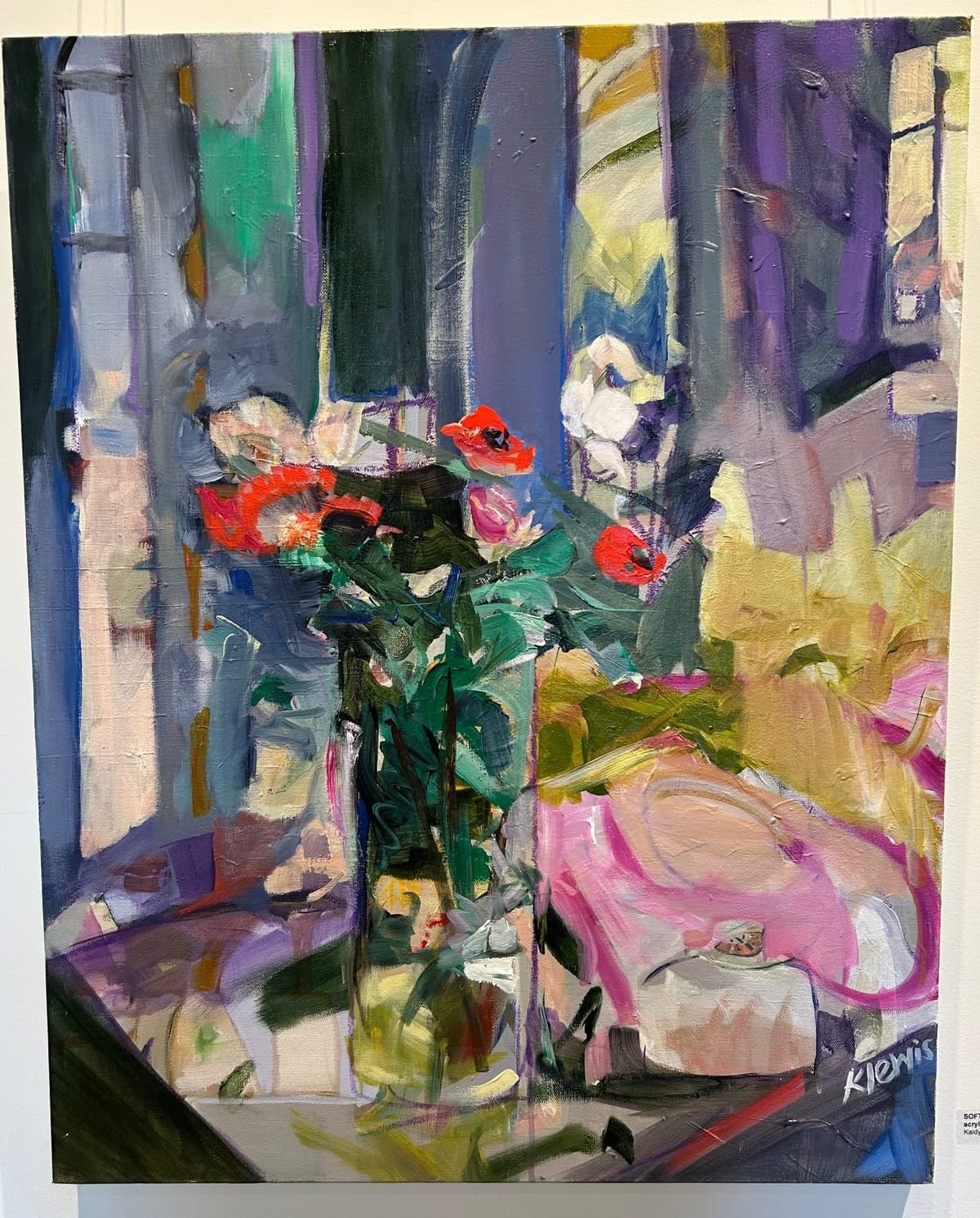
Kaidy and Madeline Lewis moved to the U.S. from the U.K., settling in the Triangle area in 2016. Madeline watched her mother’s work change as she acclimated to the new environment. “I think something transformed when we came to America.” The new work reflected “an openness.” For Madeline, “One of my favorite things about being here is an optimism or a feeling of like, we can change things, we can do things; there's more power to the individual. Whereas in the U.K. it felt more like, ‘Oh, no, you can't really do that. It's not the space.’ So that openness, it feels like there's an energy of ‘you’: you can do it! It's nice.” In Muse's spacious gallery, mother and daughter have created an experience that will delight, provoke thought, and awaken a sense of wonder.
Kaidy Lewis describes her work as an investigation of a feeling, a subject, an affair that doesn't make sense. Her canvas becomes an act of exploration and investigation to make sense of something. The Carrborean asked her to talk through an example.
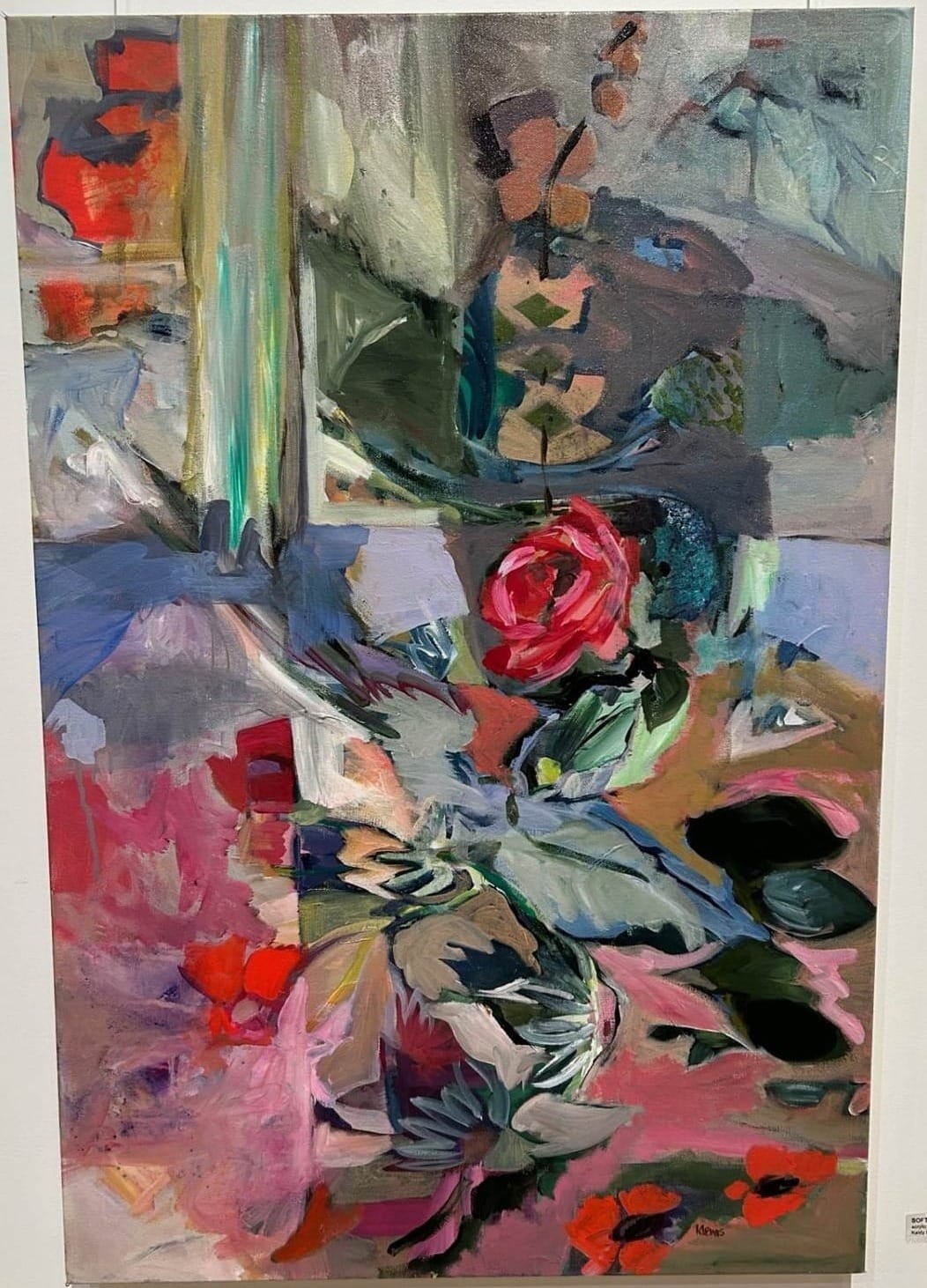
Pointing to Soft Reverence [featured on the November cover of the free print edition of The Carrborean], she said, “I always come back to the still life.”
She recounted that many painters have said that still life is all one needs to paint for their entire career and through that work, anyone can understand what is important to that painter, “and that is my case.” What that means is seeing interconnectedness through objects. “The reason why I'm paying attention to [an object] is I'm an individual part of that. We're all individual parts of the whole, and so I go through the world and I'm affected by things I hear, things I see, and then I have my whole life experience…I'm trying to increase my self-awareness and hopefully through painting, that touches other people and resonates with them.”
While painting, she stops thinking literally and goes to “the soft space, the gap.” She describes her process as a journey of excavating in which she is pushing to understand something through her work. “It feels instrumental. And the ego is dropped. That's part of the process.”
A distinctive color palette: “I'm a colorist, and I think that's separate from the painting almost. Color is extremely important to me. I think it's probably one of the best things about life, knowing that whole idea that light is split and we get this array of colors. I mean, that's just fun and joy right there.”
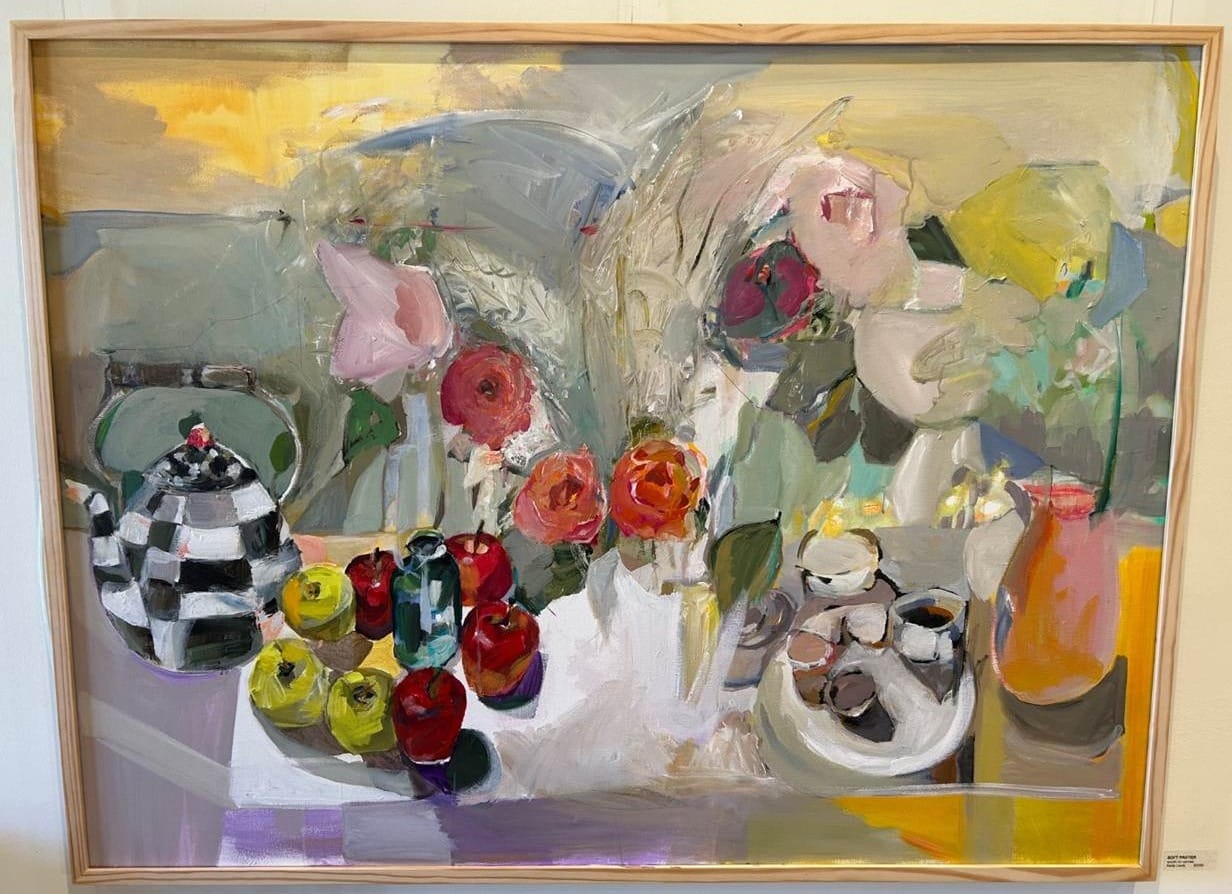
Her work tries to “deconstruct chaos into compassion.” The painting Soft Prayer, stopped in many good places, she said. “At the time I saw this figure approach, for me there's a figure behind here. Although this is kind of a still life, I love to have a window always because of the different worlds. And so once this character came in, I knew that it was about reverence. It just made sense to me and finally, I could stop.” Regarding the teapot, “I wanted to do the black and white to talk a little bit about the game that we kind of feel like we're immersed in all the time, which is almost separate from the other world that we're kind of always a little bit in; it's always there, but we're not really conscious in it all the time. We just put it to the back end. I want to talk about the game and then bring in the spiritual. And that's where the checkers come in.”
As she kept painting, she began to see “rich worlds” (on left) and “worlds that might be war ridden or where there might be some more chaos” (on right). That came intuitively. When she finished, she was happy with the balance of this work. “I’m trying to say, look at history, look at how many times you feel like we're going round and round. And people say, ‘history is good because we're learning from it’ and I'm shaking my head saying, ‘where do you get that from?’ This [painting] is about trying to be positive. The world isn't perfect. But what we can do is just look for harmony. Compassion through chaos.”
Madeline Lewis’s work discusses relationships among “bodies, materials, and meaning.” The Carrborean asked her to describe how that appears in her work. “I'm obsessed with the word ‘body’. To me, it means more than just what we're inhabiting. It's more about the bigger picture, the bigger thing, whatever that is that we're a part of.” The red piece (The Body) is the physical body.
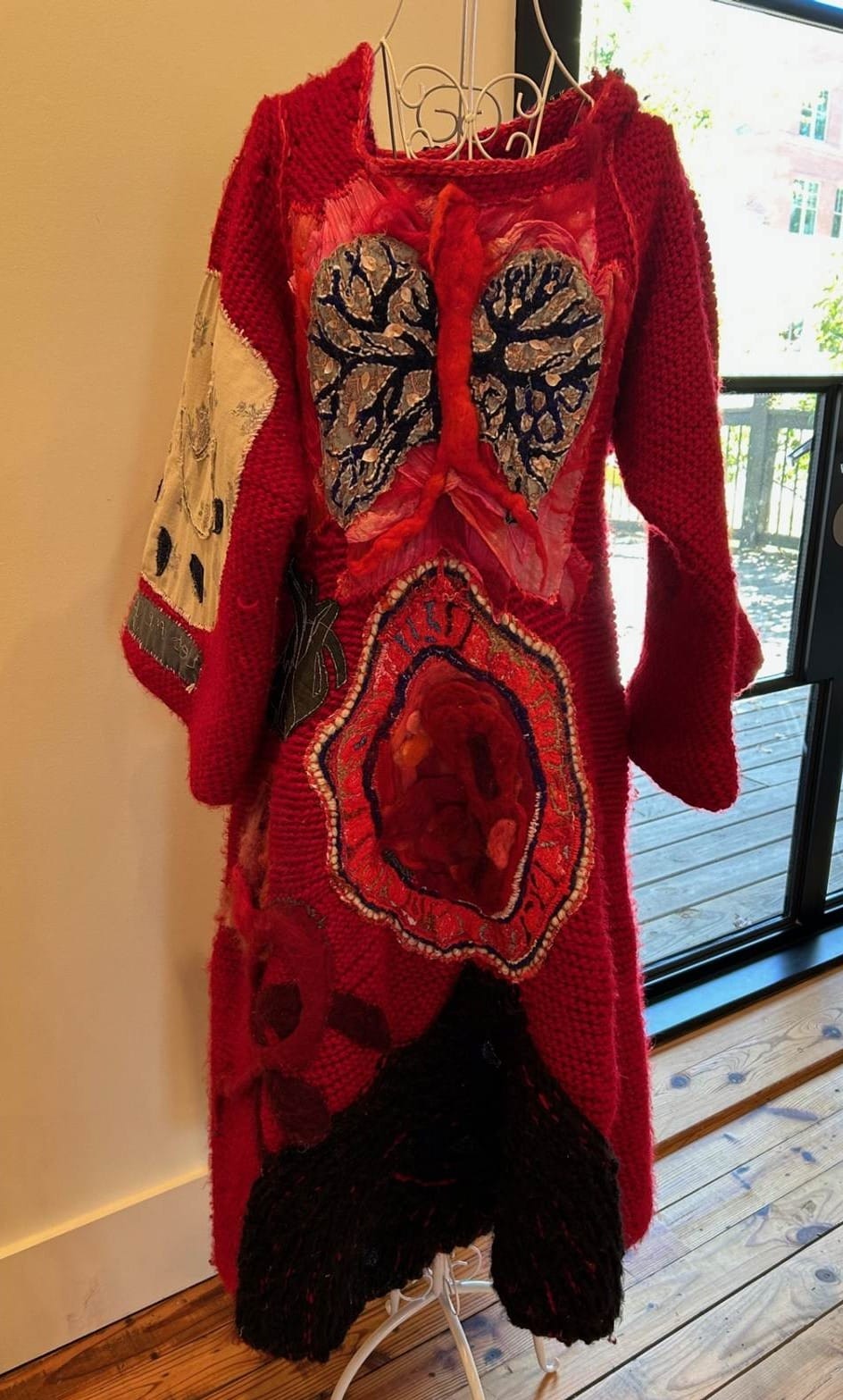
“The soul in the body is a tree. And weight is where I lean towards the yarn--something that I can create that has mass because it feels like a good material to be able to put energy into, to try and talk about the container or whatever it is that we're in. I was feeling so frustrated with how the woman is looked at, how women are looked at. I wanted to talk about how much meaning and fullness there is in the body and again, whatever it is that we're part of, and that's usually just stripped away. I feel like it's too much sometimes for us to look at, but it's there. And the more I can make it physical, the better. So I wanted to talk about the soul being worn and carried with us.”
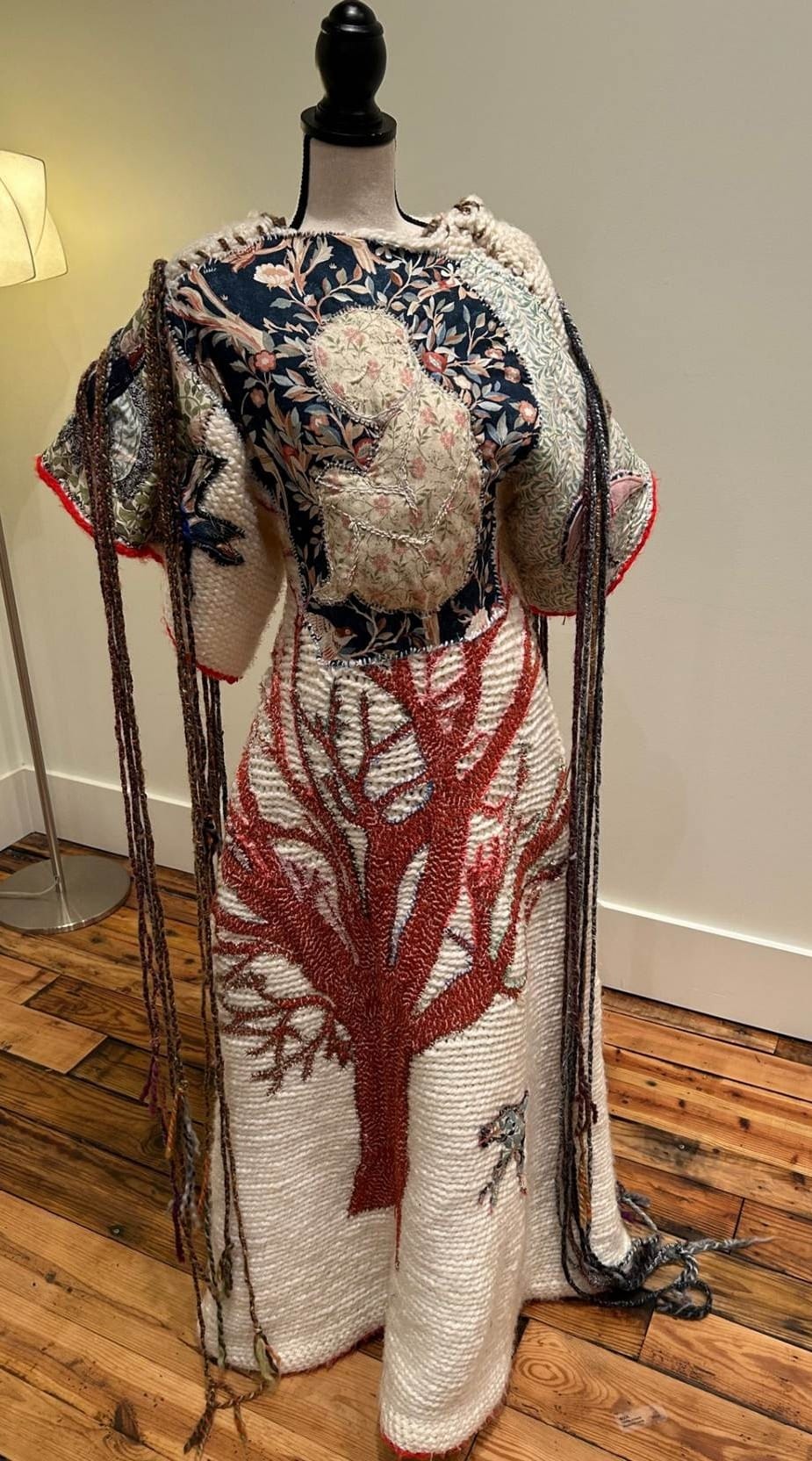
‘Body’ as singular and collective: “Yes. Again, picking up on what Mum talked about, how we're individual, but also part of the whole. It can be one thing but it is also trying to talk about everything. And the greater body to which it feels a part of. And the collapsing of ideas of distance. The experience that sometimes I feel when I'm making the stuff is that there isn't any distance at all.” Her challenge is expressing that with material.
About “the labor of care,” referenced in her artist’s statement: She explained that the dresses take a lot of time to make “and part of the reason I want to do that is because I want to show the devotion and the fact that our existence here is tricky and it's costly.” Working on these pieces can cause cuts and bruising and in life, “we're constantly experiencing things that are uncomfortable, but also rich with meaning. It’s my way of talking about what it is to be in this world and how it impacts us.”
Regarding relationships, “I like to think of the fibers and all of the crossing over and the pattern that is in there. It just feels like it's almost an exact mirror of what's going on all the time. The constant layering, sometimes the splitting, the overall, the more constantly adding to it, too, and then it creates something physical. And we're creating weight too. It's like we're building this body. It's almost like the muscle. It's the yarn and it feels like a muscle in building, so it feels like the relationship between things.”
She feels an energy in fabrics that affects how she uses them. She likes working with second-hand materials. “When something is fresh and new, you can feel it. It's a blank canvas, even if it's got pattern or particular design. Something that's been lived in or worn, it carries an extra weight, carries the stories of whoever was wearing it or using it. And so if I can somehow use that in my work, I mean, I'm really particular. Sometimes I don't like the energetic feel of particular pieces of cloth and I'll pick and choose which ones I feel like resonate more with the feeling I'm trying to capture. And the ones that are chosen usually work harmoniously with others to build a particular sensory experience.”
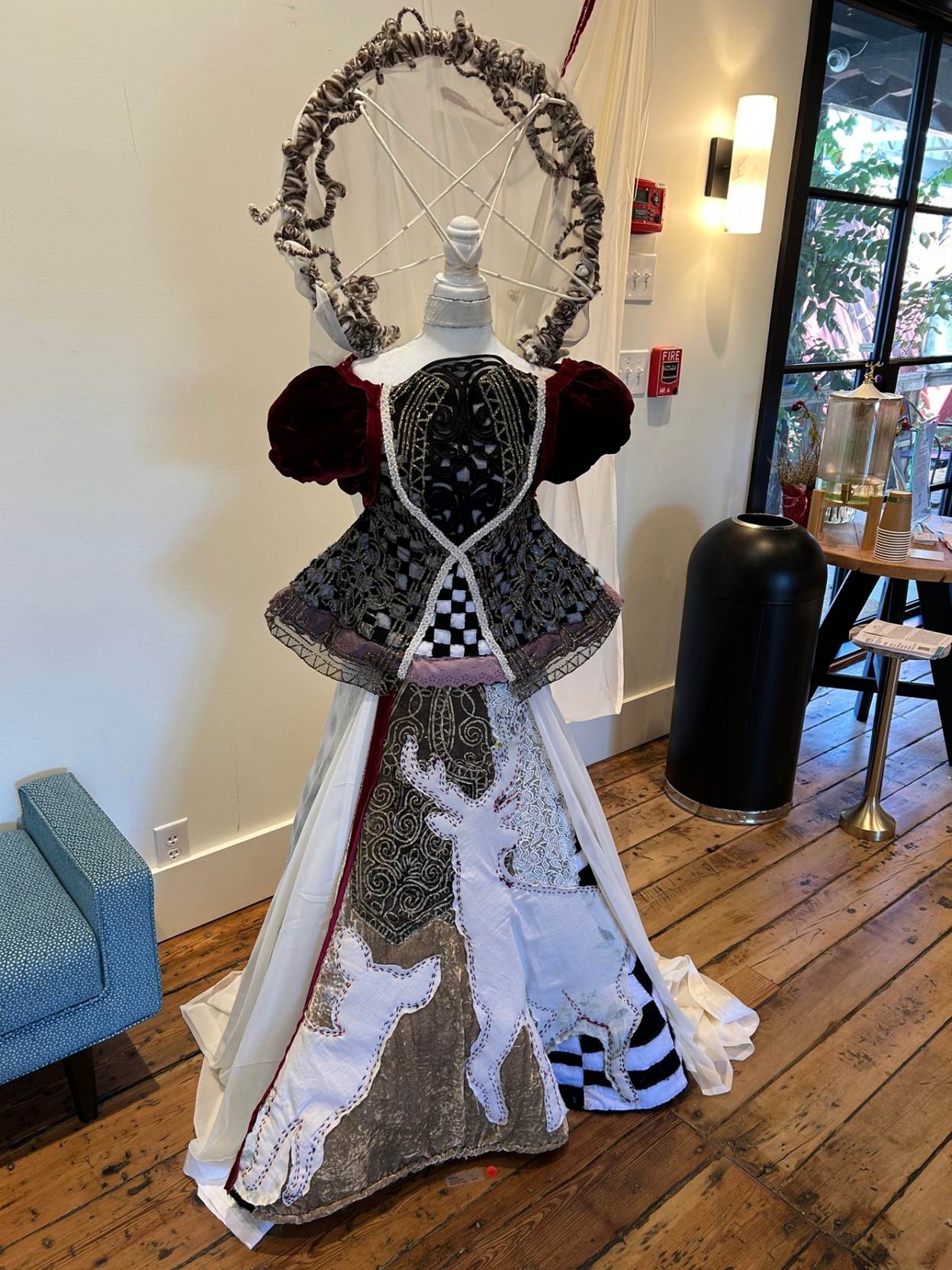
Reign was a commissioned piece. She describes it as, “the light in the dark, the play of interactions and what we are trying to accomplish in the physical world…the deer were vital.” There was a pair of deer that came around every morning where she was working on the piece. Making a difficult decision, she used material from a rug she really loved to represent them on the dress. “But the couple, the deer, I think that was me trying to talk about love and rhythm. And then me flipping them around [to show the underside of the rug] was me trying to let me go.”
In addition to her textile work, Madeline Lewis uses found objects to construct pieces with layered meaning.
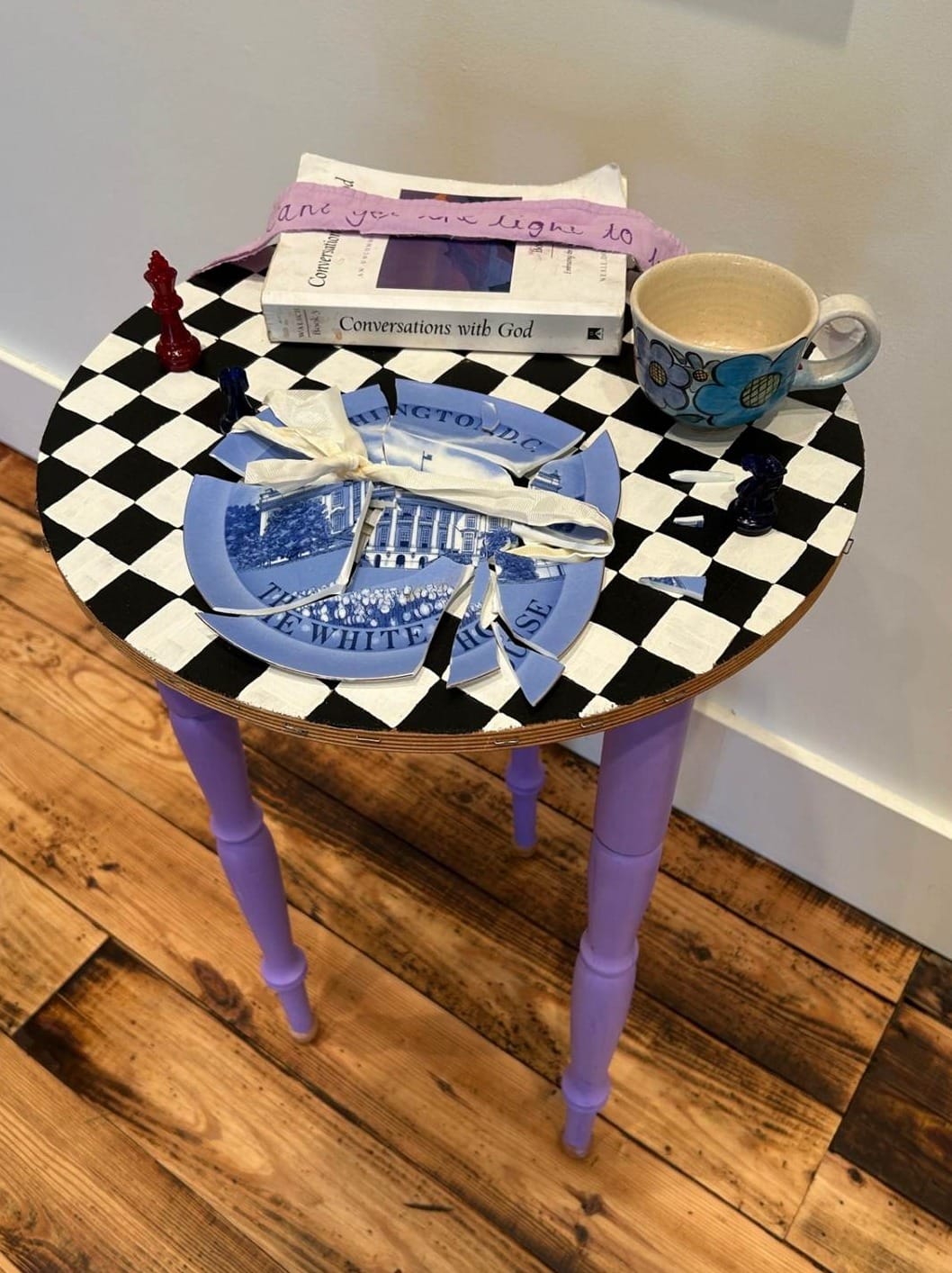
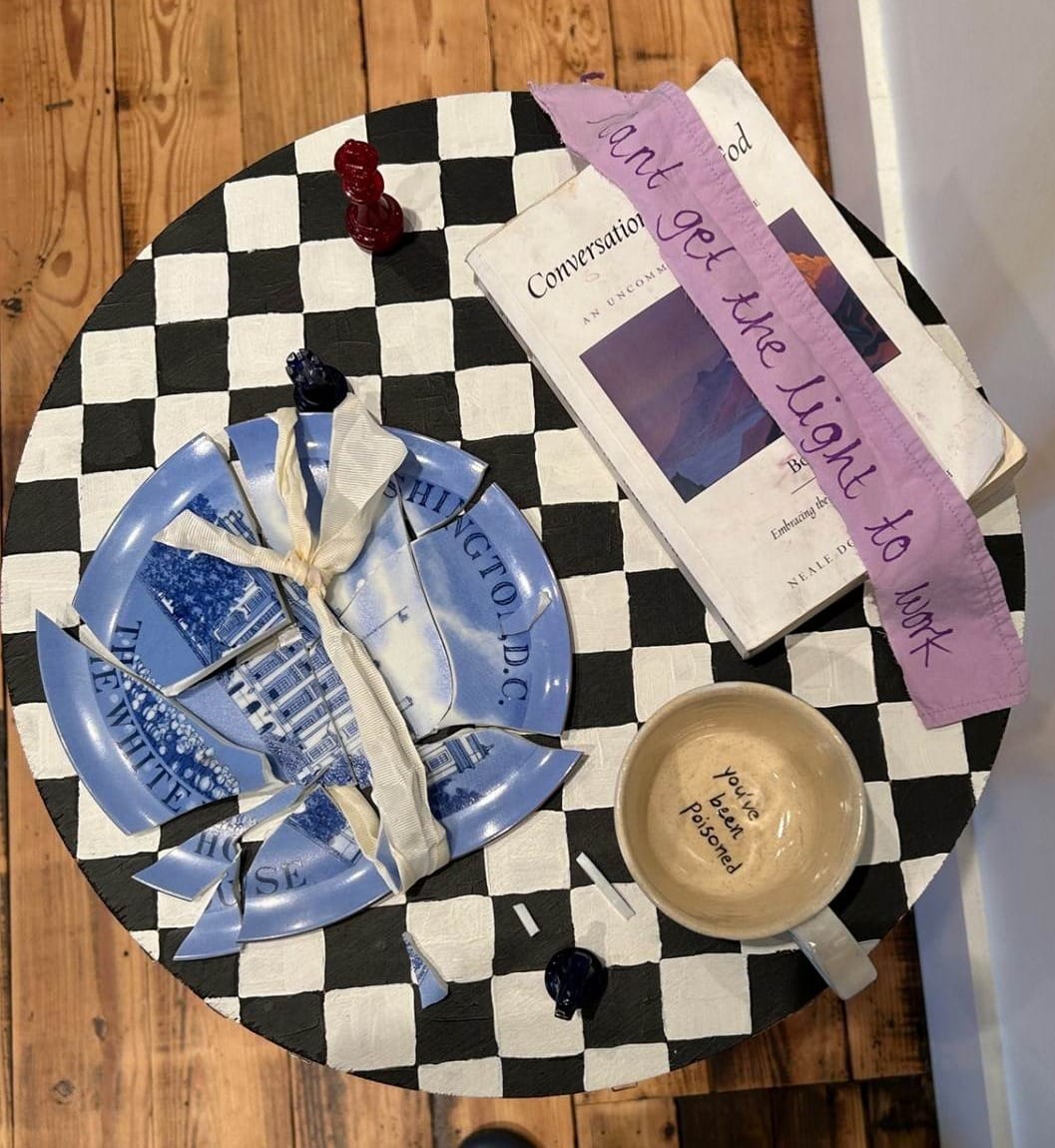
The future: “I have some ideas for some dresses I would like to make. I think I might move away from crochet a little bit. I'm going to try some different fabric techniques. I also want to work with some more natural fibers.” And not exclusively with fabric. “Actually, recently I've been thinking I want to work with a moss, so that's my next [piece].”
See Soft Vase, the exhibition, at Muse Gallery, 201 East Main Street through November 28.