
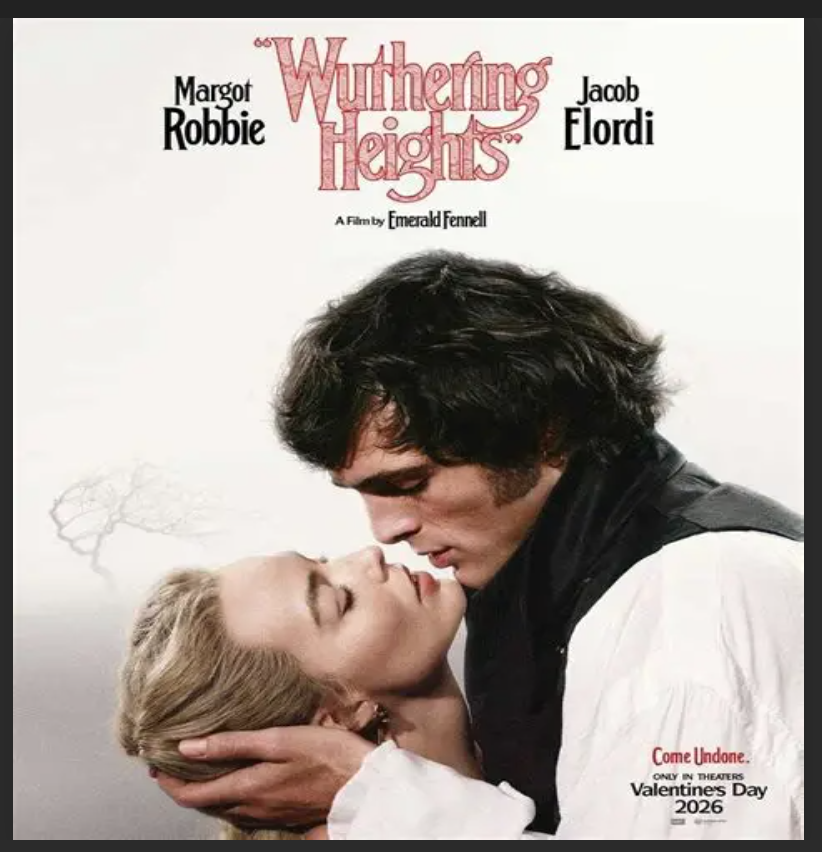
Many of us read–and loved or hated–Wuthering Heights, the lurid Victorian love story by Emily Brontë, which is now a feature film splitting audiences across the nation. Here are two takes on the new film, for the lovers and the haters.
Point
By Amy McLean
After seeing viral, flirtatious interviews of Margot Robbie and Jacob Elordi, I made plans to see Emerald Fennel’s 2026 Wuthering Heights.
“I’ve heard it’s pretty explicit,” the theater employee said as she handed me a bucket of popcorn.
“Good,” I replied, drenching it in butter.
Fennel’s Wuthering Heights is intentionally placed in quotation marks, hinting that if you’re hoping for an exact interpretation of Emily Brontë’s novel, this is not going to be it.
This film combines both old and new–18th century language, dramatic moors with heavy fog and rain, and traditional clothing, roles and expectations–but with the volume of everything else turned up. The music, the physicality, and the set are all over-the-top. Take Cathy’s peach bedroom, its squishy walls an exact replica of her skin, complete with her veins and moles. Heathcliff will lick that wall. You’ve been warned.
The story of Cathy and Heathcliff starts in childhood and takes us on a journey that convinced me of their insatiable obsession with each other. Their chemistry is so palpable that when Heathcliff touches her hand behind her back, where no one else can see, it sent a shiver up my spine. When he smashes a wooden chair to start a fire to warm her, I panted involuntarily.
The movie is shocking and weird and devastating, but for two hours and sixteen minutes, I was no longer in 2026. I forgot about the worries of the world. I was sucked into a toxic, tragic love story with two talented, beautiful actors. On the edge of my seat, wide awake, not tempted to check my phone, I wished I was nowhere else.
Counterpoint
By Maren Schneider
Emerald Fennell’s Wuthering Heights is a visually striking film in which Jacob Elordi’s tongue does most of the heavy lifting. The windswept landscapes are stunning, Alison Oliver steals the movie as Isabella Linton, and child Heathcliff provides the only moments that feel emotionally real. Beyond that, the film never lives up to its own atmosphere.
The film feels oddly disjointed, floating somewhere between time periods with costumes and aesthetics that never quite anchor the story. Even the novel’s most iconic line—“Whatever our souls are made of, his and mine are the same”—appears less as an earned moment and more like tear bait.
The emotional payoff never arrives. The film insists you should be devastated, but the characters never earn the emotional weight. In trying to balance gothic tragedy with humor, several scenes lean so far into absurdity you will laugh out loud.
Fennell has said this version reflects how she imagined the story when she read the novel at fourteen, and it shows. The novel’s complex structure, psychological brutality, and themes of class and social exclusion are largely stripped away in favor of a more explicit, stylized relationship.
Fennell clearly knows how to make polarizing work. The social media discourse before the film dropped was chaotic, and people showed up in droves to see how she would mangle a literary classic.
So if you’re expecting an adaptation, I promise you’ll be angry. But if you’re hoping to relive your last toxic love affair complete with obsessive longing and questionable decisions, this movie will hit the spot!
Your Turn
Do you like the new film adaptation of Wuthering Heights? Vote here.