
This interview was conducted via email and then condensed and edited.
The Carrborean (TC): How old were you when you started painting? Did you study painting formally? How often do you paint now?
I have memories of trying to draw before I could talk. I’ve been drawing from a very early age. I sold my first painting when I was about 15 or 16 years old. I’ve only taken a basic drawing class in college. I did take art all four years in high school. I paint on average 20 to 30 hours per week.
TC: What first drew you to Union Chapel as a subject? Was there a specific quality of light, architectural detail, or historical weight that made you say, "I have to paint this"?
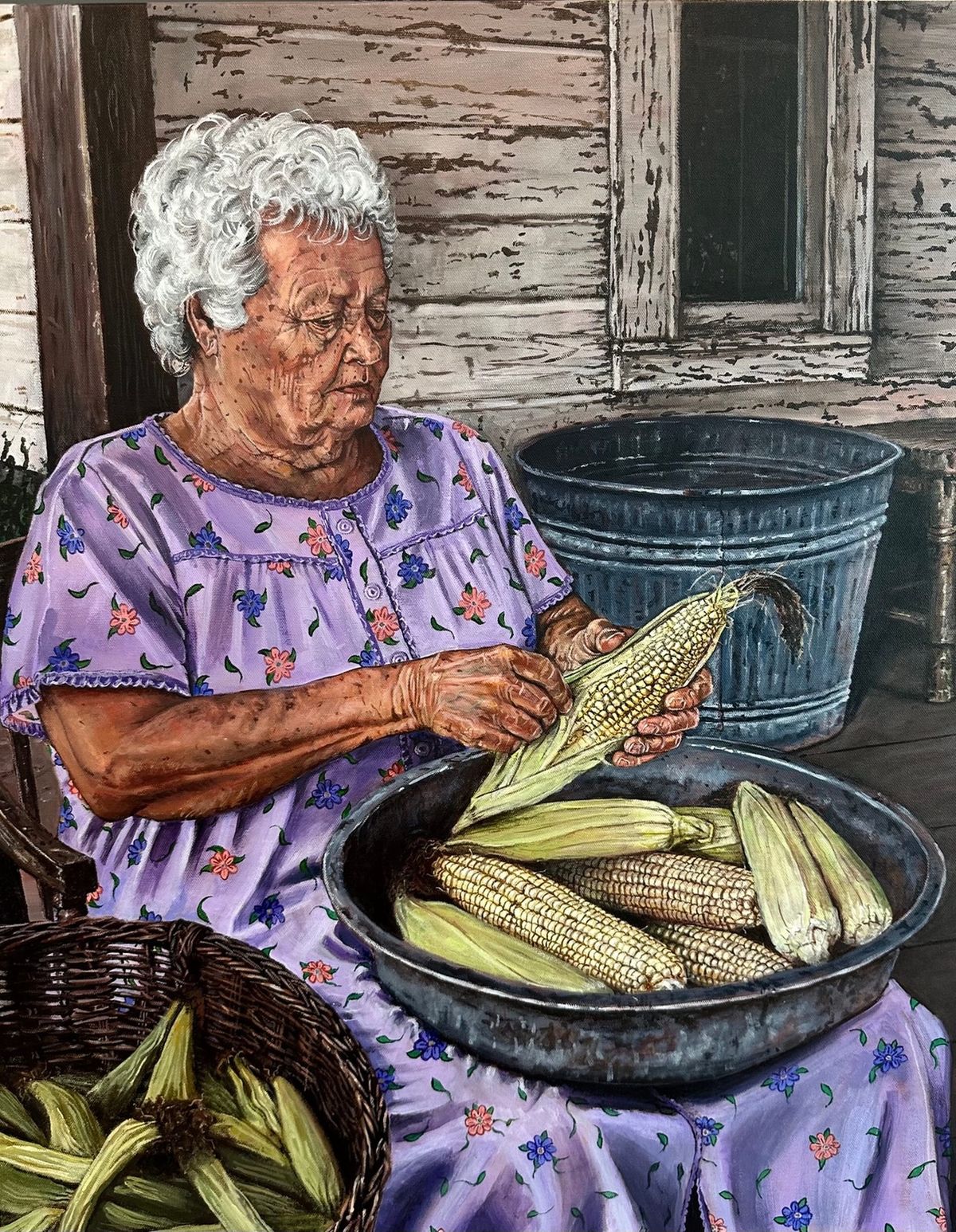
This painting evolved from the actual reference photo quite a bit. I knew the subject, my cousin Phoda, was going to be the main focus of the painting. I saw Phoda’s daughter, Wendy, post some photos of her mom shelling peas online on a social media platform, I reached out to Wendy to get permission to use her mom’s photos and she agreed. But as an artist, a creator, I often stray from reference photos, so I can make the creation, the art piece, my own. A reference should not always be a locked-in target, it should be inspiration, motivation for something better.
Phoda is a Native American woman that lives in Union Chapel, I’ve known her my entire life and she has a beautifully interesting face, with wisdom, character, and time. “Time” is a good thing to have on your face, it means you still have an opportunity to contribute to the living world. Phoda shucking corn recognizes the farming community in Union Chapel, and calls back to a time when so many families participated in similar activities to feed their families. But it’s much more than the tangible process of harvesting food, it’s about family and community. Get a group of Native American women sitting on a porch shucking corn or shelling peas and you will usually find good times, good stories, and laughter.
TC: How much of your process involves working on location (en plein air) versus developing the final piece in the studio from sketches, studies, or photographs?
I don’t do very much plein air work; however, I do love to work from life when possible. Still life work for example, being able to hold an object in your hand like a jar or quilt, this matters…. It allows you to feel the curvature of an object, the tactile nature of a subject, and this, for me, translates better from physical subject to painting.
If I have to work from a photo, I want to work from 5 to 10 photos if possible. The more angles and references I can use, the better. I also like to research what I’m painting–who is this person, what type of work did they do as a career, when was this structure built, what type of work goes into a hand-made quilt. All this knowledge, this energy, it goes back into the art piece, and people can feel it and see it.
TC: Can you walk us through a pivotal moment during the creation of this piece where the painting took an unexpected turn or surprised you?
I changed so many things from the original reference, and I think the decision to do this early on in the process not only makes this piece “my work” but just made the entire process so much more interesting. I changed her clothes, I changed the food from peas to corn, the house she was sitting by originally was brick, that changed to weathered wood. So I think, if anything, the surprise was that all the changes worked together. Often, when so much is changed from a reference, the end art piece can feel unauthentic if you are not confident in your changes and how they are incorporated into the composition.
TC: Buildings like this one often hold deep community, cultural, or spiritual resonance. Did you uncover or feel any particular stories or atmosphere while working on this piece that influenced how you approached it?
So, “Union Chapel” is a reference to a community. Ms. Phoda is a member of the Union Chapel community as was I, growing up as a child. I named this piece “Union Chapel” because Phoda embodies the farming community that was Union Chapel when I was growing up. The Union Chapel community is mostly made up of Native American people from the Lumbee tribe.
I was flooded with all the stories of my childhood when creating this piece, I thought about the times I had to shuck corn, work in the tobacco field, pick cucumbers, etc. I also just thought of the Union Chapel community in general. Getting together at the “Old Homeplace,” the homestead of the Hayes Locklear generation of Lumbee people, came to mind while creating this piece and the old porch in the background pulls from the Old Homeplace.
My style of painting, representational or incorporating realism, is not a style or technique that you often see in contemporary art galleries. I revel in this fact and it highlights who I am. I am not going to conform to another style. I am an old-school soul who will continue to paint and explore art that often reflects a time in the past. My subjects might not be considered thought provoking or moving in a contemporary mindset, but I feel my subjects are ancestral, primal, and foundationally formative, and they come from within and scream to all who will listen, “the past matters.”
TC: For those looking closely at the textures and brushwork in this painting, what materials or techniques did you lean on most heavily to capture the essence of the building?
For the texture of the wood in the Old Homeplace referenced above, I did an underpainting that was a brown, rusty color. I sketched out the wood planks first, then I started to layer a warm grayish white over the sketch, while allowing some of the underpainting to remain. I then darkened these areas with a raw and burnt umber which is the weathered brown paint stripped areas that come through in the final art piece. I also intentionally let some of the warm rust color come through. This is very subtle, but it gives a warm soft glow to what would otherwise be cold and stark.
TC: As an artist, what do you hope viewers notice or feel first when they stand in front of this specific painting?
I want them to feel. Whatever that feeling may be, love, hate, nostalgia, familiarity. I don’t mind if someone doesn’t like my work, that still means they felt something. That is one of the greatest achievements as an artist, I made you feel something.
But for a select few people, who lived and grew up in a similar Union Chapel lifestyle, I hope this piece feeds your soul, I hope it makes you recall hard times, good people and good stories.