Local Artist Builds a 25-Year Legacy in Books
By Wendy Hower
We can’t talk to Monet about why he loved water lilies or ask O’Keeffe how flowers became her obsession. We can’t ask Van Gogh about the enduring appeal of sunflowers. We can, however, ask Emily Eve Weinstein about the hundreds of books she has constructed by hand over the past 17 years—and about her plans to create 450 more books over the next nine years. “It’s like breathing,” she said. “Some things in my life I don’t question. I just do.”
Weinstein, 70, lives in Chapel Hill in a home that doubles as a studio and gallery, its walls lined floor to ceiling with her paintings. Every year, she writes, designs and produces a book that documents the artwork she created that year—photographed and printed in color from JPEG files. The pictures also illustrate autobiographical essays about her life as a full-time artist. The project began in 2009, the year she married Marc Alperin.
The 25-Year Handmade Book Project will be the subject of Weinstein’s solo exhibition at The ArtsCenter in Carrboro, on view since March 11. A public reception is scheduled for April 10. The show presents all 17 books alongside many of Weinstein’s oil paintings documented in the books. Visitors to the exhibition can learn how to craft their own books, too. Throughout the month of April, The ArtsCenter will offer “Elements of Bookmaking” a series of five workshops taught by artists. Topics include urban sketching and accordion-style books, making decorative paper, basic bookbinding, paper folding and more. “I want people to stop and look at art,” she said, “and look at what it takes to make art.”
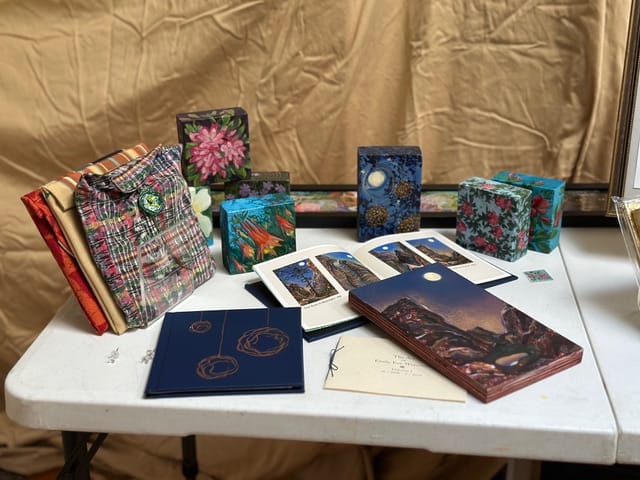
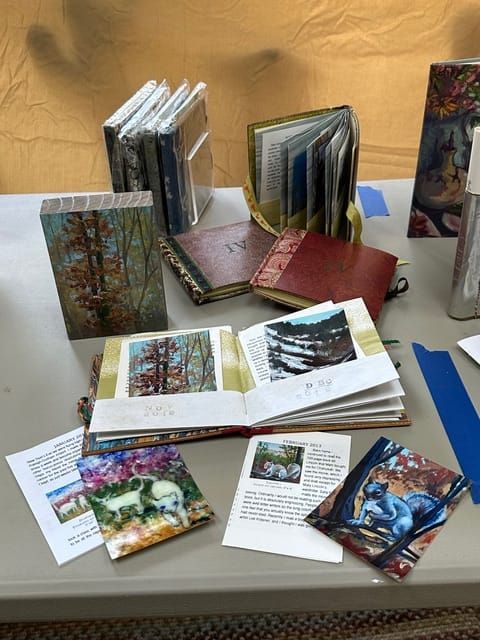
Each mixed-media book in Weinstein’s 25-Year Handmade Book Project is an exhibition in miniature. Open one and discover unexpected materials and tiny treasures inside. The cover of Volume V is a clear sheet of real mica, framed; the spine is a piece of hand-stamped aluminum can. Volume XII is a corrugated box with 12 dollhouse-sized books nested inside. Volume VI is accompanied by a 6-by-6-inch oil painting that is also depicted on the cover. Turn over the painting and find a wee hand-bound book tucked into the wooden armature. With each unique volume, which she duplicates by hand 37 times, Weinstein experiments with new techniques and materials, picking up skills along the way.
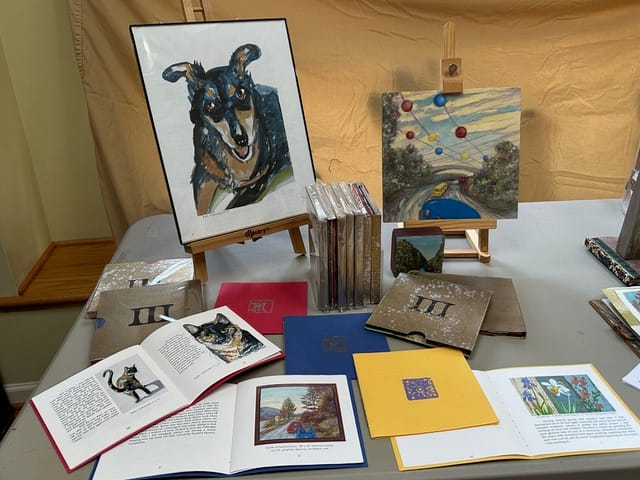
All 37 volumes of Book No. 14 are constructed from cereal boxes and cardboard food boxes that Weinstein salvaged from her neighbors’ recycling bins. Each book section is delineated by folded cardboard, the graphics and text still recognizable as product branding. Each volume is wrapped in a cover made from multicolored mulberry paper. Every single cover is unique. Designing each book takes about a year. Weinstein said she dreams about the next volume long before she begins it. “I think about what I want to do when I’m sleeping, in my dreams, and while daydreaming, and I envision what should be the next book. I don’t think anything’s impossible—I just go for it. I’m asked by others, ‘Are you crazy?’ and I say, ‘Yeah, maybe.’ ”
This project, Weinstein said, is part of her long legacy of making things. She talks about her handmade books without hesitation. “To be exact, this project is 25 years of my life’s work, and it’s gratifying to have a sense as to why I exist,” she said. “I now really understand what it means to have goals.”The 25-Year Handmade Book Project gave Weinstein some clarity in her work, she said. “Never having a 9-to-5 job, I felt like a free-floating amoeba.”
Weinstein began drawing the family cat at age 3—and cats are still one of her favorite subjects. She grew up in New York and traveled extensively around Europe and the United States. She earned her BFA degree at Virginia Commonwealth University. Shortly after arriving in Durham in 1982, she worked as a freelance artist. In the late 1990s, Weinstein began painting under every full moon. Her moon paintings were published in Moon Book by Beau Soleil Press, the first of four art-gift books.
The 25-year Handmade Book Series came about when Weinstein realized with dismay that manufacturers had stopped producing camera film. Digital photography became the standard for reproducing art, overnight. Weinstein had become adept at photographing her paintings and printing them as photographs from negatives as the primary way to document her work. When film went away she had to switch to digital. But she wanted to hold reprints in her hands--thus, this book project.
This lifelong artist realized that because she is prolific she often does not recognize her own paintings hanging in people’s homes. Documenting her work has always been important. Turned out, designing and creating books is an exciting and challenging skill for her to hone, and a reason to focus and maintain the discipline of documenting her art each year.
“I realized I wanted it in my hand,” Weinstein explained. “I can have my entire year in one book. That is really rewarding. It gives me physical memory. Having a solid provenance of my work is life affirming.”
For Weinstein, the question isn’t why she makes handmade books. It’s what she will make next.