
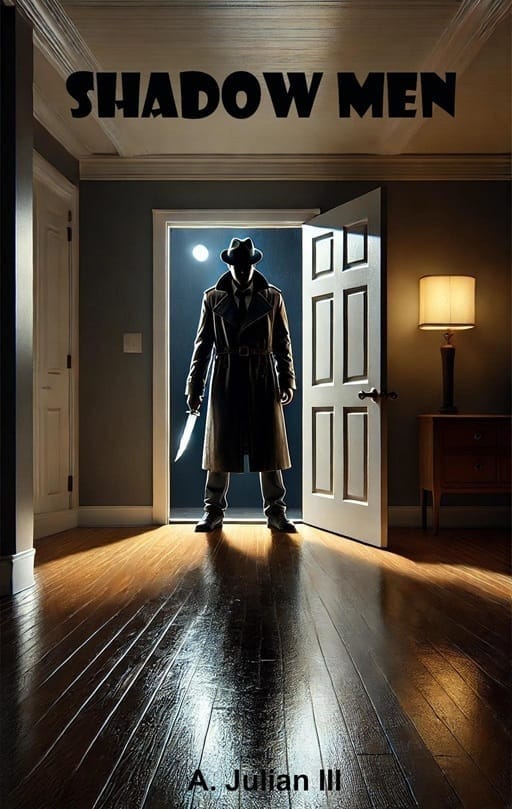
This article provides an edited and condensed transcript of an interview with Al Julian that occurred on November 10 on The Carrborean Radio Hour on WCOM 103.5. You can hear the full interview on The Carrborean Radio Hour YouTube channel. Please note: some content describes murder and violent scenes.
Al Julian is an award-winning screenwriter and filmmaker, and a long-time resident of Carrboro.
Al Julian: I came to this area about 34 years ago. I was in the midst of one of my many crises, the early, well, actually, midlife crises. I decided to change careers. I'd been a practicing clinical psychologist for about 15 years, and had come to realize slowly over time that sitting in a room and listening and taking maybe a year or two to get through a problem didn't fit as well with my kind of impulsive nature as it needed to for long term. So I came here to go to law school back in 1993, practiced law for a few years and stayed. I just liked the town, the atmosphere, the college.
The Carrborean: I think that's a quintessential Carrboro story. You come here to learn and you end up staying. You've had a really interesting and varied career through clinical psychology, law, forensics and writing. Can you tell us about that, the arc of your career and how all those things come together in your writing?
Al Julian: Yeah, when I practiced psychology, I was kind of a jack of all trades in that profession. I did a number of things, including working at forensic hospitals, which are hospitals which we used to call “hospitals with the criminally insane” years ago. I got to know a lot of very interesting characters there, which I think also eventually fed into some of my writing interests. But as I said, after years of working in clinical psychology, which I liked and felt I had some success with, I decided I'd like to go into law and maybe think about working in criminal law.
I went to law school and ended up doing some work with local attorneys and some work, again, in forensics. I did some work-ups for pre-trial screenings and so I did quite a bit of evaluations with people who were in some serious trouble. I did a couple full work-ups down on death row, looking for mitigating circumstances, which was pretty interesting but once again, I found myself spending a lot of time in a room, taking a year or so to get through a problem, and once again, that didn't fit my disposition as much as I'd liked.
So I segued into doing forensic work, which is a kind of combination of the two and which suited me more. In forensics, you are asked to size up a criminal or civil situation, or an individual, and give an opinion about what you think is happening and what ought to happen in the future, in writing or in court. You'd have the problem done in a couple of weeks or a month and then you're on to a new one. And I like that. It fit my personality better, and I did that for about 10 years, did it well and met a lot of interesting people, a lot of interesting cases, a lot of fodder for what I do now. And then I retired, began doing what I've come to really love and that's writing, and I also produce films. The films I've made pretty much reflect my background and some of the strange characters that I've known.
The Carrborean: Fodder for your writing. Let's talk about that for a moment. Your writing of the scenes when we see the victims, and even scenes when violence is being perpetrated, is so graphic, it takes the reader into that space with the detectives to see what they're seeing. We see the blood. We hear the slice of the knife. And I'm wondering if these scenes are ones that you imagined when you were doing your forensics work or things you experienced.
Al Julian: That's a good question and it's probably a combination of both. When I was working in psychology for two years, I ran “murderers groups,” which were what they sound like, and that was groups for people that had killed other people. And those entailed, oftentimes, graphic descriptions from the individuals in those groups as to what they'd done. And over the years, I've probably indirectly been privy to that kind of information, even information I didn't want.
I can remember working in a forensic unit for a couple years running those murderers groups. I then took a break, did some other psychological stuff, came back and thought I'd try a forensic job again. I went to Walter Reed Hospital and I got the job to run the forensic unit. I went down in the unit to meet the staff and I took about 15 feet into that unit and realized I never want to do this again because just the PTSD of having to dissociate from getting really involved with people that had done some terrible things was something I didn't want to do full time again. So, yeah, there's a lot of this stuff that still rolls around in my mind. I think probably there's some kind of relief to me in getting it on paper, there's some kind of tension relief, because there's a lot of imagery that stays with me that I don't particularly want, and….
The Carrborean: this [writing] helps get it out. About the murderers groups– when you're sitting there in the room and there's 6,7, or 8 people in a group therapy-type session and people talk about what they're carrying around with them, their memories of committing these acts--did you leave there with a sense that the group therapy made a difference? Was it therapeutic? Did it help them move on with their lives in a positive way?
Al Julian: I think in some cases yes, and in some cases no. We would get people in those groups from three different directions. One direction was from the street, from the prisons where they had tried to harm themselves. We'd get people directly from the court system that were found criminally insane, and then they were sent to the forensic hospital, oftentimes for a life sentence. And then we had also what I would call manipulators who had basically conned their way into this unit because it was a more pleasant place to be than prison. So we'd have those three types.
I think the ones that benefited the most were probably the ones that had serious anxiety and depression related to what they'd done. But we had other people that I didn't think benefited. We had some people that were more purely sociopathic, who probably didn’t benefit as much. But it was a fascinating experience for me, and actually, I made a TV pilot last year called The Sessions, which is based on those groups, and it's a six episode series. We made the first episode, and it's been doing really well on the festival circuits, been winning a lot of awards, so we'll see. We're trying to see if anybody wants to pick it up to make it all the way through.
The Carrborean: Congratulations on the awards! That sounds like an interesting show but not for the faint-hearted. Let's talk about your writing and the writers that have influenced your work. When we spoke before, I mentioned that your work has a noir quality to it, with flawed characters. We're all flawed, but these characters’ flaws are front and center, and relatable. It brings a reader into the story in a way reminiscent of James Ellroy. And the recurring theme of male anger, which we'll talk about later–I could hear John Updike in those scenes. Who are your writing influences?
Al Julian: Well, you mentioned two of them already. Updike, I love the rabbit books, and I love the LA Confidential and the Black Dahlia by James Ellroy. Other people I've loved are Ian Rankin and Joe Nesbo. I feel like those particular writers must have had some experiences with the dark side of life to be able to write the way they do because they're all really great. In terms of the anger, it may be a phenomenon that's common to a lot of men, certainly something I wrestled with for a lot of my young life. I won't get into all the details of my own upbringing but it probably is the kind of upbringing that would lend itself to having some problems with anger.
So I think some of those experiences that I talk about are related to my own struggles with learning to manage myself better and imagining what would happen if a person like me or someone with similar problems didn't learn to manage or choose to manage themselves better. And maybe that's what I'm saying, that I have a little bit of one foot inside these characters and maybe one foot out. So I think part of me can relate a little bit to what I'm writing in terms of--that's a little bit of me. And I guess I'm at the age where I can admit it. I can admit it without feeling too terrible about it.
The Carrborean: I'd like to give listeners a preview of your writing about anger; it was graphic and the reader could feel what this character was feeling.
Al Julian: Page 130, second paragraph: “He almost throttled him on the spot, but the hospital waiting area was half full, and he knew that once he started, he wouldn't be able to stop. He could stop the overwhelming rage he felt like he was trying to contain a nuclear explosion.”
The Carrborean: One of many examples in the book where you're talking about an aging man's rage and reaction to things. What are they reacting to? What's really triggering this anger?
Al Julian: There's probably lots of reasons for everybody, lots of different ways it comes out. But for me, I think one thing I can kind of tie some of that emotion to is, I remember when I retired from the forensic work about 11 years ago now. I thought, “Boy, now I'm going to have fun. I'm going to write, I'm going to travel, this is going to be great.” And I really struggled for about a year or two, with feelings of isolation, feelings that I was no longer that important to anybody, feelings that were kind of being dismissed by society, which I think a lot of men go through. They say that retirement for men is the number one predictor of death in the first year, which I could understand. And so I think a lot of the frustration and some of the rage also stems from that experience.
It took me about a year and a half to pull out of it, to really get righted. And I think I wrote the first screenplay that this story was adapted from in that time, and that's the first screenplay that I actually wrote. I've rewritten it a few times since then but I think a lot of it was coming right from that kind of emotionality that I was having myself, as the two principal characters are also struggling with age. The protagonist and antagonist have a lot in common. They're both struggling with the phenomenon of not feeling that they're as relevant to society anymore but they're handling it in very different ways.
The Carrborean: Are there any ways that living in Carrboro has affected your writing, influenced your writing in any way?
Al Julian: I think probably by being a very calm place to live. I think I carry around a lot of PTSD by virtue of my own childhood experiences and a lot of the work I've done. I've spent a lot of time in prisons and I've known a lot of scary people and but this is a very nice, calm, relaxed environment, and I think that's allowed me to calm down and relax and maybe put some of these experiences to pen in a way that maybe I couldn't have done before. I would have been too wound up, and I think maybe it's been helpful and maybe that's part of the reason I'm still here.
Tune in to the recording to hear Al Julian talk about the process of turning his screenplay into a novel and developing his characters.
Mr. Julian said he’ll be making a film out of Shadow Men, with some of it set in Carrboro and will be looking for local cast and crew in early 2026. The Carrborean will keep you posted on those developments. Fever Dreams, also written by Al Julian, is streaming on Apple, Amazon Prime, and YouTube.
Shadow Men is now at Amazon and Goodreads.