
Dungeons and Dragons: Playing Make Believe
By Noah Basil
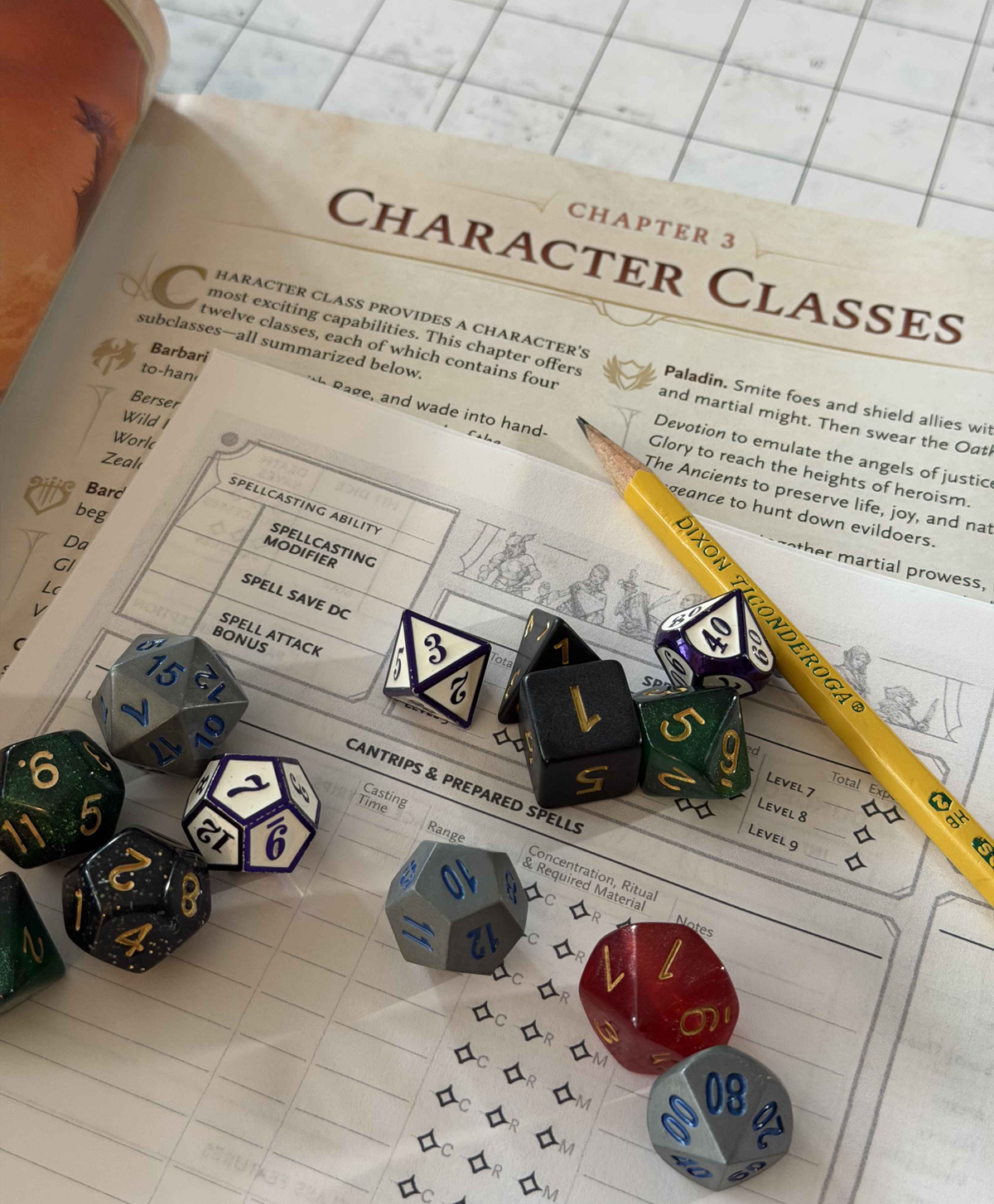
Dungeons and Dragons (D&D) has reached a new high point in its popularity and presence in public spheres. The Dungeons and Dragons: Honor Among Thieves film came out in 2023. Stranger Things, a popular show on Netflix, ran from 2016 to the last day of 2025 with a story based on D&D lore and monsters. The newest iteration of D&D came out in September, 2024 and is early in its development. Precise player numbers are hard to acquire for D&D but the company that makes the game, Wizards of the Coast (WOTC), gives us some insight from 2020, which marked 50 million players to date, its 7th year of consecutive growth. [1]
The last time D&D experienced such widespread popularity, and engagement was in the ‘80s. But now its popularity is not impeded by a moral panic, fueled by misinformation and skepticism that plagued the game during the time depicted in Stranger Things. But people without intimate knowledge of D&D still wonder, what is it? How does it function and why is it so popular?
Dungeons and Dragons is a “Tabletop Role Playing Game” (TTRPG) where you take on the role of a character you make and play as that character through a series of events, encounters and interactions that make up an overarching story. D&D players are guided through this story by a ‘narrator’ that D&D refers to as the Dungeon Master (DM). Players are responsible for their character, and the DM is responsible for taking on the role of everything and everyone else in the story.
Outcomes, events and actions in D&D are often generated through dice. A set of seven gaming dice make up the instruments of your character’s success and failure, with the principal piece being the 20-sided die (d20). Your character’s statistics (decided when you make the character with parameters governed by the game rules) affect dice rolls. So, D&D is a make-believe game with some level of randomized outcomes.
The main measure of success: is everyone having fun? However, D&D also has a wide range of benefits for those that play. D&D can serve as a method to teach Social and Emotional learning for adults and children. [2] During play, you practice empathy, teamwork, collaboration, cooperation and compromise. Simple math, addition, subtraction and probabilities are all practiced during the course of a D&D session.
The game teaches acceptance of failure or outcomes outside of your control and turn taking. Most groups play the game cooperatively. The role-playing nature of the game provides a safe space for people to explore their personal identity/expression. In group therapy, D&D has been shown to help those who deal with ADHD, trauma, anxiety or depression. [3] Geek Therapeutics offers a continuing education course that teaches those in professional environments how to utilize D&D as a treatment option.
In a perfect world, D&D also features a great deal of analog participation: friends gathered around a dinner table with the DM at the head of the table behind a secret screen to hide their plans and schemes. Pencil and paper character sheets and physical on hand rule books. Miniatures of the players’ characters, the monsters and foes they face on a map to represent the area they might be fighting in.
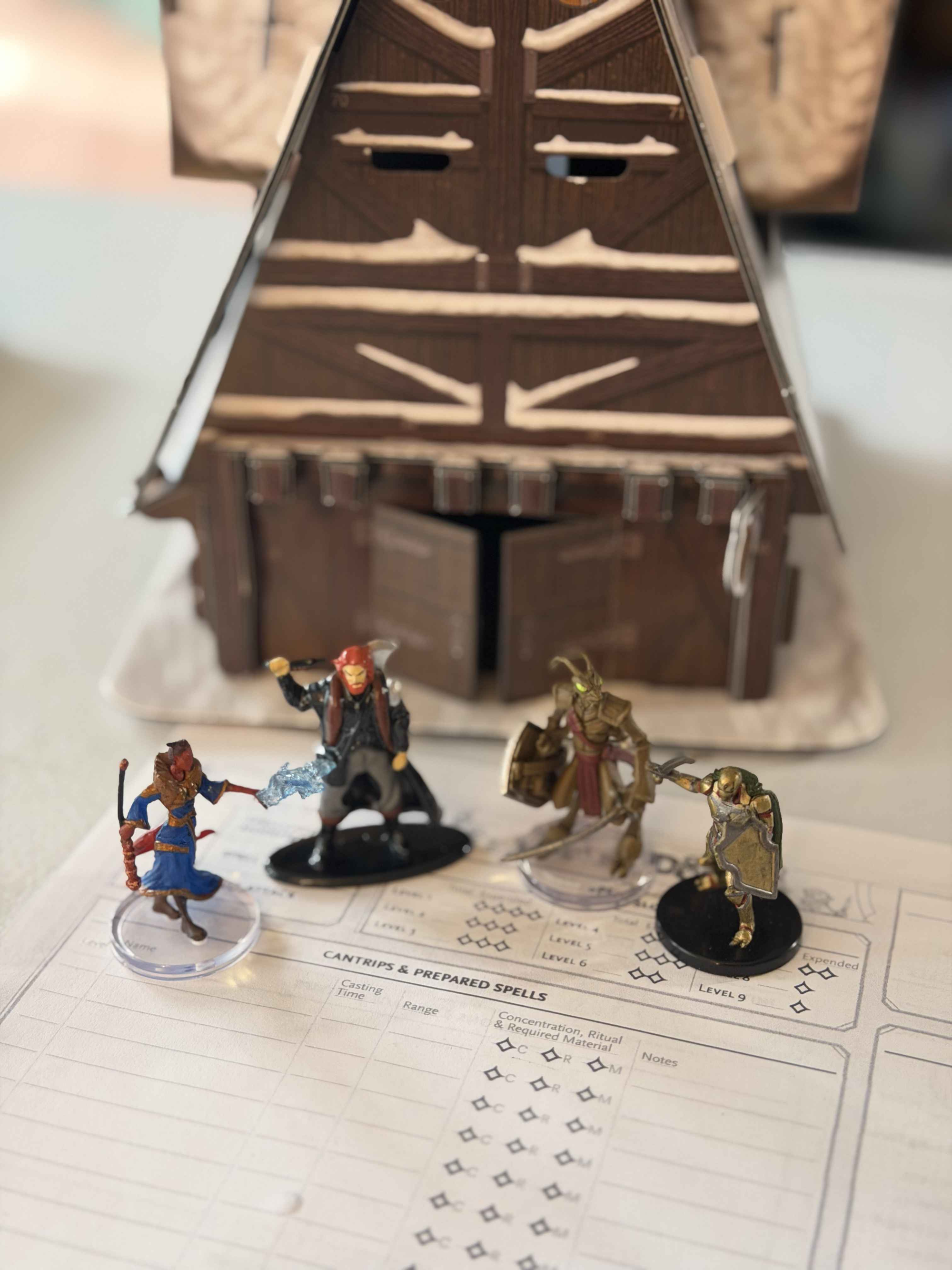
Fortunately, these things come with a fairly low startup cost. The core rules of the game are open source and free, accessible and adaptable by anyone. WOTC offers free educators’ kits, licenses and supplies for afterschool programs. D&D’s benefits and the fact that it is supported by WOTC in dedicated education environments, makes its inclusion in schools and afterschool communities a logical next step. The children of those who played in the ‘80s are the ones driving the new wave of D&D now, making it open and welcoming to all, and its momentum is not slowing down.
Below is a sample scenario of what an encounter in D&D might sound like. With the DM setting the stage and providing the voice for everything but “you”, “you” would be one of the players at the table.
"You have been hired by the northern wintry town of Lonelywood to venture into its neighboring humble forest and investigate some questionable reports by locals. You recall the shaken, frostbitten logger in the inn telling you about it, 'I swear by the stars the moose was stalking me. Like a panther it was, quiet and creeping. Then I was face to face with the beast, I swear it looked at me like it knew something I didn’t.'
The thought of the story is enough for you to draw and ready your longbow. The soft *crunch* *crunching* of snow under foot is about the only sound you hear aside from the occasional *whiff* of a bird’s wings. When you finally arrive at the location of the logger’s sighting, you see a hurried set of prints, hooves and boots interspersed. Clearly the logger must have spooked the moose all the same but as you turn your senses to your surroundings you hear it, *crunch*, not yours. You whirl around to see it, nearly imperceptible white fur on a white snow background, towering antlers and a surprisingly afraid elk face. Much to your shock, the moose opens its mouth and speaks. 'Shhh. It knows we are here.' What do you do?"
Noah Basil is the founder and operator of Guild of Adventures. You can contact him at guildofadventures@gmail.com or via website at www.guildofadventures.com to discuss the article or inquire about professional D&D services.

References:
- Corliss C. 2021. Dungeons and Dragons Infographic Shows How Popular the Game Has Become. Gamerant. https://gamerant.com/dungeons-and-dragons-infographic-2021/
- Stubbs R and Sorensen N. 2025. Tabletop role-playing games and social and emotional learning in school settings. Social and Emotional Learning: Research, Practice, and Policy (5). https://www.sciencedirect.com/science/article/pii/S2773233925000142; Wells KC, 2023. Supporting Student Development With Role-Playing Games. Edutopia. https://www.edutopia.org/article/supporting-student-development-role-playing-games/
- Abramson A. 2025. Improving treatment with role-playing games. American Psychological Association. https://www.apa.org/monitor/2025/04-05/role-playing-games-therapy; Goudreau C. 2023. Tabletop therapy: How Dungeons & Dragons can improve mental health. Johns Hopkins University. https://hub.jhu.edu/2023/12/04/dungeons-and-dragons-therapy-group/