Conversations with Two Carrboro Artists on the Open Studio Tour
A closer look at process, meaning, and artmaking in the tech age
The annual Orange County Open Studio Tour, held on the first two weekends of November, is much like a countywide open house. Visual artists open not only their studios, but also their thoughts, inner worlds, and artmaking processes to curious art lovers. It’s a way to experience paintings, ceramics, photography, sculpture, and more outside the retail environment and connect directly with artists and makers. Whereas in a gallery, there’s a sense of distance and you can’t touch the art, the studio tour provides tactile and sensory experiences: the smell of wet paint or clay drying, fragments of fabric or paper, heavily used brushes, worn tools, and, while readied for visitors, the dust and imperfection of a working studio. Artists spend considerable time in their studios and usually keep them private. The tour offers a chance to get to know artists better and see them and their works in a natural habitat.
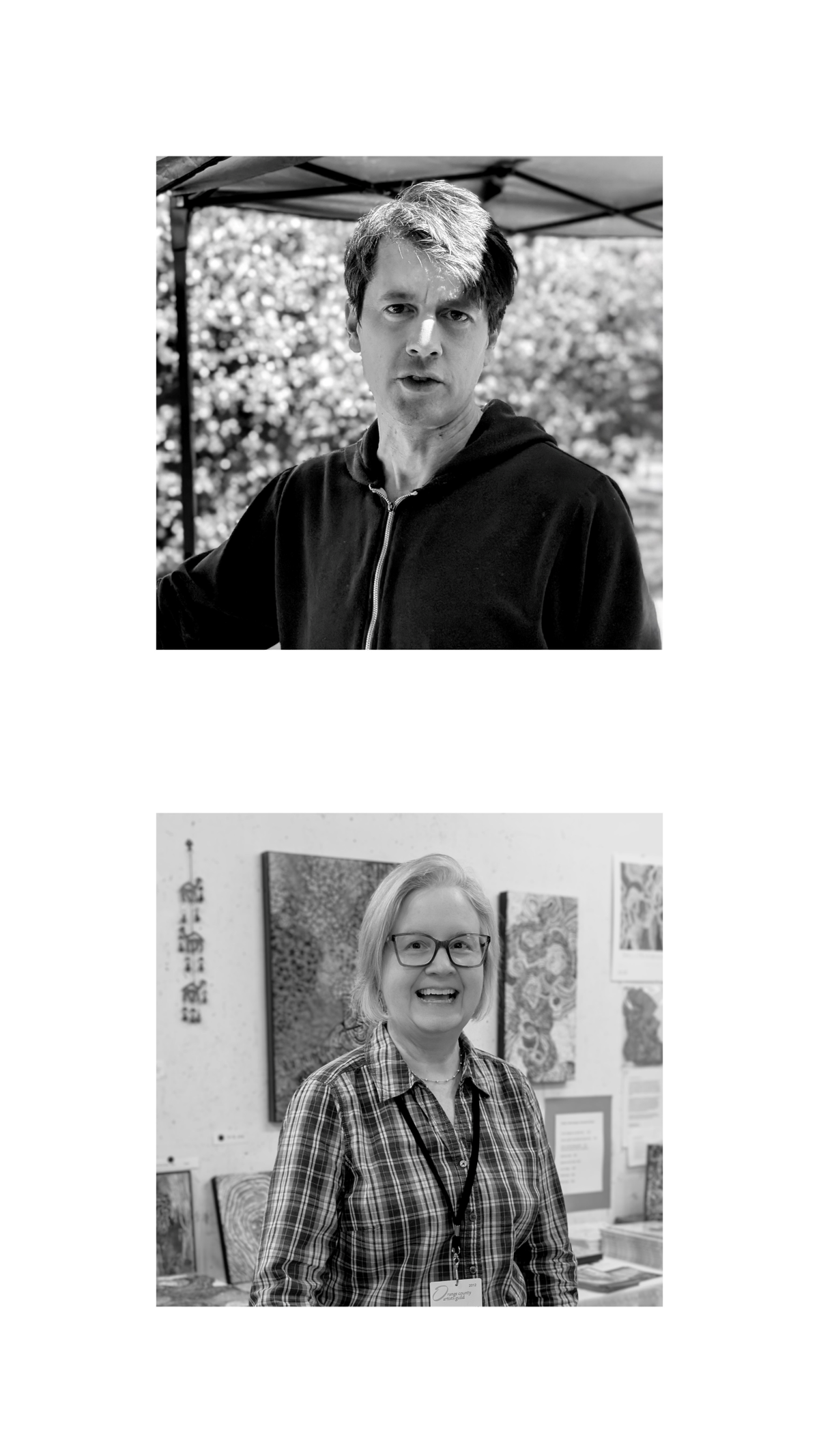
In its November print issue, The Carrborean previewed eight Carrboro artists on the 2026 tour, which is also available online. Then, on the first weekend, visited two more artists for a deeper look. The event is free to attend on November 14–15, Saturday 10–5pm and Sunday 12-5pm. Each studio is numbered.
# 44 Ross Ford: Form- and color-focused abstract paintings
Ross Ford’s paintings are clearly obsessed with one thing — the human face and head. When asked why, he said: “It’s a compulsion. I mean, art is a compulsion.”
While all his works are abstract, some are more recognizable as heads and faces. “It started as a nervous habit in high school when I would doodle in the margins of notebooks.” But why this anatomical feature? “The face is a universally translatable language. Facial expressions hold the same meanings across cultures and barriers.”
Ford’s work expresses human feelings and emotions. “They are moments; each is a moment when that expression felt right. I don’t give them titles; they only have dates, the date each one feels finished.”
Because the works are abstracted, they’re open to interpretation. “How you decode the paintings and what you see in them is also a reflection of what you bring to it.” Ford found a visual language through comic books early on. “The only thing that’s different in superhero comics is their faces, and you have to communicate so much through that face.”
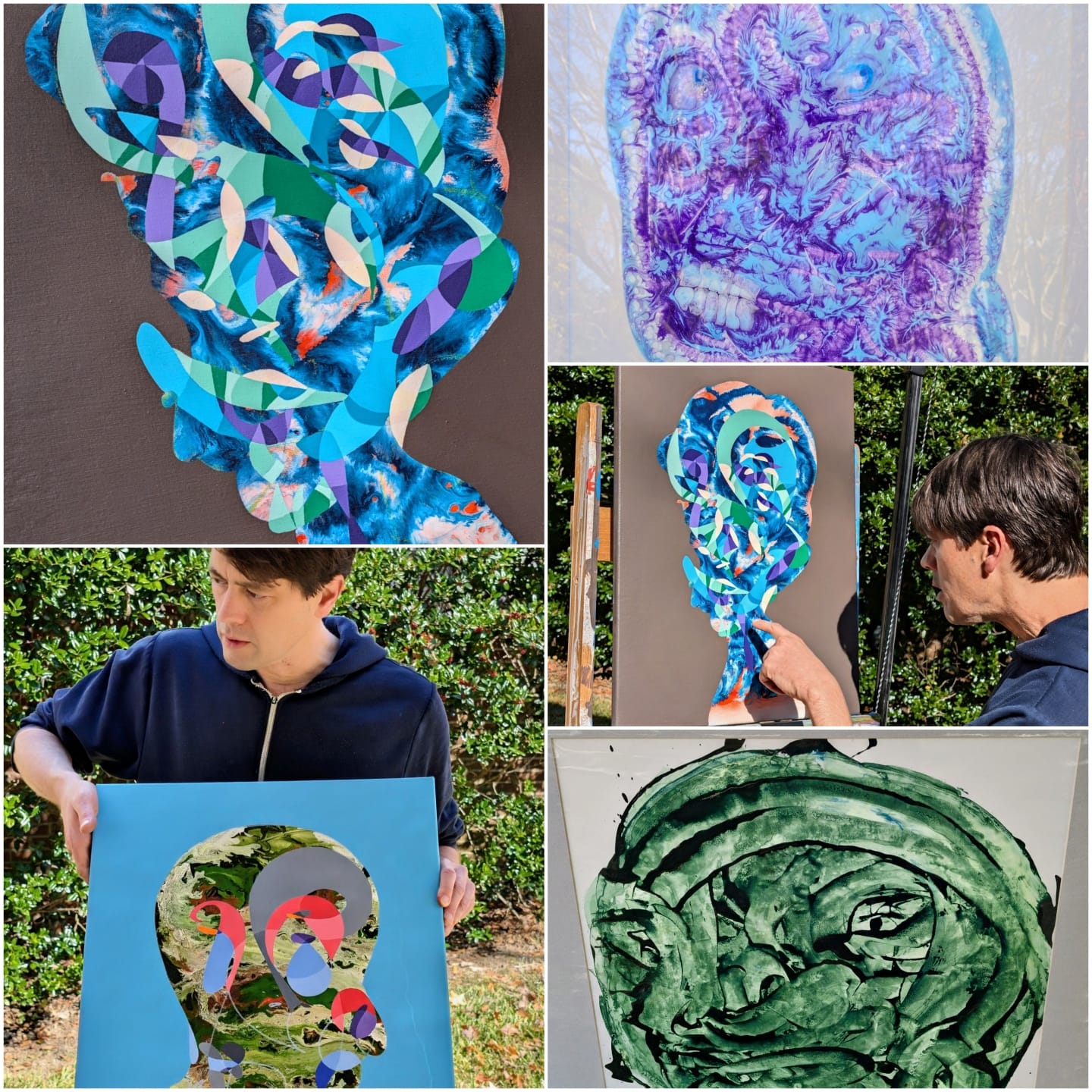
In college and since, Ford refined his technique, producing thousands and thousands of paintings. “All technique is self-taught,” he commented. This led to a conversation about how hard it would be to reproduce his artworks, despite today’s available technologies. “Social feeds are ephemeral, and you don’t know if they’re original. The experience of standing in front of a painting is not equal to looking at it on your phone.”
Many thousands of paintings through the decades point to the compulsion and say a lot about how originality and technique are built over a lifetime of practice in the studio. It isn’t an emotionless algorithm designing art, but a feeling human being taking tools, color, and materials to paint surfaces over and over and over again.
Ford showed a painting he has returned to, adding some of the hard-edged geometric markings he used to make, but in the way his work has evolved recently. Describing a few others on display, he pointed out: “These are painted with a rubber kitchen spatula on Mylar. It works like a palette knife. The spatula just glides along.” The paint stays wet for only so long, so all of them were painted with a timer. With the multicolored ones, Ford waited for each color layer to set before working in the next color.
# 51 Shelly Hehenberger: Patterns in nature and natural sciences
Shelly Hehenberger’s paintings depict the granular reality of cell structures, geologic patterns, and subatomic particles. “Where I grew up in Southern Indiana, there were a lot of caves and waterfalls. I was fascinated with natural forms.” She feels we are all natural forms embedded in this world, and that's why her fascination makes sense to her. She started with oil paints in college because acrylics weren’t on the scene yet. In the 90s, when acrylic matte gel became available, she produced a lot of paper and acrylic collage work. Now she’s settled on two cold wax mediums.
“It’s meant to be added to oil paint, and over the years I started using it more sculpturally.” Pointing to a work on display, Hehenberger described the additive and subtractive steps of her current way of working on paint cradle boards: “I’m creating cold wax pieces, putting layers down and carving off layers, then having these materials to use like a collage, embedding them back into the cold wax media.”
Recently, she decided to focus on color and form and made small paintings on paper. She then cut them up and collaged them on canvas. “It’s bringing the forms together and completely painting over 50% of the original painting fragments.”
Hehenberger aims to slow down in her work so that the imagination can slip its knots from the normal passage of time and really look.
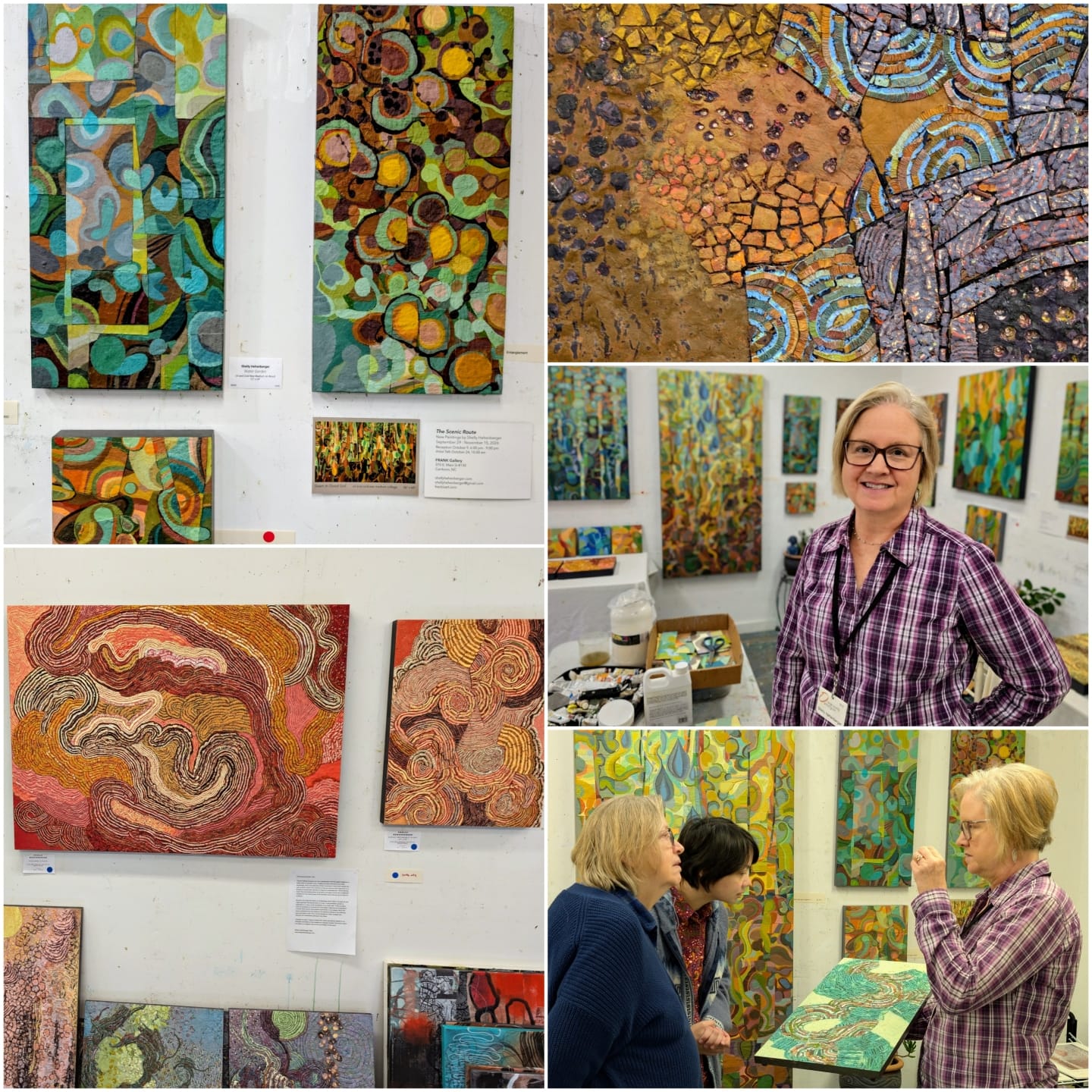
Today, she continues her childhood interest with the rocks and natural forms in the mountains, waterfalls, and plants of North Carolina, especially around Asheville — so ancient and beautiful, she said. “Looking at textures, surfaces like bark, and colors gives you a sense of Earth time, which is different from normal time,” Hehenberger continued, talking about the slowing-down process of her explorations in nature and how she conveys the same in her paintings. Simulating natural formations, the multi-step surfaces and color patterns in her art are moldable and reformable.
A stack of children’s books she wrote and illustrated sits in one corner. She’s been a professional illustrator with a large body of work for outside clients, and that work is now gone. “Nobody wants to hire an illustrator because they can get AI to do it.” Instead, she focuses on making slow art by hand, step by step, with cold wax media that self-hardens but can take about a week.
The Open Studio Tour follows a direct-to-consumer model, giving artists another marketplace and art lovers a chance to experience art outside the polished environment of showrooms. Prevailing technological trends devalue human-made art; direct access to artists in the community is a big deal. Where intentionally made art that honors technique and process flourishes, we step into another’s view, find beauty and new meaning, and widen our own view. The community has more artists than consumers, and supporting this ecosystem means original, painstakingly human-made art survives and thrives. When we encounter human creativity, it leaves a lasting impression because we know it’s authentic, true, and born of human hands.
This article was supported by the North Carolina Arts Council, a division of the Department of Natural and Cultural Resources.