
“12 Angry Jurors” remakes a classic while addressing contemporary themes
See Center Theater Company's production this weekend or next
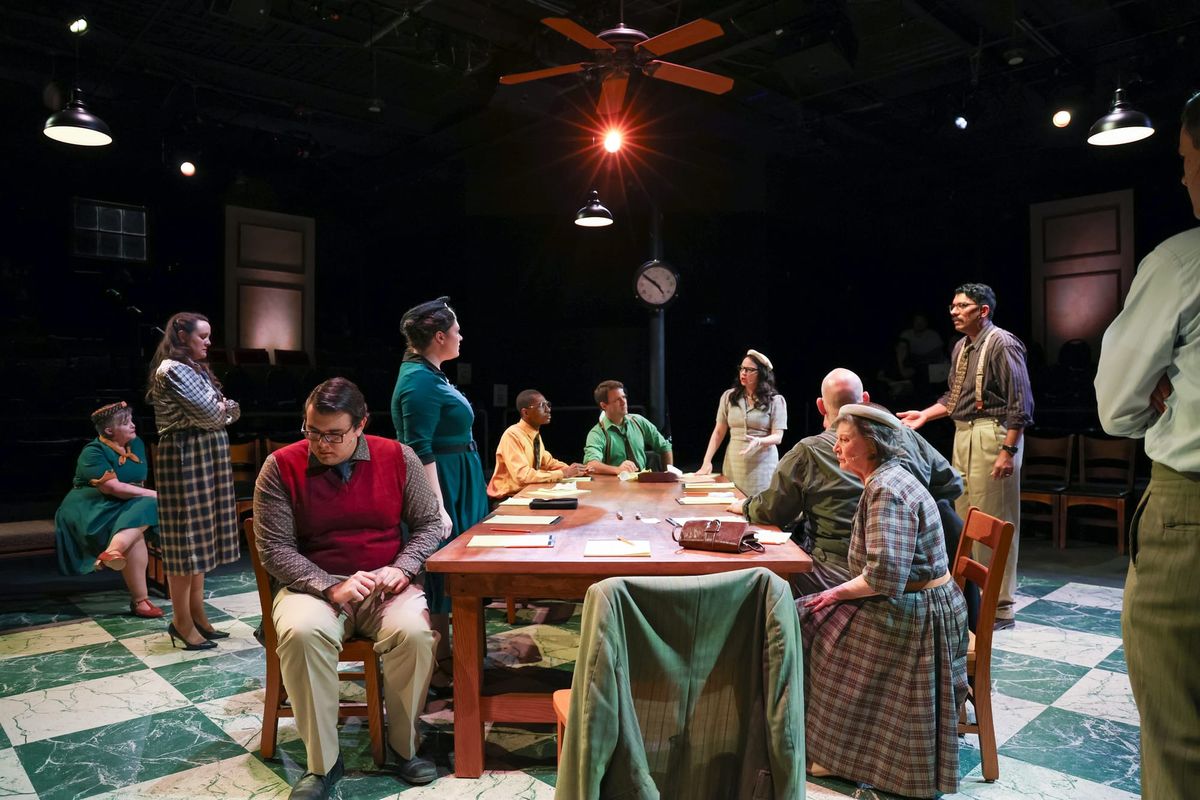
What happens when 12 people locked in a sweltering room are tasked with determining the fate of a teenager charged with murder? Center Theater Company's current production of “12 Angry Jurors” explores that scenario while questioning the morality of determining whether someone lives or dies through conversations that weigh emotion with facts and humanity with laws. Charged exchanges take place within the constructs of an imperfect legal system during an era rife with prejudice and fear, in a crowded room of sweaty, unhappy people.
“12 Angry Jurors” follows closely the plot of “12 Angry Men,” Reginald Rose’s 1954 teleplay set in New York that was made into a film in 1957 starring Henry Fonda and a cast of 11 other white men. However, the jury in Center Theater’s production includes five women.
Women were permitted to serve on juries in New York state since 1937, although they were not required to serve for decades after that. In 1975, the Supreme Court ruled that women could not be excluded from jury pools.
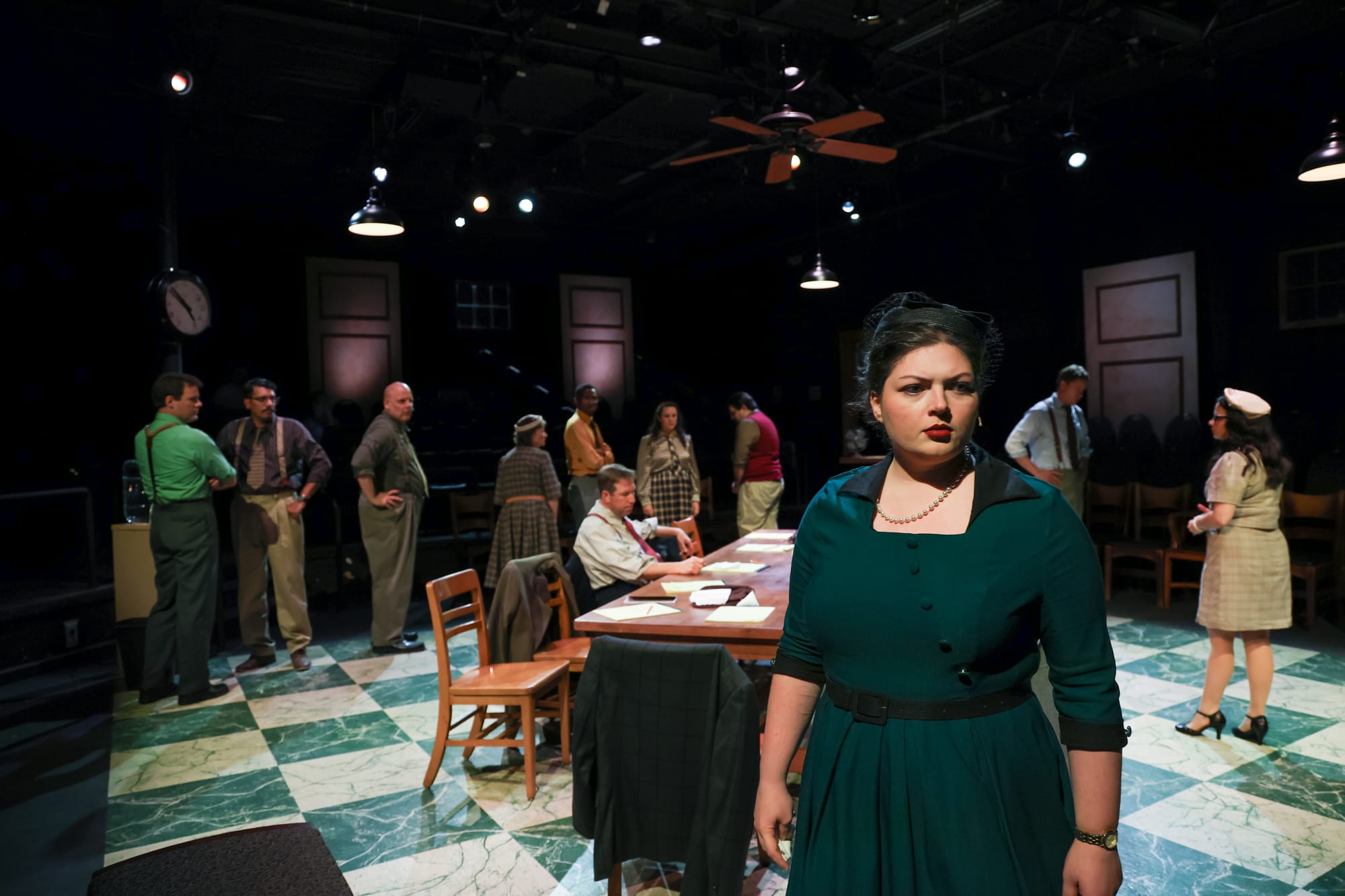
Director Dana Marks provided insight into the making of this production through email. She explained that they’ve reimagined the cast makeup and relationship to the audience “by inviting everybody of any identity there is [since] the original was all white males. I am drawn to the adaptation - anybody can be in the room. Any. Body. Every identity. And we have a richly diverse cast that offer a well of different points of view across so many more cultures, religions, genders, sexual identities, and experiences.”
The Carrborean attended a dress rehearsal last week. We found a spare set that immediately conveyed the stifled atmosphere in the famous film, providing the same understated backdrop for riveting dialogue.
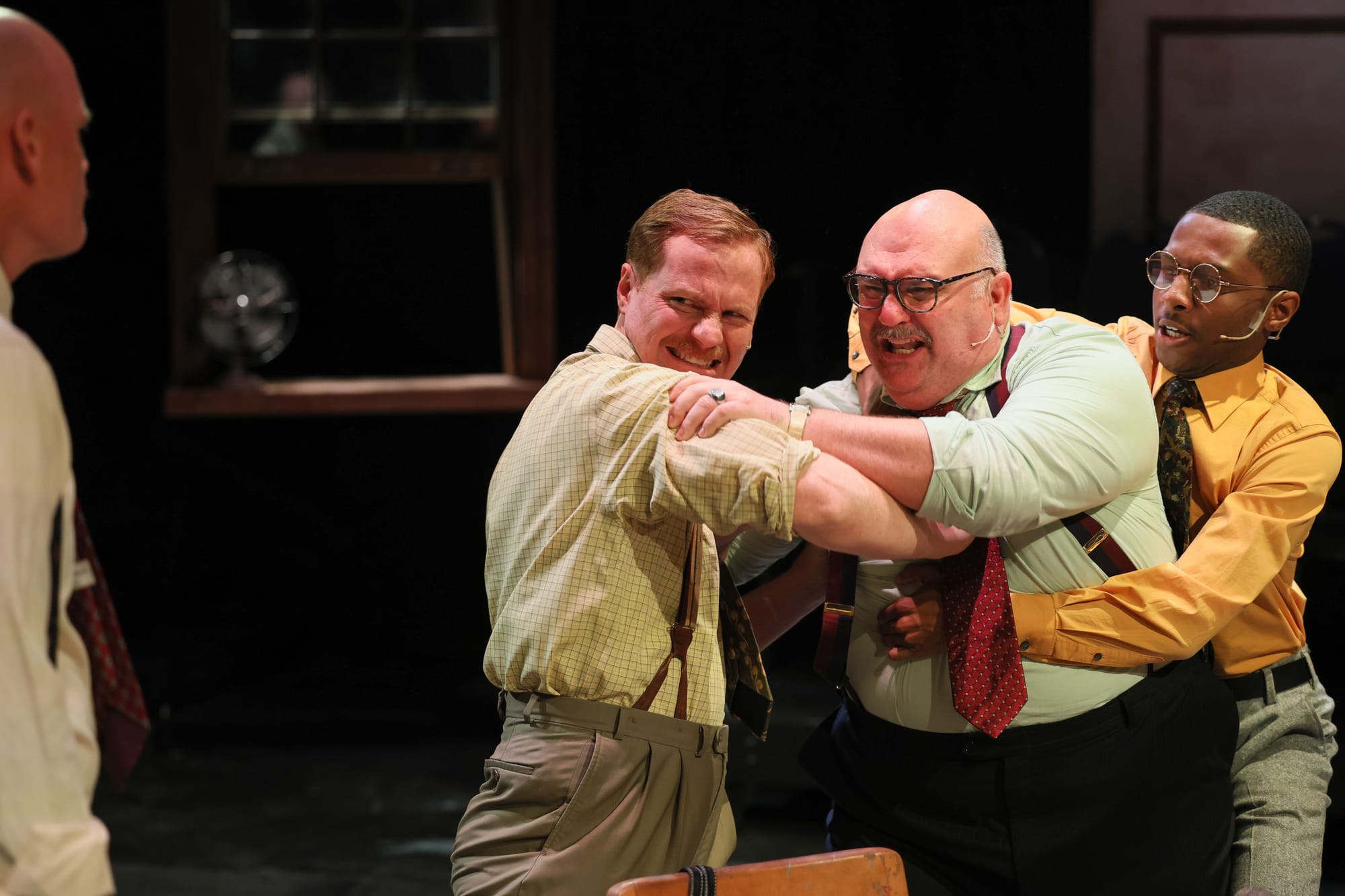
But it was the actors that brought the story alive with vivid portrayals of “everyday people” grappling with moral questions and challenging each other’s prejudices within the oppressive confines of the deliberation room. Their unflinching performances conveyed rising tensions through heated verbal exchanges and violent physicality during the deliberations.
On casting actors, Marks noted, “I have to have an immediate feeling for an actor. If in an audition an actor makes me immediately curious or feel something, I'm in. I'm also looking for the unfamiliar, the uncommon, the unconventional, the odd. I want people that I'd see going to work on the subway.” She takes a collaborative approach. “Actors who come in with ideas are gold. They often came in with backstories or interpretations that I could riff off of.”
To build credible tension and conflict, she encouraged actors to "be impolite! Meaning, they don't have to feel bad about yelling at or insulting a fellow actor...that's the story. It's not about you. You are serving the material. If you pull your punches, you're not serving the story. And in that way, I mean you can't be always nice in every role.”
The room she created resembles that of the film adaptation and provides a palpably compelling and stifling atmosphere. At key moments in the story, after particularly tense exchanges, the actors turn the table together, metaphorically signaling a change in perspective or view of the situation while providing both actors and audience an actual change in perspective within the space.
Marks wrote, “We made the table important rather than just an object. It is "home": When do you feel safe there? When does it feel dangerous and you need to leave? When does it feel dangerous and you need to stay? When do you need to go back but can't? And motivating that. We also made reacting to everything hyper important. Who do you ally yourself with and how do those evolve over the course of the play?”

Lighter moments add levity through common human foibles and those are Marks’s favorite parts. “I love when we get to laugh. [Juror number] Seven's temper tantrums, Eight's constant pursuit of truth, I love Nine...I call it the Human Shield: when Ten launches her overtly racist rant and almost everyone leaves the table in support of Twelve.”
Marks believes the themes of “12 Angry Jurors” are just as relevant today as when the original version was written. “It's unavoidable now to not notice the intentional bigotry, prejudice, and bias in our current administration against what feels like every kind of person. Read the headlines: ICE raids, investigations into modern lynchings of young black people, desires to close museums that offer a look into non-white or non-Christian culture and history, censorship of talk show hosts and free speech, the wars it's supporting...it's rather stunning."
"I kept saying "personhood" throughout the process and I think that's one big theme. Personhood. Can we look at the person first? Every character gets a light thrown on them and, in that moment, we see them not as the stock characters but as people at the rawest layer, and then we can empathize. We have to get past all the things we pile onto ourselves that hide our personhood from one another. And people deserve time, consideration.”
Indeed. "A man's life is at stake," a line delivered at a key moment and the recurring theme of this jury's deliberations, reminds us to slow down, consider the person, and spare judgment.
You can see Center Theater Company's Production of “12 Angry Jurors” this weekend and next on their stage at 300 East Main Street. Find the schedule and ticket information here.