
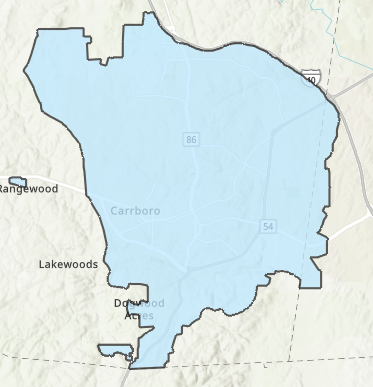
The Orange Water and Sewer Authority, serving Carrboro, Chapel Hill, and parts of Orange County, is on a mission to keep their customers informed and engaged, and a new effort is underway. Often taken for granted, clean, always-on, drinking-quality water is a staple of a modern community. But a lot of dedicated people put a lot of hard work into making that nearly invisible resource available at the turn of a tap.
You may have heard of “forever chemicals” in the water system (per‑ and polyfluoroalkyl substances, or PFAS). These are by-products of industrial manufacturing dating back to the 1930s, with between 12,000 -15,000 known compounds. They are called “forever” chemicals because their chemical bonds are extremely strong, they resist quick natural breakdown and persist in the environment (and living organisms) for decades or even centuries. Government agencies often solve problems the private sector can’t or won’t solve, and in the case of PFAS, they are addressing a problem the private sector also created.
But savvy scientists and infrastructure experts are always watching. If you’ve seen the film, Erin Brockovich, you may be familiar with the potential negative outcomes of drinking water contamination. From fracking to industrial waste to agricultural and residential run-off, a lot can enter our water system where raw water is sourced. Water pollution is nothing new: in June 1969, a spark from a freight train ignited industrial waste floating on the Cuyahoga River in Cleveland, Ohio, with flames reaching several stories high and burning for 30 minutes before being controlled. This was one of several incidents that led to the creation of the Environmental Protection Agency (EPA) in December, 1970. EPA guidelines help local water utilities identify, gauge, and treat or remove pollutants from our water, making it drinkable (a.k.a. “potable”).
Why is OWASA Asking Now?
OWASA officials have been riding the circuit to let us know what they are doing about PFAS. After treatment, PFAS levels in our water supply are lower than current EPA limits. Not resting on their laurels, the team at OWASA is working with its Board to develop a plan to mitigate PFAS. They have held two learning sessions so far, one at the UNC-Chapel Hill Carolina Student Union on October 1, and a second at the Drakeford Library in Carrboro on October 6. The next session will be on October 20, at 6pm at the Carrboro Town Council meeting.
As the team detailed at the meeting on October 6, PFAS present a challenge that is complex, dynamic, and costly. Thankfully, OWASA is up for the challenge and wants your attention and input. Some details from the meeting include:
- PFAS have been detected in the main water supply, Cane Creek Reservoir;
- OWASA has been successful in removing PFAS from our drinking water, bringing levels below EPA limits;
- OWASA is currently using a process of powder-activated carbon, which is then collected in solid form in the treatment waste and sent to a landfill;
- Researchers are still studying what levels of PFAS are harmful concentrations;
- Approximately $3 million has been given to OWASA as part of a state settlement. The current powder-activated carbon solution costs OWASA about $1 million per year in operating expenses;
- A future solution using granular activated carbon could remove PFAS even from the treatment waste, allowing OWASA to resume giving high-nitrate biosolids to local farmers, but would require a new facility and increase annual costs;
- OWASA is part of a coalition of utilities working to educate legislators about the complexities of PFAS, as well as working with university researchers on viable and cost-effective solutions;
- North Carolina is a PFAS hot-spot given past manufacturing in the state;
- Wastewater treatment plants are key in helping to determine the source or origin of PFAS.
OWASA Wants Your Feedback
As OWASA works to address this challenge, they have crafted a plan and want public input. Key components from their plan on the OWASA website (and distributed at the public meetings) include:
Protect Public Health:We commit to protecting the health of our customers and the greater community from PFAS.
Take a Holistic Approach: We will consider options to reduce upstream sources and minimize or eliminate downstream impacts on public health and the environment in our PFAS-related decision making.
Communicate Proactively: We commit to openness, honesty, and transparency in our communication about the public health and financial considerations of addressing PFAS.
Protect Ratepayer Interests: We will be responsible stewards of our ratepayers’ dollars and consider both long- and short-term cost effectiveness in our actions to address PFAS.
Maintain Flexibility: We will analyze PFAS mitigation alternatives in a manner that allows for future flexibility in consideration of evolving regulations and emerging technologies.
Act Deliberately: We will engage in a robust and defensible process to ensure community confidence in our decision-making to address PFAS.
OWASA welcomes all to attend the next meeting on October 20 at Carrboro Town Hall or to review their PFAS playbook and offer comments directly. Find out more about PFAS and OWASA’s efforts here. More information about the settlement is available here.
OWASA’s proactive approach to managing PFAS, including diverting biosolids to the landfill, challenges recent EPA changes, which have reduced its risk stance on the danger of PFAS. In an October 6 memo, the Southern Environmental Law Center and 37 co-signing organizations urged the EPA to not ‘retreat’ from its risk assessment of PFAS, which is shifting toward ‘voluntary guidance.’
Water is an easy resource to ignore or assume will always be there, and Carrboro is fortunate to have an award-winning water provider (in 2023, the Partnership for Safe Water awarded OWASA an award for 10 consecutive years of drinking water treatment processes beyond North Carolina and EPA standards). Clean, potable, always-on water has been so consistent and available for so long that we have the luxury of critiquing its taste from city to city, town to town and even implementing additional home-filtering as we’d like.
OWASA is also working with researchers on PFAS challenges. Just next door, there is a team at UNC Chapel Hill led by researchers Orlando Coronell, PhD, and Frank Leibfarth, PhD, guiding a coalition to clean up PFAS in North Carolina.
OWASA mails an annual Water Quality Report to all customers which shows contaminants and compliance against EPA standards for drinking water quality and aims to meet and exceed national standards, even when those standards are changed.