
The Odyssey: Point and Counterpoint
Divergent views on Christopher Nolan's epic journey
A Complicated Man and an Unabashedly Epic Film
By Maren Schneider
As a true Christopher Nolan fan, I can admit that The Odyssey is not his best film. Then again, ask Nolan fans to rank his 13 films and you may accidentally start a minor war. I am partial to Inception and The Prestige; others will disagree. What is less debatable is that Nolan is one of the defining filmmakers of his generation, and The Odyssey may be his most unabashedly epic work.
Three sequences alone are worth more than the price of admission: Circe, Hades, and the Siren Song. Hoyte van Hoytema’s stunning IMAX cinematography, Ludwig Göransson’s incredible score, and phenomenal sound design create the kind of cinematic experience that reminds you why leaving your couch is occasionally worthwhile. Already a record-breaking commercial success, the film should be a serious Oscar contender, particularly in the technical categories.
At two hours and 52 minutes, The Odyssey is Nolan’s second-longest film, although its pacing frequently moves at breakneck speed. The story races through genres as readily as Odysseus crosses the Mediterranean: historical epic, action-adventure, war film, psychological drama, fantasy, and—in several genuinely unsettling but awesome moments—horror. Somehow, it all feels like part of the same movie. Mostly. It even finds time to emotionally devastate dog lovers.
The final act occasionally seems to arrive at an ending, reconsider, and then arrive at another ending. And perhaps another. Apparently, a nearly three-hour odyssey cannot simply pull into port.
The star-studded cast is consistently good, although no single performance dominates. Robert Pattinson is delightfully despicable, while Matt Damon lends Odysseus about as much inherent likability as reasonably possible without turning him into someone else entirely. Odysseus is a brilliant strategist, notorious liar, accomplished trickster, and utterly consumed by pride. So, well, kind of a jerk.
Nolan’s adaptation is deliberately modern. The dialogue is contemporary, the cast largely performs in American accents, and the gods appear more as mysterious forces than conventional characters. This will undoubtedly bother viewers who prefer their ancient Greeks to sound inexplicably British.
More importantly, Nolan emphasizes the humanity of the story. At its center is “Zeus’s Law,” his streamlined interpretation of xenia, the ancient Greek tradition of hospitality between host and guest. Some dialogue is heavy-handed because Nolan occasionally treats subtlety as a possible threat to audience comprehension. Still, the concept gives the sprawling story a strong moral foundation.
Classicists have raised legitimate objections to the film’s departures from Homer. Emily Wilson, whose acclaimed translation influenced Nolan, practically roasted the adaptation over an open flame. Mythology purists may share her frustrations, as may viewers already resistant to Nolan’s style.
I understand the criticism, but it did little to diminish the experience for me. Flawed and slightly overstuffed, The Odyssey is imaginative, immersive, and spectacular. Nolan’s creative DNA is all over it, and the film feels like a logical culmination of the scale, structure, and themes he has explored throughout his career. It is absolutely worth seeing on the largest screen available—and even better the second time around.
Chris Nolan: Zero stars
By Julia F. Green
“Let’s watch Dunkirk,” I said to my spouse years ago during the Friday night scroll. “I heard that was good.”
“We saw it,” he replied.
“I don’t think we saw it,” I said.
We debated until my dubious spouse relented. Twenty minutes in he said, “We definitely saw this.”
I believed him—the scene looked vaguely familiar—and yet none of the movie, beyond war, stuck with me.
Nor do I remember any part of Memento, Inception, or the Batman one with the scary face guy. Dear reader, Christopher Nolan films leave no lasting mark on me. I forget them as soon as they are over. As such, I shall not be seeing The Odyssey, or any other Nolan film, for the rest of my life. And I will die happy.
I can hear you shouting: But Oppenheimer! But Inception! But Interstellar!
Was that the one about the lonely man forced to confront his existential dread as he faces a monumental challenge with far-reaching consequences? Oh right, that’s what all his movies are about.
Is Nolan skilled at an impressive visual? I’ll allow it. But his character development is middling at best (Hold your “Oppenheimer!” – he did not come up with that story). And character is the basis of all great storytelling.
I watch and read because I want to experience the human journey of growth and change and feel all the feelings that go along with it. But Nolan’s films, beautiful though they may be, even clever, have never made me feel anything.
But, you’re screaming, The Odyssey! It’s the most classic of tales! The OG Hero’s Journey. No matter how meh Nolan is when it comes to character, The Odyssey is too rich a story not evoke feeling in me, right????
Perhaps, but it could never make me feel as much as I did when I was 18 years old and I read The Odyssey, the lyrical epic poem about home, identity, and justice.
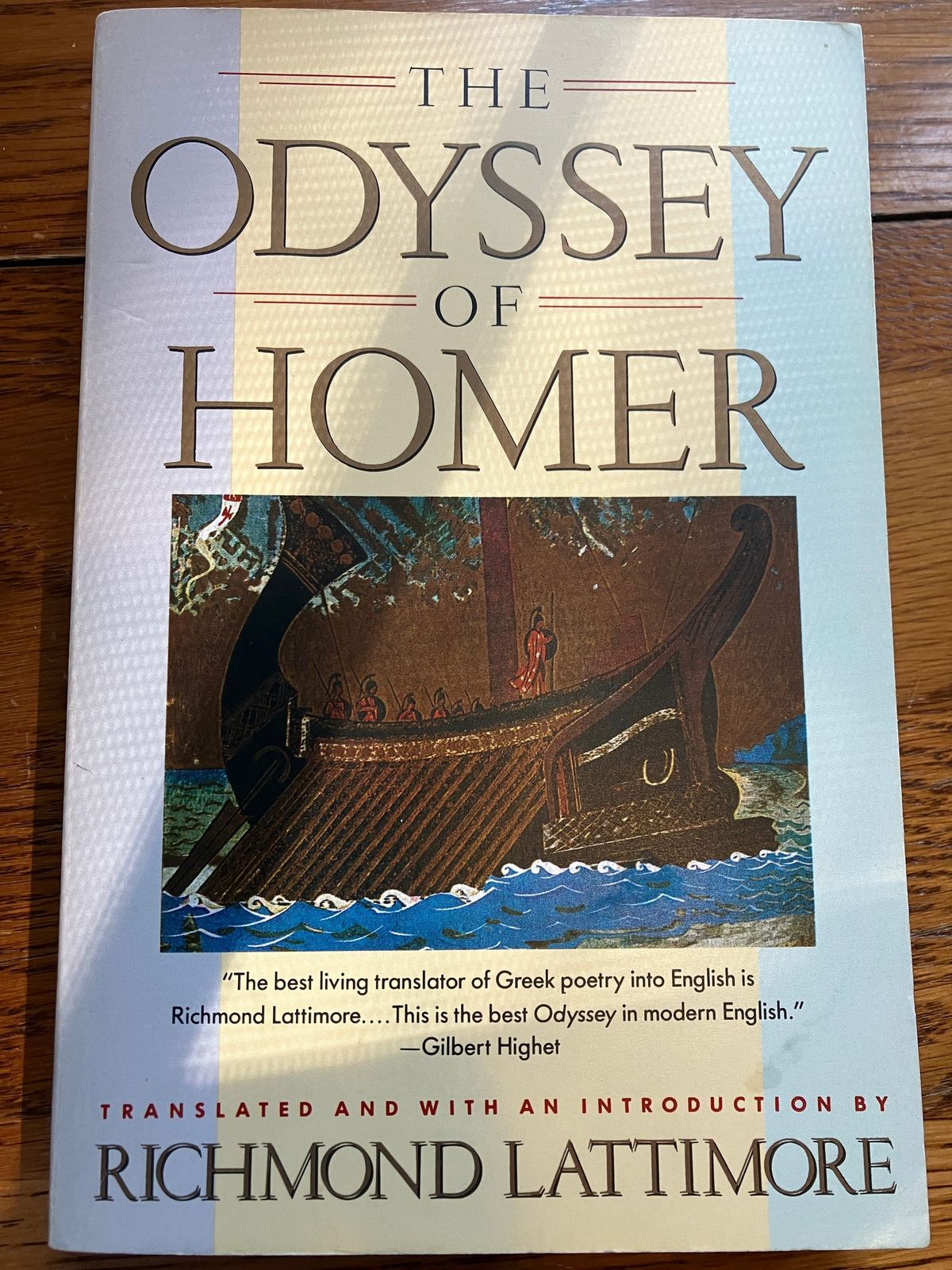
“Tell me, Muse,” my yellowed college copy starts, “of the man of many ways, who was driven far journeys after he had sacked Troy’s sacred citadel. Many were they whose cities he saw, whose minds he learned of, many the pains he suffered in his spirit on the wide sea, struggling for his own life and the homecoming of his companions.”
Dense yes, but I, 18 years old, newly departed from the only home I’d known, greatly enjoyed those hours of deciphering and discovering, of cheering for and grieving with a man trying to get home.
Those challenging lines are from the Richmond Lattimore translation. Emily Wilson’s is much crisper:
Tell me about a complicated man.
Muse, tell me how he wandered and was lost
when he had wrecked the holy town of Troy,
and where he went, and who he met, the pain
he suffered in the storms at sea, and how
he worked to save his life and bring his men
back home.
Now that’s a story.
Nolan’s adaptation runs 2 hours and 52 minutes. So while you enjoy your first, second, or third viewing of The Odyssey, I’ll be on my couch, enjoying the OG movie: reading. No IMAX needed.