Service Dogs Transform Lives at Both Ends of the Leash
By Josie Sollee and Deborah Gibbs
For years, Cindy Leacox was afraid to go to sleep. After developing type 1 diabetes over 30 years ago, Cindy’s blood sugar levels sometimes plummet to life-threatening lows, before she hears any warning from her continuous glucose monitor, or CGM. Knowing that she could lose consciousness at any time, Cindy could no longer enjoy her passions for travel and hiking.
Then Cindy met Lattie, a medical alert dog trained by the Hillsborough-based nonprofit Eyes Ears Nose and Paws (EENP). Lattie alerts Cindy to blood sugar fluctuations well before her CGM warns her. She is trained to let Cindy know there’s an issue by giving her a firm nudge to the leg – and if Cindy isn’t getting the idea, Lattie will do whatever she needs to get Cindy’s attention. If Cindy is unable to get up, Lattie brings her medication kit from its storage place.
Since being paired with Lattie, Cindy’s blood sugar fluctuations are less severe than at any time since her diagnosis, reducing the long-term health impacts of her diabetes. She now travels, hikes, and swims again.
“The more I trust her,” she says of Lattie, “the more life I get to do.”
Lattie, like all EENP dogs, received her advanced training through the organization’s At Both Ends of the Leash program – or ABEL for short – which runs in partnership with the North Carolina Department of Adult Corrections. Inside three NC correctional facilities, incarcerated men work closely with EENP dogs, training them in the skills they’ll need when placed as medical alert or mobility service dogs to support people living with disabilities.
For many ABEL trainers, the work quickly becomes transformative. As one trainer explained, the program “gives us the tools to be a better human.” Another shared that ABEL helped restore “a sense of pride and purpose, discipline, and determination.”With a focus on leadership, accountability, and teamwork in the program, ABEL trainers gain professional skills while becoming part of a supportive community that encourages growth throughout their incarceration and beyond. “I’ve learned responsibilities, learned skills to use in the work force, and I’ve learned tools to stay out of trouble.”
That same dedication ABEL trainers bring to EENP dogs is mirrored by EENP’s commitment to the trainers. EENP provides a multi-year pathway through reentry into the outside community for participating trainers, allowing them to stay connected to the program and successfully rebuild their lives during and after incarceration. Trainers receive support that begins in medium security facilities, continues in minimum security, and extends into work release employment with EENP while still incarcerated, and through post-release.
As one trainer reflected, “ABEL has given me life, joy, a sense of belonging, meaning and purpose. ABEL has taught me I’m not my past. ABEL has made me a service dog trainer, in other words, ABEL has made me a HERO.”
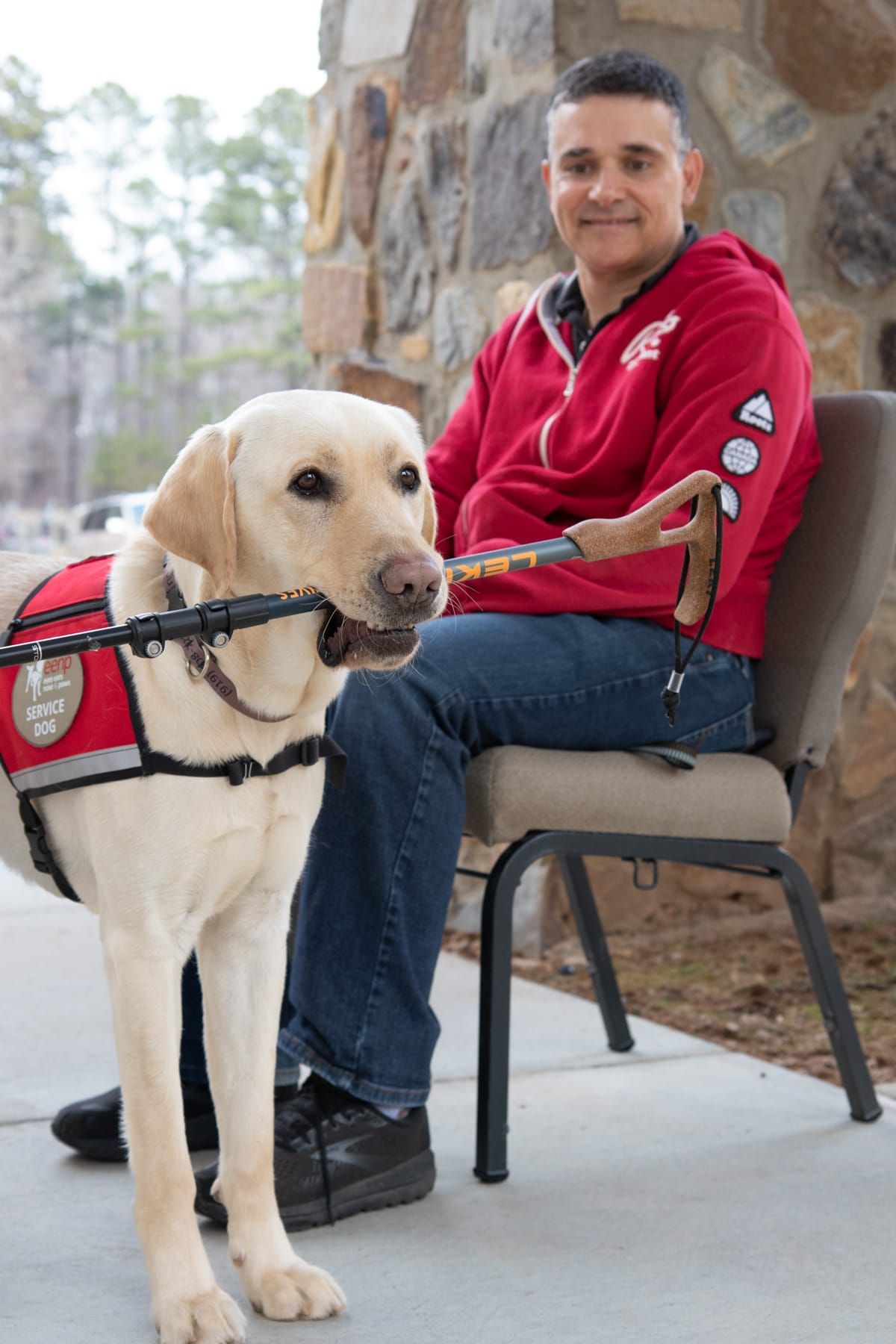
EENP celebrated its 100th service dog placement at a graduation ceremony in March. One of the graduating dogs, Tomate—a mobility assistance service dog—was paired with Nick Said, a Chapel Hill radiologist living with multiple sclerosis.
Multiple sclerosis is a chronic progressive disease that affects Nick’s mobility and balance. He falls sometimes, and as he explains, not trusting your own legs “quietly shrinks your world – your confidence, your independence, even your willingness to join your family in simple things.”
“Then Tomate arrived.”The difference was immediate. Nick recalls a recent afternoon when his family was setting up an outdoor activity in their backyard. The rocky, uneven ground would have kept him watching from a distance before. “But this time I called Tomate to my side for stability, and suddenly I could be a part of it. Maybe not doing the heavy lifting, but I could be present. Involved. Contributing.”
Speaking at the ceremony, Nick celebrated both the skills and presence of the three graduating dogs, and acknowledged the staff and trainers, volunteers, donors, and the incarcerated men who helped train them. “It truly takes a community to bring a puppy to this moment—and we are standing in the middle of that community today.”
The EENP community continues to grow, creating opportunities for others to get involved as volunteers, donors, or advocates and take part in moments like these.
If you want to volunteer, contact josie@eenp.org.