Perspectiva: ¡Carrboro tiene una radio comunitaria de nivel mundial y no se ha dado cuenta!
De Rodrigo Tossi
Uno de los grandes beneficios que hemos tenido viviendo en Carrboro-Chapel Hill, es conocer nuevas formas de vivir junto a las personas que habitan la ciudad. Podríamos pensar en la palabra “comunidad”, pero que hay que detenerse un poco. Mi esposa, estudiante de un PhD, vive en el mundo complejo, profundo y exigente de UNC. Yo, como digo siempre, vivo en el enorme mundo fuera de la Universidad, que a su vez, es enorme, dinámico también, muy diverso y donde siento que siempre estoy aprendiendo cosas nuevas. “Duerno en Chapel Hill, pero vivo en Carrboro”. Una experiencia llena de sorpresas y fenómenos sociales interesantes.
En mi idioma, el “castellano” o español, como le llaman acá, la palabra Comunidad, suena a “como una unidad,” donde probablemente encuentra su origen etimológico. Pero esta idea, como premisa al observar una población cambiante, diversa y sujeta de derecho, nos puede llevar a expectativas que no siempre van a cumplirse. Y me refiero a subcomunidades que encontramos dentro de una población identificada por un censo y que describe a una ciudad. Segmentados económicamente, zonificados de acuerdo con el lugar en que viven, diferenciados de acuerdo con nuestras nacionalidades, idiomas, credos religiosos o diferencias culturales, e incluso al tipo que trabajo que tienen, o a quienes no acceden a tener un trabajo. La diversidad que encontramos es tan grande, como la búsqueda que deseemos hacer.
Bueno, es por eso que podemos ver entre nosotros, personas que viven concentradas en si mismas, y otras con conciencia plena de su entorno. Nuestra reflexión de hoy invita a profundizar en ello. Hay quienes viven de paso, por las ciudades y pueblos. Hay quienes se asientan y buscan conocer, comprender y aportar al lugar en que les ha tocado vivir, aunque sea por un periodo breve de tiempo. Quienes hemos elegido esta opción, tenemos oportunidades para vernos y comprender nuestro lugar en este engranaje social, que además de enorme y complejo, es hermoso, lleno de solidaridad, y siempre cálido… si así decidimos entenderlo. Y claro, este artículo plantea una opción, una alternativa que se encuentra si usted decide vivir en armonía son el entorno social de Carrrboro-Chapel Hill y más allá.
Las herramientas, son los “espejos” que tenemos para mirarnos, y estos son entre otros, todo aquello que resuena como emblemático y característico de nuestra ciudad. ¿Cuáles son?, preguntan nuestras amistades de Chile, mi país. Los bares, restaurantes y galerías de arte, responde un amigo artista. Los festivales, parques y trails, comenta otra amiga deportista. La red de non-profits que trabajan para dar solución a un determinado problema social o deuda que se tiene con una parte de la comunidad, diría un trabajador social. La visibilización alcanzada en las protestas de “No Kings Day” y manifestaciones pacíficas en relación con las políticas federales, comenta también una amiga, claro ejemplo de una característica fundamental de esta área de Carolina del Norte, y que nos provee de opiniones y miradas progresistas respecto a cómo entender nuestra comunidad, sus necesidades, capacidades y limitaciones.
Y yo, claramente de acuerdo con los expuesto, quisiera agregar siempre, que, así como una familia tiene un álbum de fotos y relatos familiares, una comunidad siempre tiene la hermosa oportunidad de mirarse al espejo a través de sus conversaciones comunitarias, del aprendizaje intergeneracional, del encuentro con sus personas mayores y también de las personas que han llegado a la ciudad a vivir recientemente.
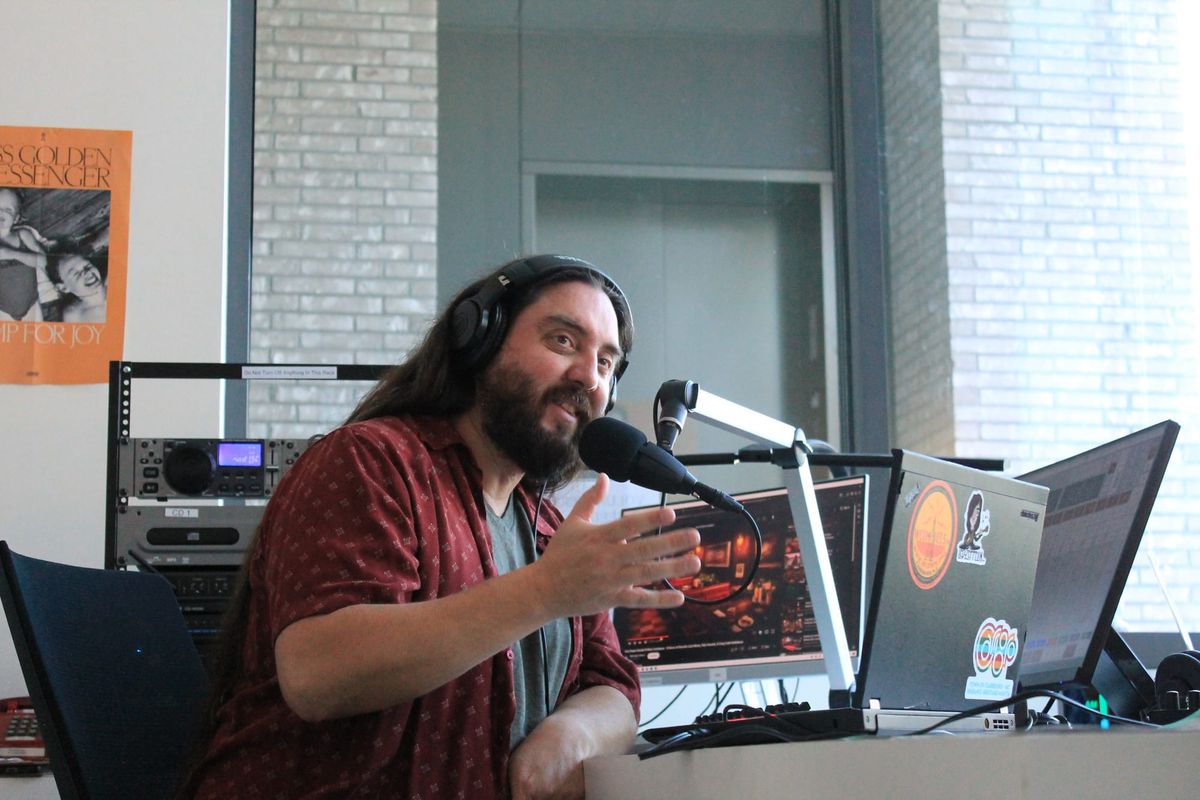
¿Pero dónde está esta oportunidad? En mi opinión, en el enorme privilegio que nos da tener una Radio Comunitaria en el pueblo. En un espacio central, abierto, acogedor, flexible. Un verdadero lujo para una comunidad, para expresarse, para reflexionar, para mirarse a sí misma en un espacio sonoro. Para construir historia, mirar hacia adelante y atrás, con todas las opciones que la tecnología nos ofrece. Incluyendo los desafíos, como integrar la dimensión audiovisual, la interpretación simultanea entre inglés y español, y transcribir a texto, nuestras conversaciones con la comunidad.
No hay salida al mundo más concreta y visible, que una radio que se piensa a sí misma y que está disponible en internet como un acto de integración comunitaria. WCOM y sus programas, sale de la ciudad y se integra con las ciudades hermanas en una relación colaborativa, para potenciar nuestros recursos, crecer de forma sostenible, y resistir a los efectos de políticas abusivas.
Carrboro tiene una Radio Comunitaria, de nivel mundial, y creo que aún no se da cuenta. He participado en cuatro Congresos Latinoamericanos de Radios Comunitarias con las de 380 emisoras cada uno, muchas de ellas, de Europa, y sé lo que estoy diciendo.
En un mundo desbordado de distracciones, con medios de comunicación que filtran sus contenidos de acuerdo con la segmentación de interés comercial, y que ofrecen solo entretenimiento, una radio comunitaria con contenidos diversos como WCOM, es un espacio de crecimiento, de transformación social, consumido y escuchado por diversas personas en el mundo a través de internet. Me pregunto entonces; ¿Por qué, estando 21 años al aire, aún hay personas que no la conocen, ¿o personas que la ven como un capricho de unos pocos? O como un espacio de entretención o de personas sumergidas en la nostalgia musical (dicho sea de paso, soy coleccionista de música en vinilo de los 60 y 70!).
El cambio social, requiere contraste. Exige discusión, quejas, reclamos, propuestas, reflexiones y manifestación a través del discurso complejo, que nos permite tanto el inglés como el español. No es suficiente una pancarta en la calle. Necesitamos expresar la complejidad de nuestros pensamientos.
Un artículo escrito nos permite expresarnos de forma detallada, leer y releer. La Radio Comunitaria permite el encuentro de opiniones y experiencias. Un tesoro en términos de capital intangible. ¿Lo ven otros?, ¿Lo ve usted? ¿Está consciente usted de lo que tiene realmente? ¿Comprende que también es suyo, o aun lo ve, como algo ajeno? Esfuerzos comunitarios como la creación de una co-op, permite tener espacios de encuentro físico y de núcleo social. Un espacio sonoro, como una estación radial comunitaria también lo es. ¿Lo escucha? ¿Usted dice algo? ¿Quiere sumarse?
Le estamos esperando y mirando de vuelta, cuando ustedes nos miran desde la calle. Los miramos con interés cuando ustedes nos miran en las mesas en los festivales. Mi esposa me dijo ayer, “El primer paso, es soñar, el segundo es actuar." Moverse, preguntar, acercarse. En este espejo social que es la radio comunitaria, tal vez usted descubra a un/a líder comunitario que hay dentro suyo. Tal vez podamos conocer la riqueza de experiencias que usted ha tenido. Tal vez podamos enriquecernos con sus miradas y propuestas.
Carrboro tiene una radio comunitaria de nivel mundial y no lo sabe. ¿Usted si lo sabe?
Le esperamos con los brazos abiertos, la consola encendida y el micrófono activado para escucharlos, aprender de ustedes y juntos, sentirnos en casa cada día.
Perspective: Carrboro has a world-class community radio station and hasn't realized it!
By Rodrigo Tossi
One of the great benefits we have had living in Carrboro-Chapel Hill is discovering new ways of living alongside the people who inhabit the city. We might think of the word “community,” but we have to pause for a moment. My wife, a PhD student, lives in the complex, deep, and demanding world of UNC. I, as I always say, live in the vast world outside the University, which in turn is enormous, dynamic as well, very diverse, and a place where I feel I am always learning new things. “I sleep in Chapel Hill, but I live in Carrboro.” It is an experience full of surprises and interesting social phenomena.
In my language, “Castilian” or Spanish, as they call it here, the word Comunidad sounds like “como una unidad” (as one unit), which is probably where its etymological origin lies. However, adopting this notion as a premise when observing a population that is shifting, diverse, and endowed with rights can lead us to expectations that will not always be met. And I am referring to the subcommunities we find within a population identified for a census that describes a city. Economically segmented, zoned according to the place they live, differentiated by our nationalities, languages, religious creeds, or cultural differences, and even by the type of work they have—or those who do not have access to a job. The diversity we find is as vast as the search we choose to undertake.
Well, that is why we can see among us people who live focused inward on themselves, and others with a full awareness of their surroundings. Our reflection today invites us to dive deeper into this. There are those who just pass through cities and towns. There are those who settle down and seek to know, understand, and contribute to the place where they happen to live, even if only for a brief period of time. Those of us who have chosen this option have opportunities to see ourselves and understand our place in this social gear—which, besides being enormous and complex, is beautiful, full of solidarity, and always warm… if we choose to understand it that way. And of course, this article proposes an option, an alternative that can be found if you decide to live in harmony with the social environment of Carrboro-Chapel Hill and beyond.
The tools are the “mirrors” we have to look at ourselves, and these are, among others, everything that resonates as emblematic and characteristic of our city. “What are they?” ask our friends from Chile, my country. The bars, restaurants, and art galleries, responds an artist friend. The festivals, parks, and trails, comments another athlete friend. The network of non-profits working to provide a solution to a specific social problem or a debt owed to a part of the community, a social worker would say. The visibility achieved in the “No Kings Day” protests and peaceful demonstrations regarding federal policies, a friend also comments—a clear example of a fundamental characteristic of this area of North Carolina, which provides us with progressive opinions and perspectives on how to understand our community, its needs, capacities, and limitations.
And I, clearly agreeing with what has been stated, would always like to add that just as a family has a photo album and family stories, a community always has the beautiful opportunity to look at itself in the mirror through its community conversations, intergenerational learning, encounters with its elders, and also with people who have recently arrived in the city to live.
But where is this opportunity? In my opinion, it lies in the huge privilege given to us by having a community radio station in town, in a central, open, welcoming, flexible space. A true luxury for a community—to express itself, to reflect, to look at itself in a soundscape. To build history, to look forward and backward, with all the options that technology offers us. This includes the challenges, such as integrating the audiovisual dimension, simultaneous interpretation between English and Spanish, and transcribing our conversations with the community into text.
There is no more concrete and visible gateway to the world than a radio station that reflects upon itself and is available on the internet as an act of community integration. WCOM and its programs go beyond the city and integrate with sister cities in a collaborative relationship to boost our resources, grow sustainably, and resist the effects of abusive policies. Carrboro has a world-class community radio station, and I don't think it realizes it yet. I have participated in four Latin American Community Radio Congresses with more than 380 stations each, many of them from Europe, and I know what I'm talking about.
In a world overflowing with distractions, with media outlets that filter their content according to commercial interest segmentation and offer only entertainment, a community radio station with diverse content like WCOM is a space for growth, for social transformation, consumed and listened to by different people around the world via the internet (wcomfm.org). I ask myself then: Why, after being on the air for 24 years, are there still people who do not know about it, or people who see it as a whim of a few? Or as a space for entertainment or for people immersed in musical nostalgia (by the way, I am a collector of 60s and 70s vinyl records!).
Social change requires discussion, complaints, grievances, proposals, reflections, and manifestation through complex discourse, which both English and Spanish allow us to do. A banner on the street is not enough. We need to express the complexity of our thoughts. A written article allows us to express ourselves in detail, to read and reread. Community radio allows for the meeting of opinions and experiences. A treasure in terms of intangible capital. Do others see it? Do you see it? Are you aware of what you really have? Do you understand that it is also yours or do you still see it as something foreign? Community efforts, like creating a co-op, allow for physical meeting spaces and a social core. A soundscape, like a community radio station, is one too. Do you listen to it? Do you have something to say? Do you want to join?
We are waiting for you and looking back at you when you look at us from the street. We look at you with interest when you see us at the tables during festivals. My wife told me yesterday, “The first step is to dream, the second is to act." To move, to ask, to reach out. In this social mirror that is Community Radio, perhaps you will discover a community leader inside yourself. Perhaps we can learn about the wealth of experiences you have had. Perhaps we can enrich ourselves with your perspectives and proposals.
Carrboro has a world-class community radio station and does not know it. Do you know it?
We await you with open arms, the console turned on, and the microphone activated to listen to you, learn from you, and together, feel at home every single day.
Translated by Gemini; edited by humans.