This is an edited transcript of an interview with Scott Conary that aired live on WCOM 103.5 on March 9.
You’ve been roasting coffee in Carrboro for a long time—22 years. Tell us about your background. How did you get interested in coffee, and how did this all start?
Scott Conary (SC): Probably like a lot of people, my personal interests led me down a winding path. I have multiple interests, and I realized that when I like something, I want to know everything about it. That curiosity drives me to dig deep, even if it’s not “my job.”
That was definitely true with coffee. I was unusual for my generation in that I was drinking coffee at a very young age—like 8 to 10 years old—and even more unusual in that I actually liked it. Kids don’t usually gravitate toward bitterness, but I did. Coffee became a mainstay in my life, though I didn’t initially think of it as a profession.
Professionally, I was on a different track. I’m a scientist by training--a biochemist--and I worked in research labs for years. But coffee never went away. Over the decades, I kept asking, “How can I—and maybe how should I—fit this into my life?” Eventually, an opportunity came up, especially here locally, as an answer to my own complaint: I couldn’t find good coffee at the time. So I thought, “Well, I guess I’ll do it.”
At that point I was still working in a lab, commuting to RTP for that half of my life, and spending the other half in Carrboro, not sleeping—so it was a good thing I was in the coffee business.
So that’s how Carrboro Coffee Roasters came about. And at the inception, were you just selling coffee or did you already have a café?
SC: Carrboro Coffee Roasters came about because I dug in deep and wanted to know everything that was, at the time, a black box. We’re talking about the 1990s—there wasn’t much information, and people weren’t eager to share it. You either volunteered somewhere or somehow found access to knowledge; it certainly wasn’t online.
I wanted to learn the roasting process and everything behind retail—everything that leads up to what customers see. In the industry, it’s hard to just jump straight into roasting. The easier entry point was retail—offering what we believed was good coffee and working hard to maintain a high-quality level, then convincing people they wanted it.
So yes, I was roasting from the beginning, but it wasn’t my full‑time gig yet. I was fortunate to work with Broad Street Coffee Roasters, one of the first specialty quality roasters in the Southeast. They were originally in Carrboro near the train tracks, then outgrew that space and moved to Durham. I met them in Durham, they let me get hands‑on with roasting, which was huge for my learning and helped me decide how much I wanted to do this. Eventually, that company fell apart—and I picked up the pieces.
Carrboro Coffee Roasters and Open Eye Café have been a staple of the community now for decades. How has the coffee culture in Carrboro changed over that time? What have you observed?
SC: One key thing we learned early on was that not everybody wanted what we wanted. That might not seem obvious now, with so much enthusiasm for specialty coffee and easier access to information online, but back then it was very different.
We had to build customers cup by cup, explaining what we were doing, why it mattered, and why they might like it—even if they didn’t like it the first time. We had to build the customer because they really didn’t exist when we opened.
When we opened Open Eye Café in 1999, many people still thought of that area as the “wrong side of the tracks.” It was blue‑collar, and people were hesitant to pay more for something they believed didn’t need to cost more. We had to help them understand why there was a reason for what we were doing and why it was important.
A good example is the local police. They’d come in and order “a coffee.” We’d usually have a couple of different coffees brewed at any time, so they actually had choices—even if they didn’t think they wanted them. Each time we handed them a cup, we’d say, “Here’s your coffee from Guatemala,” followed by a 10‑second story: who the farmer was, a bit of context. Over time, that repetition worked.
At first customers didn’t care about the details, but after a while, when we’d say, “We have these two brews,” they’d respond, “I don’t like that one; I want the other one.” They were learning preferences without realizing it—why they liked one coffee more than another. Decades of that work, along with other efforts, got us to where we are. If you opened a shop today, there’s much more baseline awareness of what coffee is and what it can be; that did not exist when we started.
Back then, were you watching more commercial competitors, like Starbucks, and what they were doing? Your approach seems very personal and story‑driven.
SC: You can’t help but pay attention. I wouldn’t say they influenced us in terms of goals, but we tried to understand what they were doing, what their goals were, and whether any of their tools could be useful to us.
Our main question was always: is there something in what they’re doing that resonates with people and could help us connect better? Because the core goal is connection and communication with customers.
Everyone in town knows the smell of roasting—it wafts over Carrboro. What about the sound? Is there a particular sound that signals the beans are ready? I’m thinking of the different sensory parts of the process.
SC: That’s a fantastic question, because that’s exactly how we approach roasting—using all five senses. That’s something I worry might be getting lost with modern roasting styles that rely heavily on computers, programs, and automation—especially at larger scales, and increasingly even at smaller scales.
Our goal is to deeply understand the process from a sensory perspective. Coffee seeds are very dense and full of water and other compounds. When you heat them, you start internal chemical reactions. Those reactions produce byproducts—CO₂ and water vapor, among others. As that pressure builds, the seed expands until it must “out‑gas,” releasing CO₂ and vapor. That release creates a sound—a cracking or popping noise, much like popcorn.
You start with something (the coffee seed) small and dense and end up with something roughly twice the size but less than half the weight. You’re trading density for volume—bigger but lighter.
I’ll share a not‑so‑secret “secret” from the roasting side: we have an upfront weight loss of roughly 15% on average. We pay for the weight of green (unroasted) coffee and sell the weight of roasted coffee. So managing that transformation is critical.
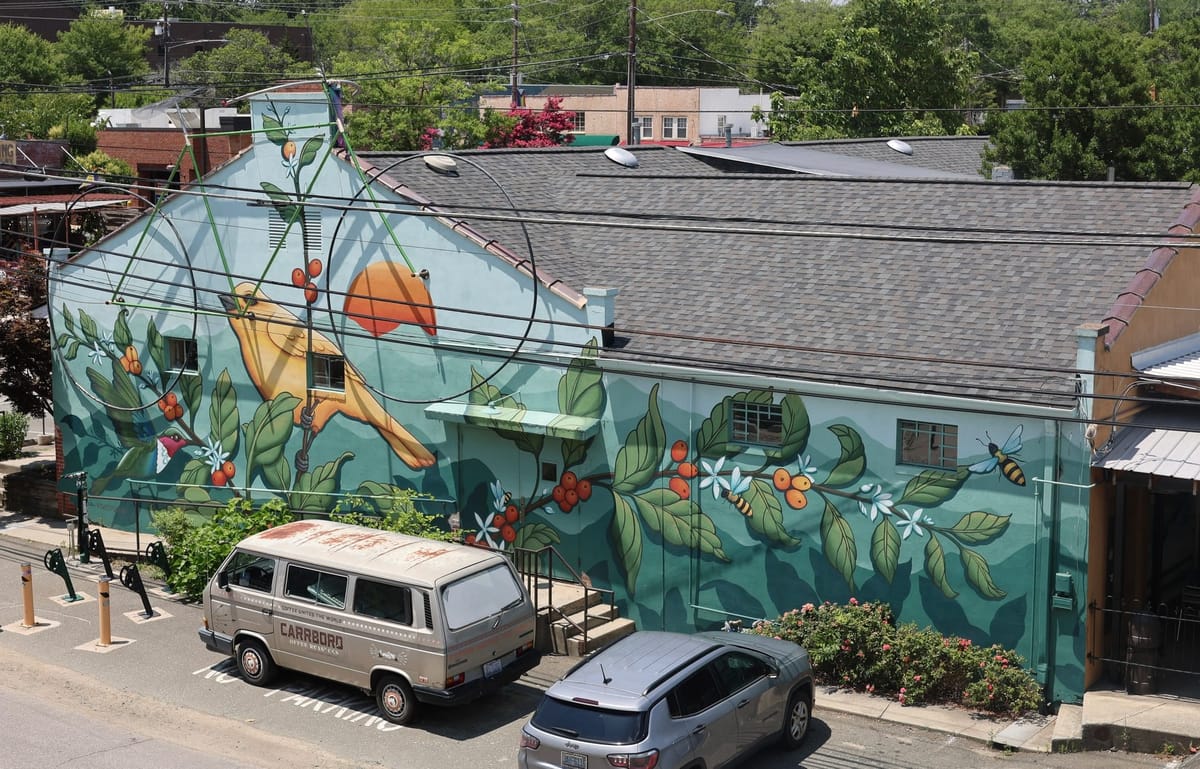
We’re in a unique spot here: the WCOM station windows face Open Eye Café and its beautiful mural. Tell us about the mural.
SC: Knowing this building was coming, and wanting to brighten the town, we asked local muralist Loren Pease—who’s clearly incredibly talented—to work with me on conceptually depicting a coffee farm, but more importantly to evoke community connection and cross‑community communication.
We focused on animals that do that work naturally—pollinators and migratory birds. Many birds are here in North Carolina for part of the year and in Central America the other part. Bees, of course, are critical: we don’t have coffee without bees; we need them to pollinate the coffee flowers.
Those red berries on the mural are coffee cherries—that’s what coffee looks like as fruit. You see coffee flowers, which emerge roughly nine months after pollination, and then cherries that ripen over about three months. You only want to pick cherries when they’re fully ripe, like any fruit, to get the best flavor profile.
So on that wall, you’re seeing the full cycle—and these pollinators as community connectors.
Let’s talk about direct relationships with farmers. This seems like a trademark of your program. What does that mean for you, and can you share a specific farmer story?
SC: Community connection was top of mind when I created Carrboro Coffee Roasters. I built the company on the idea that if this core philosophy didn’t work, then the business wouldn’t work—period. I recognize that’s a luxury not everyone has, but I was in a position where I could say, “We’re doing it this way or not at all.”
So I went all‑in on figuring out how we would talk to people and how they would talk to us. I wanted a true two‑way street. I chose farmer‑direct relationships deliberately. At that time, “direct trade” was becoming a buzzword, but it had (and still has) no formal definition in our industry. So it’s easily used and abused.
I wanted our term—farmer direct relationship—to actually center the producers doing the work, and to emphasize a real, long‑term relationship. We’ve now had decades and even generations of these relationships.
Getting started was the hardest part. I simply dove in, went to people doing the work, and asked: “What do you need? What does this actually cost you to do?” Questions no one had really asked them before, or had the opportunity to. I knew I was lucky to be able to volunteer my time this way.
I also knew these relationships would take time—trust doesn’t come just because I show up.
A favorite story is about Nancy Hernández Contreras in Marcala, Honduras. I met her mother first; both were part of an early all‑women grower co‑op in Marcala—one of the first there, giving women some leverage and power. This was around 2005–2006: ahead of its time in some ways, and far too late in others, given the culture they were pushing against.
While I was talking with them about coffee, Nancy’s mother asked if I’d be willing to help her daughter. I assumed she meant training in Honduras, which I was already doing in other places. Instead she said, “She wants to open a coffee shop. There’s nowhere here to learn those skills. It would be better if she could go to you and learn roasting and everything.”
We brought Nancy to Carrboro for just over two weeks. She was a sponge—working 10‑hour days, absorbing everything: barista work, roasting, operations. Then she went home and opened her coffee shop. Within about three years, she opened another.
She was about 18 when she first came. By around 22, she had her first daughter. Twelve years later, she came back and said, “I want to do the same thing for my daughter. Can she come train with you?” We did exactly that with Luciana. Unfortunately, that was during COVID, so she couldn’t interact with customers as fully, but she still got a robust behind‑the‑scenes education. Nancy had zero English her first visit; Luciana is now becoming fluent.
Today, they have seven cafés, a roastery, and they’re a foundation of the Marcala region. They employ many people and help drive the local economy. One of my specific goals has been to broaden economic development so it’s not just, “You sell me coffee, I buy coffee.” That’s too transactional. I want something deeper and longer‑term.
There’s lots of information on our website (carrborocoffee.com) and Instagram where people can follow their story, and then follow them directly on their own Instagram to see what they’re doing in Marcala.
Are the beans they grow available in your stores right now?
SC: Yes, they are. Funny story—we didn’t buy coffee from them right away. At first, we were just helping. They didn’t have extra coffee to sell because everything they grew was going into their own cafés as they kept expanding. After about five years, Nancy said, “I think I finally have a little coffee left over. Would you like some?” I said, “Oh my God, yes—full circle!”
Since around 2011, we’ve had multiple coffees from their farm, and they just keep getting better. Nancy’s personal goal is for her daughters to become so skilled in retail that they can fully take over the cafés so she can focus entirely on growing coffee.
Going back to your direct relationships with farmers. That seems like a step beyond typical Fair Trade. Why do you think it’s important for a local roaster to be physically present on the farms where coffee is grown? I know for your community‑building model you can’t really do it without being there, but what about for the product itself?
SC: Being there in person is important, though you can supplement with email, phones, and so on—especially post‑COVID now that most farmers have phones. But it’s not the same. Long‑term, face‑to‑face trust changes everything.
There are many steps between the field and your cup, and any one of them can go wrong and ruin all the work that came before. I try to get people to understand that—not as a guilt trip, but as appreciation. Coffee is unusual: we’re responsible for your experience right up to the last minute.
With wine, for instance, once it’s bottled, you’re mostly done. But with coffee, we still have to make the final product—grinding the seed, extracting a beverage. Every step is a chance to mess it up. We tell baristas to be mindful; every seed is essentially gold to the producer. When they see coffee fall on the floor, their eyes say, “Don’t waste that.”
We work together across the chain to reduce mishaps. We know we play a role in shaping the final cup, but most of the work is done by the producer. Without them, we have nothing to apply our tools to.
That’s why we center them: you’ll see farmers’ faces on our bags, learn their names, farms, communities, and backgrounds. The bags are meant to be invitations—like a choose‑your‑own‑adventure—for people who want to dive deeper. And yes, we lead you to the website for more.
Whether it’s “important” to visit farms depends on what you’re doing and why. Some people use farm visits mainly for marketing, which may not truly help farmers long‑term. Maybe there’s a bit of short‑term benefit if it sells coffee, but there’s no guarantee they’ll buy from that farmer again. That’s troubling.
Fair Trade started with excellent intentions—a safety net—but it’s no longer the safety net it once aimed to be, and probably hasn’t been for a while. We’re now paying producers three to four times higher than those baselines, whether or not there’s a certification attached. In some ways, that makes Fair Trade labels less central to our conversations, which is good for producers: they don’t have to bear unnecessary certification costs or marketing structures that don’t serve them.
We’re transparent about this and have a checklist for when a relationship becomes part of our Farmer Direct Relationship program. Before they reach that level, we work with them harvest to harvest under what we call our “Harvest Program”—a sort of parking lot or waiting room—until we can sit down and talk about 5‑ and 10‑year plans: What do you need to keep doing great work? How can we help you do even better? Once we know we’re all committed long‑term, that’s when you’ll see their face appear on the bag.
What’s next for Carrboro Coffee Roasters? Any new projects or events coming up?
SC: So many events. Definitely check our website and Instagram (@carrborocoffee). We’re ramping back up.
We recently hosted a Gems of Saudi event, featuring the top six coffees from that program. This coming Friday, for International Women’s Day / Women Coffee Growers Month, we’re highlighting all our women partners.
These events are held at our expanded roastery at 1215 East Franklin Street, because we outgrew our Carrboro space. We’re still roasting in Carrboro—you can smell it—but we needed more room. The new space allows more public cuppings, tastings, and exposure to unique coffees.
We’re doing increasingly exotic things. Some offerings are unique in the U.S., sometimes even globally. For example, that Saudi coffee I mentioned—it was the first time it left the Kingdom.
Home Brewing – Simple Ways to Improve Coffee from Scott Conary
- Buy a good brew grinder and grind fresh before brewing.
This changes everything. If you’re serious about enjoying coffee, grinding right before brewing is transformative. I liken it to buying a good kitchen knife—people will spend $200 on a knife they use frequently. My grinder cost about the same, and I use it every single day.
Whenever you grind coffee and smell that wonderful aroma, remember: everything you smell is leaving the coffee and dissipating into the air. Over time, ground coffee becomes flat and dull. Fresh‑ground locks in the full experience you paid for.
- Use good water.
Coffee is more than 98% water, so bad water equals bad coffee. In our area, municipal water is within good brewing specs; many people just need a simple carbon filter to remove any off flavors. Avoid deionized water—it has nothing in it to react with the coffee, producing a very flat cup. You’ll wonder why your coffee tastes like nothing.
A good, bottled spring water is a relatively inexpensive upgrade compared to a grinder and can make a big difference.
For more from Scott Conary on Evaluating Coffee in the Field & Climate Impacts, Sharing Farming Practices Across Regions, his role as a World Coffee Judge & Competitions, and Unusual Coffee Flavors, listen to the interview.