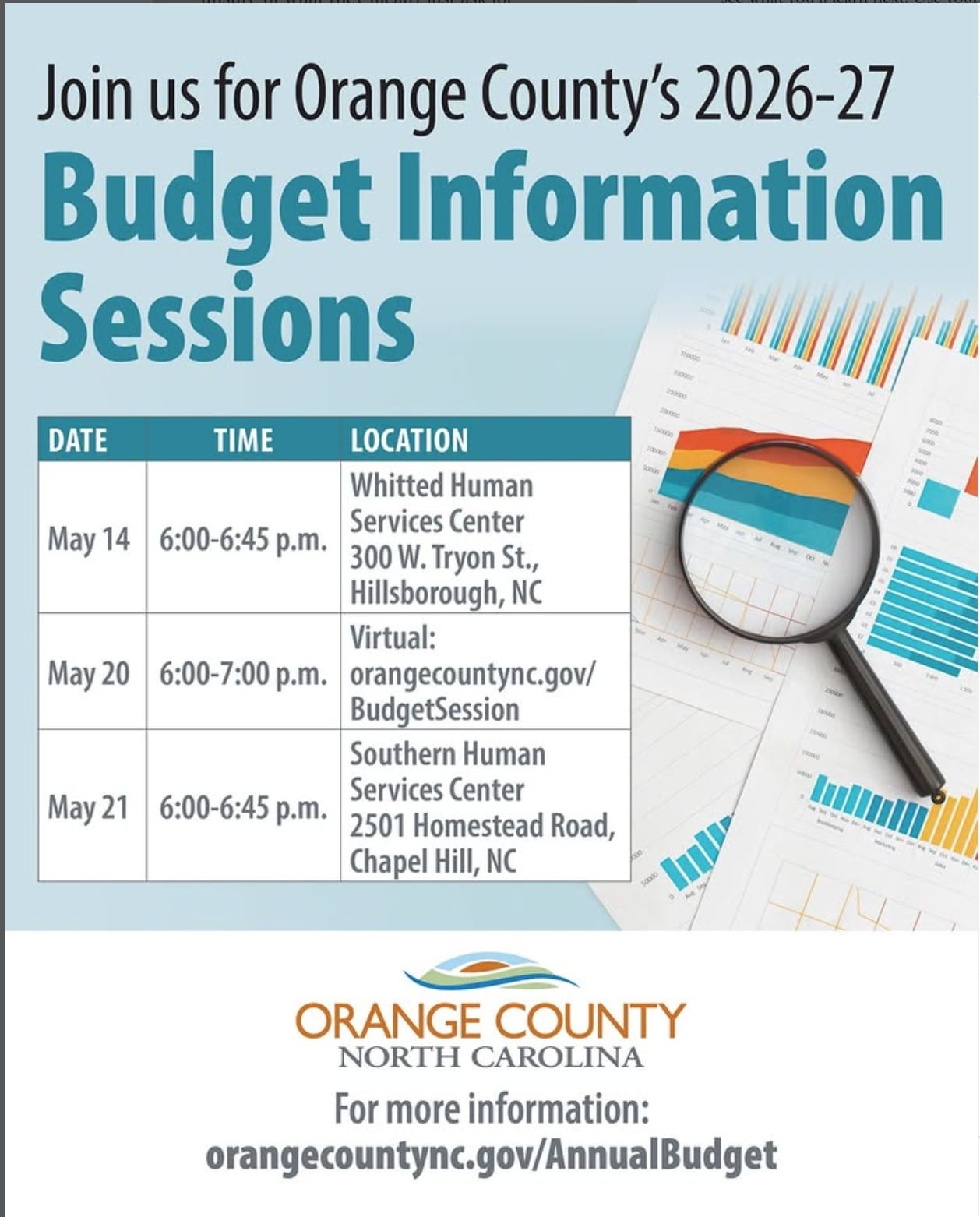
How Our County and Town Budgets Are Made and How You Can Participate
With Catherine Fray, Carrboro Town Council Member and Damon Seils, Former Mayor
This is an edited and summarized transcript of the conversation that aired live on WCOM 103.5 on April 27. You can find the recording here.
What’s the basic difference between the town budget and the county budget?
Damon Seils (DS): County and town budgets look similar on paper, but they serve different purposes. “Our county government here in Orange County has a lot of mandates from the state. Counties are basically administrative extensions of our state government. It’s how the state implements its statewide programs at the local level.”
For counties, that means big ticket responsibilities like public schools, public health, and social services. Those are largely non‑optional. By contrast, towns have just one state mandate: “Town governments really only have one mandate under state law, and that is to do building code enforcement.”
Everything else we associate with town government—trash pickup, parks, police, fire—is provided voluntarily but not mandated.
The government structure is different too. Counties are relatively decentralized, with independently elected offices such as the sheriff and Register of Deeds that the County Board of Commissioners must fund but don’t control. Town governments are more centralized under a town manager, “kind of the CEO of the government.”
Why is the budget done every year instead of for several years at a time?
Catherine Fray (CF): “The short answer is the state law requires us to adopt a budget each year. But that doesn’t mean that we can’t plan over a longer term.”
Carrboro’s budget now includes two‑ to three‑year forecasts for some major categories, and the town maintains a five‑year Capital Improvements Plan for big projects like buildings and infrastructure.
“So even though we adopt a one‑year budget, we look at it in the context of what we expect to spend over the next several years.”
How can residents actually see the budget?
DS: Staff start working on the next year’s budget as early as October. “As we get into what we call budget season—the first half of the calendar year—the county manager and town manager start making public presentations to their boards.”
Those presentations happen in open meetings, and the documents go onto the town and county websites. There is usually at least one formal public hearing.
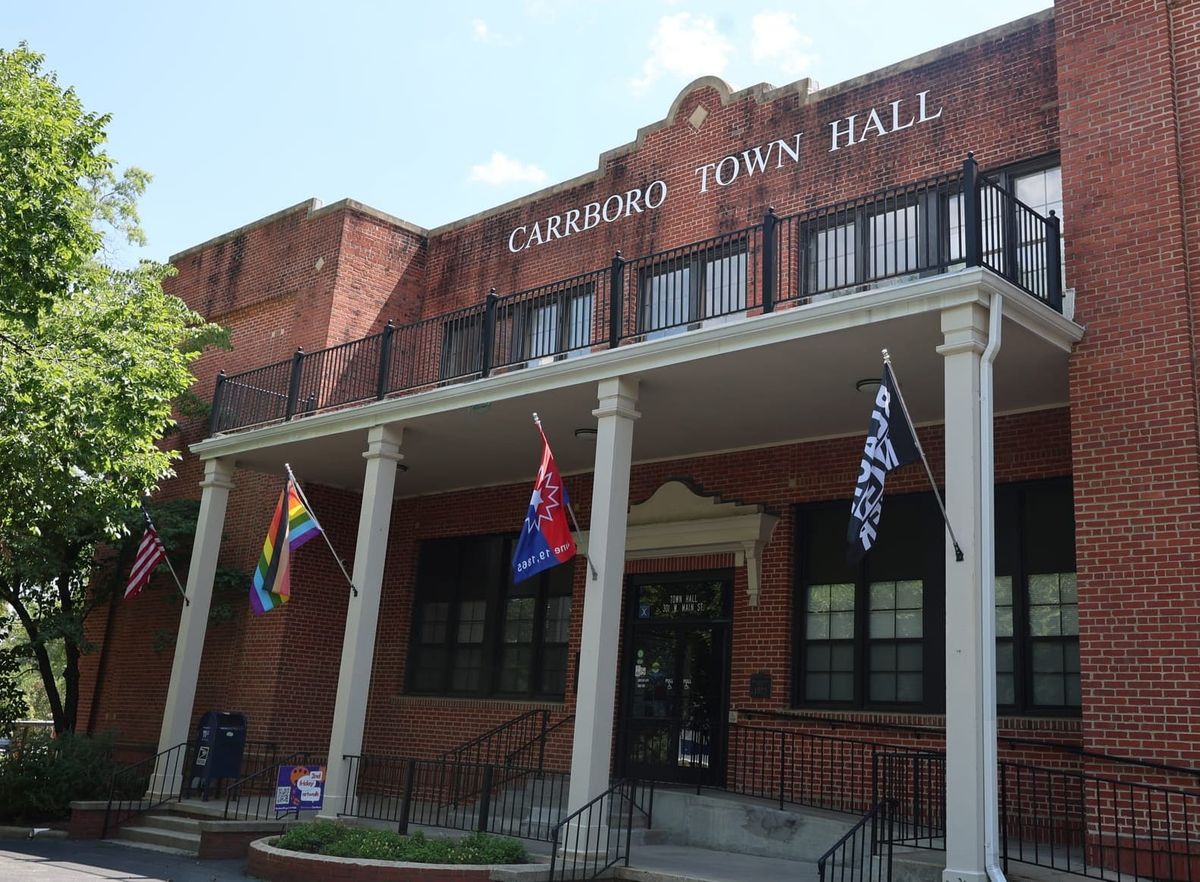
CF: For people who prefer paper, “As part of publishing the budget, there are print copies available. After May 12, you can come up to Town Hall and you can get a print copy of the budget—or a part of the budget—if that would help you go through it.”
What are the best ways to give input on the budget? Is the public hearing the main way to be heard, or are there other options?
CF: “I’d call that the formal, in‑person way to participate,” they said. “It’s far from being the only one.”
Residents can:
- Email the finance director (listed in the budget and on the website),
- Email any council member, the mayor, or the whole council,
- Reach out to the town manager, or
- Talk with the town clerk, who can record and share comments.
“When you send in an email, that’s a public comment just as much as something you might say in a meeting. Whether you come in person, send an email, call on the phone, or talk to someone face to face—those are all ways you can give input.”
DS: “The budget season is all year, really. Don’t wait for now to express your thoughts to your elected officials about what your priorities are.”
Does public input ever actually change the budget?
CF: Smaller, practical requests often get handled without ever becoming a visible line item—staff just find ways to do them. Bigger requests, though, usually take more than one year.
They pointed to a recent example around property tax fairness:
Advocates, including Justice United and organizer Elizabeth Young, pushed Carrboro to join Chapel Hill in contributing local funds to match a county property tax relief program for lower‑income homeowners.
“They came to us and said, ‘Hey, can Carrboro do this?’ We said, not this year, but we heard you. And then I think it was maybe two years [until] we were able to get that into the budget last year, which was really good to see.”
That new ongoing contribution is in the five‑ or six‑figure range—the kind of change that requires planning across multiple budget cycles.
How do you choose between competing priorities?
CF: “If something is in the comprehensive plan, you’re going to find it in the budget every year.” Different departments are always working on those priorities in some form.
The real tradeoffs happen at the project level and over time:
“We might emphasize one type of work in a given year—say, a capacity plan for affordable housing—while another department is focusing on data and planning for climate and sustainability.” When there’s a genuine conflict, council talks it through, invites comments, and decides case by case.
DS: Big community priorities are rarely one‑year efforts. “These are long‑term things that the town and the county are thinking about and having to fund over a period of multiple years, not just one year.”
How do storms and unexpected emergencies, like Chantal, affect the budget?
CF: The biggest impact was on staff time and project timelines—for example, Public Works diverted attention to cleanup and to collecting data for insurance and FEMA.
“If the town budgeted for certain projects and didn’t fully spend that money, the unspent funds stay in the general fund and roll into the fund balance." At the same time, unplanned storm‑related spending creates pressures that take several years to work through, especially as FEMA and insurance decisions unfold.
One visible change: the town’s Capital Improvements Plan now includes a new Public Works facility—a need that wasn’t in the plan before Chantal—forcing reprioritization of other projects.
How much of the budget is already spoken for--locked up in salaries, debt, and other fixed costs?
CF came with numbers:
- About 4% of Carrboro’s general fund goes to debt service.
- Roughly 60% goes to personnel—the people who actually deliver services.
“When you think about the town doing something, you might think about the end product—the event, the building, the program. But most of the expense is that there has to be someone to plan it, coordinate it, and carry it out. That’s where a lot of the money goes.”
DS: Orange County similarly manages its debt service conservatively, including its share of major projects like the Drakeford Library Building.
What can residents do now?
CF: the manager’s recommended budget will be published on May 12, with:
- A PDF on the town’s website,
- Printed copies at Town Hall, and
- A public meeting that evening where the budget will be presented and public comments are welcome.
By the end of June, Carrboro Town Council must adopt a balanced budget under state law.
Closing thoughts: Between now and then—and all year long—residents have a standing invitation to read the current budget, ask questions, and tell their elected officials what should matter most in Carrboro’s spending plan.
This transcript was created from The Carrborean Radio Hour recording by Otter.ai and edited by The Carrborean's (human) editor.