
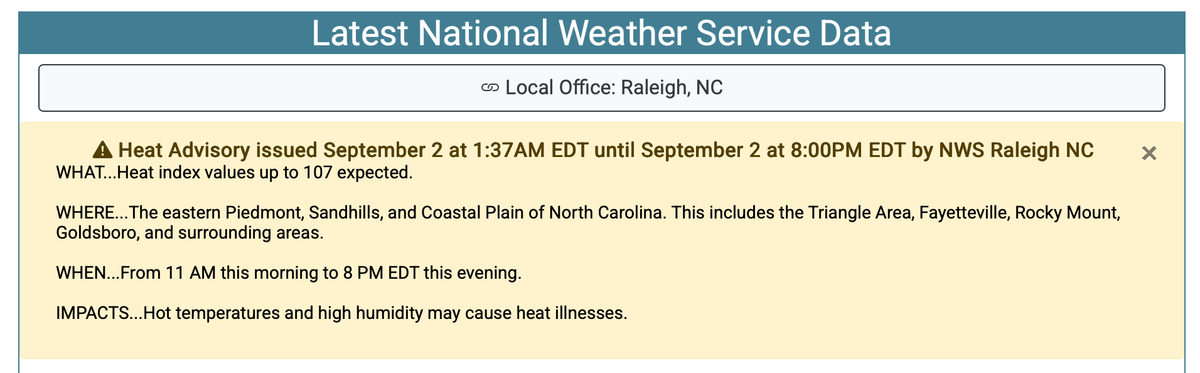
When the calendar turns to September, we psychologically start thinking about fall, but summer is having its last hurrah. Still, while the early part of the month is usually hot, it isn't typically this hot. A punishing heat dome has settled over North Carolina, pushing Piedmont temperatures toward triple digits, which, were it to reach 100 degrees, would make this only the eighth September since 1887 that temperatures have gotten so high, according to Meteorologist Chris Michaels of WRAL. At fault is a broad ridge of upper-level high pressure that is trapping warm air near the ground and keeping the clouds away.
At his presentation in Carrboro Tuesday evening as part of the monthly Carolina Science Cafe, state climatologist Jared H. Bowden, who directs the state climate office at NCSU, pointed out that such heat makes outdoor work dangerous and affects the economy as landscapers, roofers, road maintenance crew, farmers, and others who work outdoors can be at risk when the heat index gets this high.
The North Carolina State Climate Office's own regional heat thresholds classify anything above 100°F as extreme for the Southeast piedmont region during the month of September. Bowden wants people to know that they can get updated temperature and climate information for our area by clicking on a link maintained by his office. One of the state's 46 research-grade weather stations is situated at the Horace Williams Airport in Chapel Hill, and the information it provides is updated every five minutes on the state's Environment & Climate Observing website.
Meanwhile, school transportation officials across North Carolina have been fielding complaints about buses whose air-conditioning units simply can't keep pace with sustained extreme heat. Neighboring Wake County Public Schools has already faced public scrutiny this school year after a WRAL investigation found more than a third of the district's roughly 200 schools had a documented heating or cooling maintenance issue at their most recent health inspection — and transportation officials statewide have acknowledged that even buses equipped with air conditioning often can't cool a fully loaded vehicle enough to make a meaningful difference on afternoon routes when outside temperatures sit in the mid-to-upper 90s.
In online discussion forums this week, Carrboro parents have raised concerns about their children's sweaty, sweltering bus commutes. Many older buses in North Carolina fleets either lack air conditioning entirely or rely on units designed for moderate heat, not the sustained mid-90s-to-100-degree afternoons a stalled heat dome produces. The result, transportation directors across the region say, is buses that top 90 degrees inside even with the AC running, turning a 30- or 40-minute ride home into a genuine heat-exposure risk, particularly for younger children and kids with underlying health conditions.
Outdoor athletics face a parallel problem. North Carolina High School Athletic Association rules require schools to monitor Wet Bulb Globe Temperature — a measure that combines heat, humidity, sun exposure and wind — starting 30 minutes before every practice, and the association's heat guidelines lay out an escalating response: mandatory water breaks every 30 minutes in moderate conditions, removal of pads and equipment and breaks every 15 minutes as conditions worsen, and full suspension of practice once the heat index crosses roughly 125 degrees or the WBGT tops 90.
Fall sports like football and soccer are especially exposed because their preseason practices, including football's mandated 14-day acclimatization period with full pads and double sessions, run directly through the hottest, most humid weeks of late August and early September — precisely the window this heat dome is occupying. And let’s not forget the marching band and color guard kids in the Tiger Marching Band, the district marching band for all of CHCCS, which has been practicing outside at Chapel Hill High School.
This heat wave isn't predicted to loosen its grip before Sunday, Sept. 6.