
Family Reading Partners Has a New Executive Director
Stephanie Knop explains the organization's mission and why its work is important
The Carrborean exchanged email with Stephanie Knop, who recently took the helm at Carrboro-based Family Reading Partners. This is an edited and condensed version of that conversation.

What inspired you to step into the role of Executive Director at Family Reading Partners, and what is your core vision for the organization's next chapter?
Family Reading Partners is a mission-driven organization and it is a mission that I am passionate about. My time spent as an elementary school teacher early in my career really showed me how critical a child’s early experiences are before they ever enter a classroom and how much impact that can have on their later success and the challenges created when the learning foundation is lacking.
When I learned about Family Reading Partners while working in Outreach at the Orange County Library, I was excited to see there was an organization in this community that shared my belief in the importance of early literacy. I was fortunate to cross paths with co-founders, Mary Andrews and Nancy Zeman through my work with Orange County Partnership for Young Children and it further solidified my enthusiasm for the work they were doing.
When the opportunity arose in 2023 to interview for the first paid staff member position of Program Director it felt like destiny, in a way. The work I’ve been doing since then connects so much to my passions: education, literacy, books, the joy of reading, supporting families and specifically moms. I’m a mom of two children and remember all the joys and struggles of those early years. I luckily had family support and resources, but even with that it can still be a lonely and challenging experience. I hope that the families in our program benefit from the early literacy support we provide but also the reassurance of having a caring, consistent presence in their home through what can be one of the most challenging times of life.
Becoming Executive Director has felt like the natural next step, not only in my career, but for the development of Family Reading Partners. We have been steadily growing and refining our approach since becoming a non-profit in 2021. While the core programming has remained the same, the change has been in our capacity to make an impact.
My vision as Executive Director is to further increase that capacity because what we do is important for children and families in Orange County and we want to be able to ensure we can continue the program into the future. Babies continue to be born, children continue to enter kindergarten without the foundation needed for reading success, and our mission continues to be relevant and important.
FRP focuses on birth-to-five early literacy and parent modeling. How do your trained Early Literacy Mentors help parents realize the power of simple, everyday conversational reading techniques?
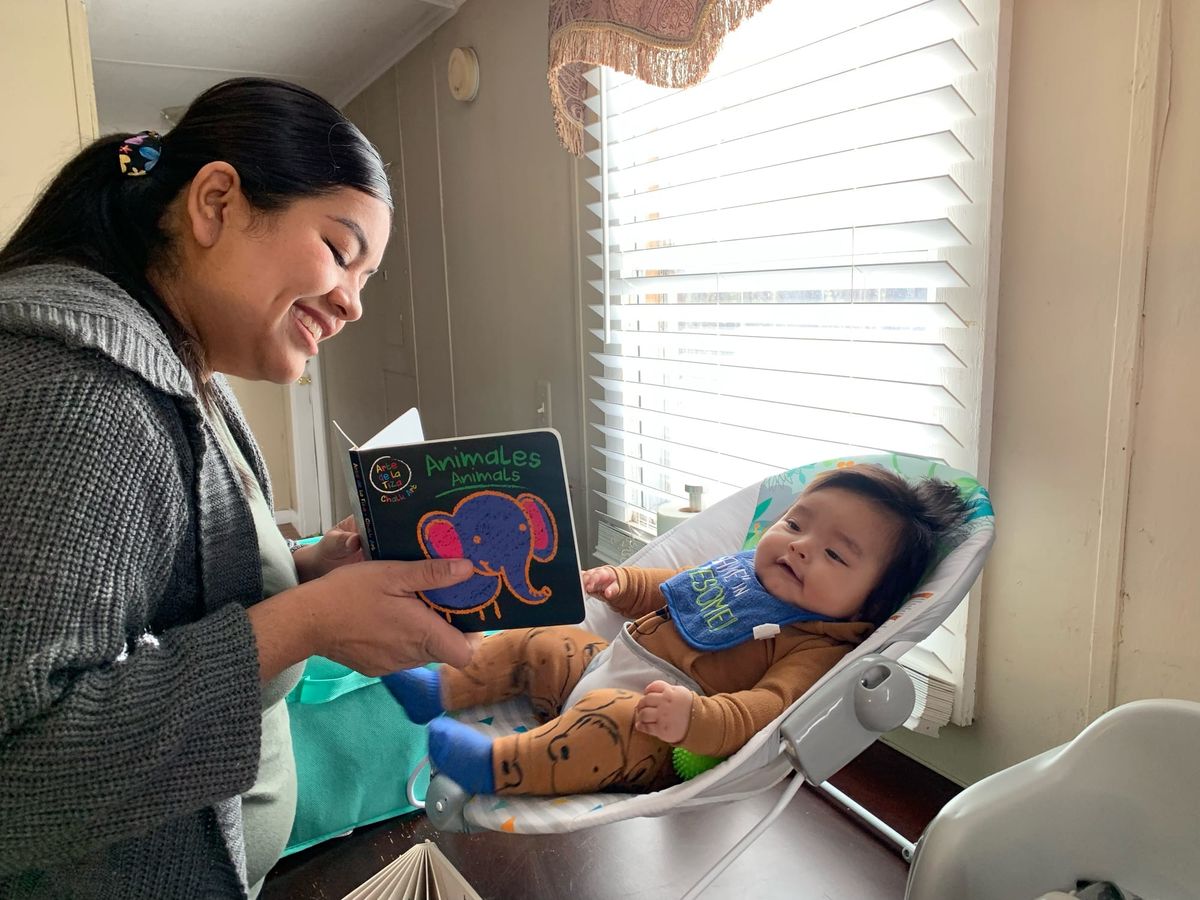
All of our mentors share with parents, early and often, the foundational principle that reading and talking with your child regularly, starting at birth, helps build the essential connections in the brain that support learning. They encourage parents to make book sharing a regular part of their family’s routine and emphasize the importance of interaction and conversation around books.
For young children, reading is a shared experience with a trusted caregiver, and those positive experiences help build both early literacy skills and the bond between parent and child. We want families to experience reading not as a task, but as something they can enjoy and do together. Sometimes parents think the reading experience should look like what happens in school—the parent reads through an entire book while the child listens quietly without interruption until they reach the end. But young children learn best through interaction and play.
Our Early Literacy Mentors model how to turn book reading into book play, which involves asking questions, taking turns, thinking about the story, allowing children to participate, and much more. Once that foundation is established, Early Literacy Mentors can dive deeper into best practices and individualize what they share based on each family’s needs and the child’s developmental stage.
Access to physical books is a cornerstone of building a home library. How does FRP select books for diverse families in our community, and how do you ensure bilingual resources reach non-English speaking households?
All of the books we provide to our program participants are brand new and carefully selected to ensure quality, age-appropriateness, and educational value. While we receive donated books that we use at outreach events or provide for older siblings in participating families’ homes, we do not give a family a book without first vetting it. We are intentional about choosing books that reflect the communities and families we serve, so children can see themselves, their families, and their experiences represented in both the illustrations and the stories. Representation is important, but we also want every book to be a tool for learning and connection. We look for books that create opportunities for rich, engaging conversations between parents and children.
Because we encourage parents to ask questions, talk about the story, explore the illustrations, and make connections to their child’s experiences, the books need to support that kind of interaction. We also select books that introduce and reinforce important early learning concepts, such as counting, colors, letters, and even early STEM concepts. For us, giving a child a book is about much more than putting a book in their hands. We want to give families books that invite them to read, talk, explore, and learn together and that make shared reading a meaningful part of their everyday lives.
For parents who feel intimidated or overwhelmed by early reading, what is one simple piece of advice you share to help make reading a joyful part of daily family life?
Find a time in your day when you have the opportunity to read with your child and just start. For most families, reading before bed is the easiest, but really, anytime can be reading time. Even if you only read for five minutes at a time, it can help build the habit of reading together. And you don’t even have to read the words, you can open the book to any page and simply describe what you see and talk about the pictures with your child. Once the habit is in place you will find it gets easier.
What strategy are you using to recruit new Early Literacy Mentors across Carrboro and Chapel Hill, and what background or mindset makes a great volunteer mentor?
New volunteers find out about us in a variety of ways, including through word of mouth, friends and neighbors, and community events. Most Early Literacy Mentors have some background in education, literacy, or working with children, and while that experience is helpful, it is not a requirement. All of our mentors believe in the power of early literacy and books, and having a desire to share that message with families is a great place to start.
One misconception about our program is that we work directly with and teach children. Children are certainly impacted by our work, and we have the joy of connecting with young children and seeing them get excited about books and reading, but at its core, our program is parent education. Mentors need to be comfortable talking with, reading with, and supporting parents and helping them build the confidence and skills to make reading and book sharing a part of their everyday lives.
Home visiting requires time, transport, and comfort in diverse environments. How do you make volunteering accessible for working adults, university students, or older adults in our community?
Family Reading Partners offers a very unique volunteer experience for people who want to become Early Literacy Mentors. We are looking for mentors who can build a relationship with a family and support them over the course of a child’s early years. We have mentors who have volunteered with us from the very beginning and have had the joy of watching children grow from infancy through their transition to kindergarten. Because of that, being an Early Literacy Mentor is not a good fit for someone looking for a short-term or occasional volunteer opportunity.
At the same time, we offer a great deal of flexibility. Mentors schedule their visits around their own schedules, and we do not require weekly hours or ongoing time commitments. This allows our mentors to travel, spend time with family out of state, volunteer with other organizations, or work full-time while still making a meaningful commitment to a family. We also offer other opportunities for people who want to connect with Family Reading Partners and support our work but may not be a good fit for the Early Literacy Mentor role. Anyone interested in volunteering or learning more can fill out the interest form on our website, and I will connect with them to see how they might best get involved.
Related stories: Nancy Zeman told us why reading to babies is important and we relayed how Dolly Parton's Imagination Library is connected to this Carrboro-based organization.