
Community Emergency Response Team Training
Help your neighborhood prepare for emergencies
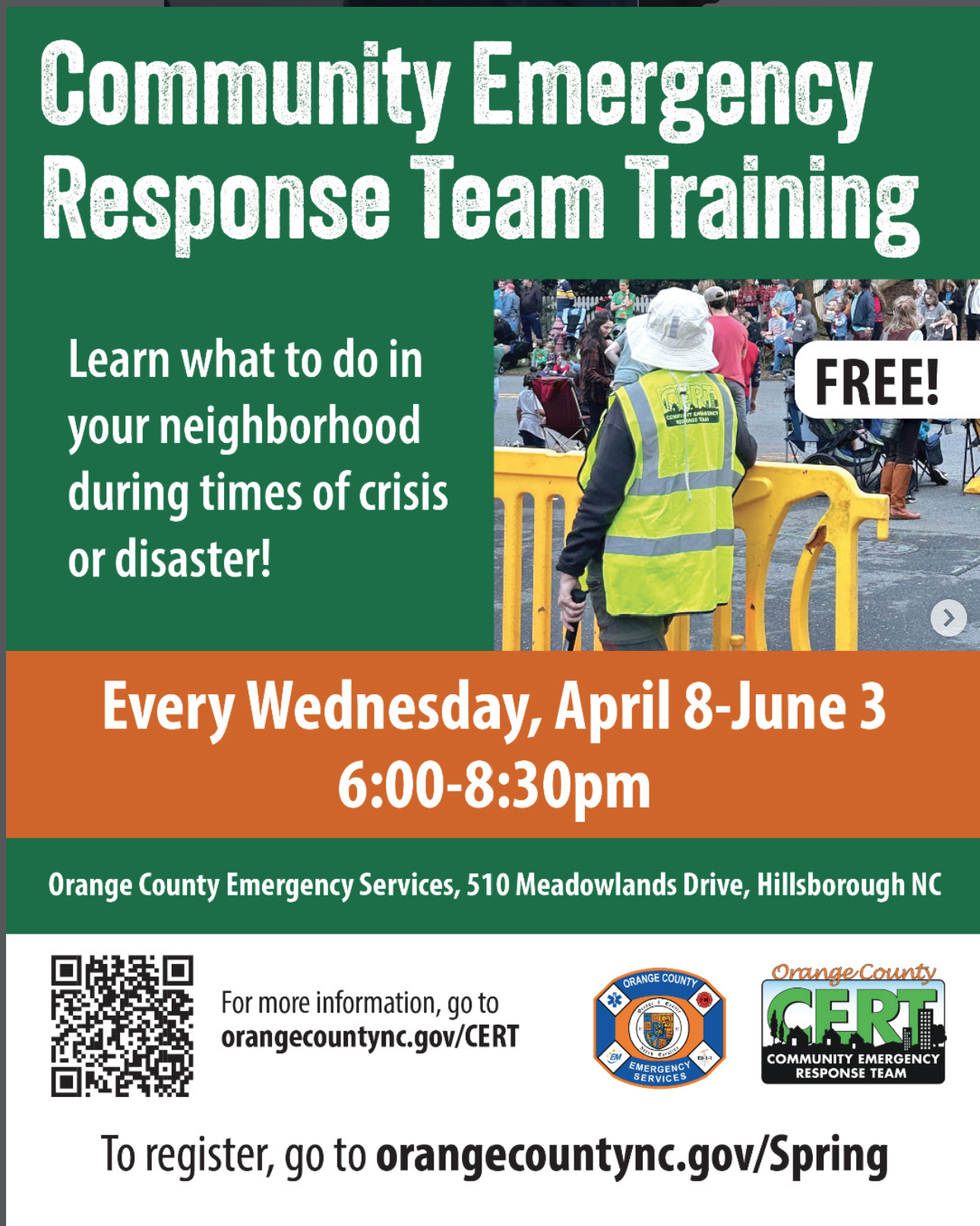
Orange County Emergency Services will host another Community Emergency Response Team Training beginning in April. Ian Fowler, CERT Program Coordinator and Assistant Chief of Emergency Management for Orange County, explained that the purpose of these trainings is to “strengthen community resilience by improving individuals’ baseline level of preparedness.”
He continued, “The demand for emergency services could exceed available resources during a major disaster and CERT equips residents with basic skills needed to safely support themselves, their families, and their neighbors until first responders arrive. It also aligns with the County's strategic goals of healthy community, and public education/learning community.”
While CERT training is coordinated at the County level, it’s delivered in partnership with local agencies. Last fall, Orange County Emergency Services and the Carrboro Fire Department co-instructed a CERT training in Carrboro. Fowler said, “This type of collaboration is ideal, as it is a great way to making training more accessible and locally relevant.”
The Town of Carrboro supports these trainings, recognizing that the program builds teams in neighborhoods, improving safety and operational efficiency using the unique skills of each team member. Will Potter, Carrboro’s Fire Chief and Emergency Manager, said, “Each of us serves as the emergency manager for our own household. While we cannot predict when the next disaster will occur, we can be certain that one will, and preparedness starts at home.”
Greg Jansen lives in the Pacifica cohousing neighborhood and currently serves as the Homeowners’ Association President. He and two neighbors attended a CERT training in September, 2025. “We have a lot of people concerned about general crises in society today,” he noted. “The flooding of [Tropical Storm] Chantal and other recent weather events made us think about planning for this kind of thing—having mutual aid and shared resources and procedures for dealing with [emergencies].”
Pacifica had formed a Safety and Emergency Preparedness Committee to serve its 47 households before the CERT training. The Committee updated the neighborhood’s first aid kit and started thinking more about preparedness. “Things like how to have water, if the water gets turned off. How to flush toilets. How to deal without having power or communications. We wanted to be able to deal with all those situations and have a way to approach them. We made some progress and that led to three of us wanting to take this training because it’s the intersection of civic and neighborhood-level preparedness,” Jansen said.
Potter noted, “Through CERT training, participants gain practical skills in disaster preparedness, basic medical care, fire safety, and incident management systems.” And Fowler added, “For individuals, CERT provides practical, hands-on training in areas such as disaster preparedness, fire safety, basic medical operations, and light search and rescue. Participants have the opportunity to gain confidence and the ability to make informed decisions during emergencies.”
Jansen commented on the skills attendees acquired: problem solving, first aid, injury prevention and rescue. “It's all very exciting--the hands-on skills. But there's also the command and communication [aspects]. What you’ll get from the training is starting to understand emergency management. When police and fire services are overwhelmed, you're stepping into this interim role. And then imagining what it would look like in your community if services are not there.”
The Pacifica neighborhood subsequently organized a CPR training with South Orange Rescue Squad and are discussing purchasing an Automated External Defibrillator for the neighborhood. Fowler noted, “At the neighborhood level, CERT helps build connected, prepared communities. When multiple residents are trained, neighborhoods are better positioned to check on vulnerable populations, share reliable information, stabilize until first responders arrive, and recover after an incident. CERT is most effective when trained residents can work together. Building small, neighborhood-based teams, ideally six or more people, would allow for coordination, communication, and a more effective response during an emergency.”
Jansen recommends the training. “People should definitely do it. You get to meet your fire chief and your police chief. You meet first responders and you get an appreciation of their skills, and then you get to learn some of those skills. I think it's great in the way it builds civic responsibility. At the end of the day, there's nobody but us to respond to [emergencies]. Who is the first responder? It's you. You are the one seeing the emergency. You're the one if you're equipped to respond. Given the number of potential crises we could face, for me, it helps to have something to do. I feel it's a collective kind of spirit--it's that mutual aid and agency.”