
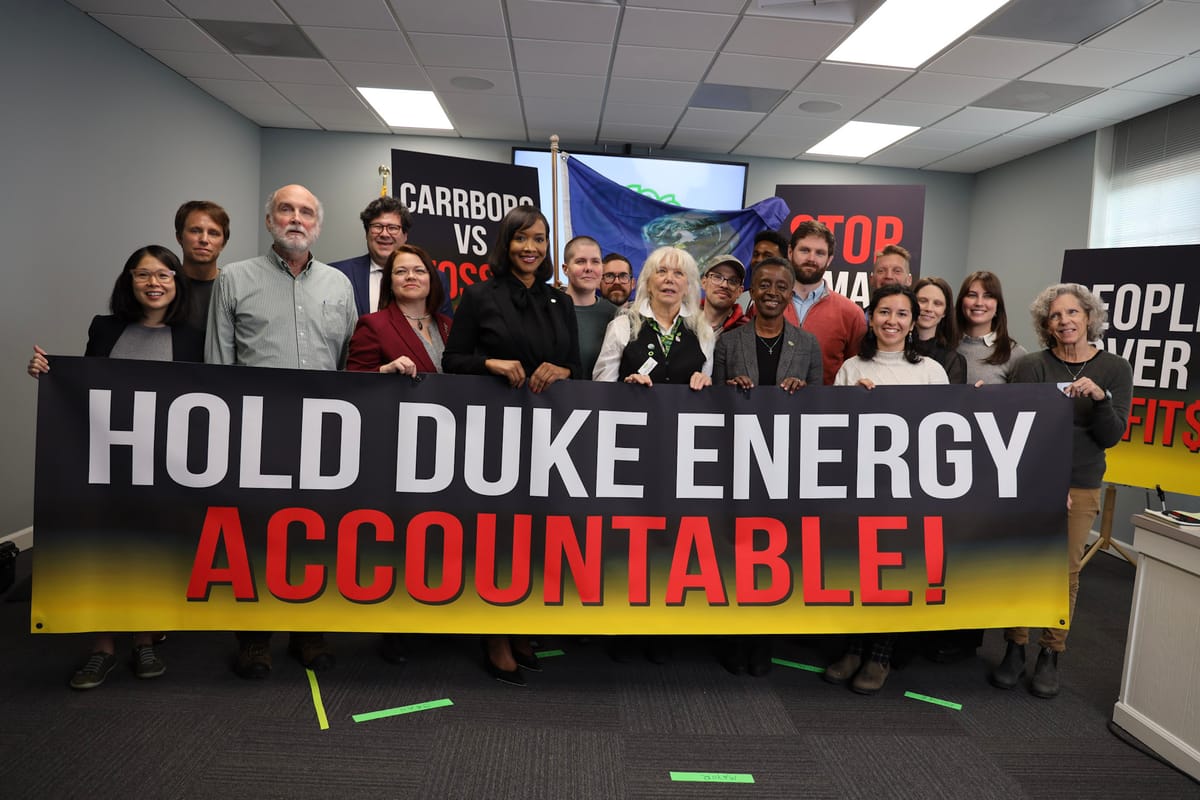
In December 2024, the Town of Carrboro filed a lawsuit in Orange County Superior Court against Duke Energy Corporation (“Duke”), alleging negligence and claiming that Duke had misled the public. The town sought compensation for damages the town “has incurred, and will incur in the future, as the proximate result of Duke’s knowing deception campaign concerning the causes and dangers posed by the climate crisis.” This made Carrboro the first town in the U.S. to challenge a monopoly electric utility for deceiving the public about damages from fossil fuels. After Duke filed multiple motions to dismiss in 2025, oral arguments were held in the North Carolina Business Court in September.
Duke Energy is the third-largest greenhouse gas emitter in the United States, according to the Political Economy Research Institute at the University of Massachusetts Amherst. Furthermore, the company is planning the nation’s largest expansion of gas-fired power generation, according to NC WARN, a 38-year-old nonprofit organization.
Duke Energy is a regulated monopoly and North Carolina’s General Assembly could force a change in its practices, according to state Senator Graig Meyer. However, political will is absent, with Duke Energy enjoying bi-partisan support. Senate Bill 261, which passed in 2025, relaxed previous regulations including eliminating an interim date for carbon reduction “by certain electric public utilities.” That bill was introduced by Senator Paul Newton who was previously an executive at Duke Energy.
The urgency to change Duke Energy’s practices is underscored by accelerating climate impacts in North Carolina. Flooding and extreme weather are recurring and costly, and many scientists warn that such events are increasing in frequency and intensity. As local governments are increasingly left to absorb those costs, scrutiny of utility practices and the regulatory systems that shape them is critical.
What are the core legal claims of this case?
The core legal claims Carrboro made against Duke Energy include negligence and gross negligence, public and private nuisance, and claims tied to alleged misrepresentation of climate-related risks. Carrboro’s complaint explains how the town links Duke’s alleged decades-long campaigns of climate denial and greenwashing to tangible harms in Carrboro, such as infrastructure cost and ongoing climate adaptation expenses.
Sue Sturgis, of the Energy and Policy Institute, found that Duke Energy knew about the effects of fossil fuels on the climate as early as the late 1960s, with evidence presented by industry scientists. Her research found that Duke Energy has participated in campaigns and communications strategies used to downplay the risks of fossil fuels.
What was the judge’s decision?
Duke Energy filed two motions to dismiss the case — one arguing that the Town of Carrboro lacked legal standing and another contending that the lawsuit raised climate policy questions outside the proper role of the courts.
Superior Court Judge Mark Davis rejected the standing argument, finding that Carrboro had the legal authority to bring claims for alleged harm to its property. However, he agreed with Duke’s second argument and ruled the lawsuit is barred by the political question doctrine, a constitutional principle that prevents courts from deciding issues committed to the legislative or executive branches of government.
Carrboro’s claims, Davis wrote, are “clearly nonjusticiable pursuant to the political question doctrine.” He continued, “As an initial matter, it is clear that North Carolina’s energy policy is textually committed to branches of government other than the judiciary.”
In essence, Davis ruled that climate and energy policy decisions are matters for elected officials and regulators, not the judiciary, and therefore cannot be resolved through this lawsuit.
Davis also acknowledged the complexity of attributing Carrboro’s alleged harms to a single utility operating within a global emissions system. Although he did not rule directly on causation because the case was dismissed on political question grounds, the opinion noted the significant challenges involved in isolating Duke Energy’s contribution to specific local climate-related impacts.
What happens next?
NC Warn said that the legal team, which they fund, will meet with the Town to discuss next steps which include the possibility of an appeal to the North Carolina Supreme Court. Mayor Barbara Foushee said, “While we are disappointed and disagree with the result, Carrboro is evaluating all of its options, including appeal.” Some observers have speculated how an appeal could play out in a state with a conservative Supreme Court and what the consequences of a negative ruling at that level could mean for future municipal actions against corporations with practices that allegedly impact the climate.
Jim Warren, Executive Director of NC Warn, reiterated the underlying motivation for this effort: “It's so important for people to realize that we, in this state, and humanity as a whole, don't have years and years longer to start making changes. The situation is desperate but not yet hopeless,” he said, while acknowledging that for some people and species already harmed by climate change, the damage cannot be undone.
Warren said that hope lies in solutions that already exist, including a transition from fossil fuels to renewable energy such as solar with battery storage, which he argues is cheaper and more equitable. He said government leadership is needed to accelerate that shift and that Gov. Josh Stein should take a leading role in countering Duke Energy in North Carolina. In April 2025, more than 60 scientists wrote to Stein urging him to halt Duke Energy’s “fossil-fuel buildout and suppression of renewable energy solutions” to avoid “the worst damages of the climate emergency and to save lives,” according to NC WARN's press release.
In related news, The U.S. Department of Energy recently selected Duke Energy for a “Beautiful Clean Coal” grant of up to $34 million for its two-unit coal-burning plant in Stokes County, North Carolina.
For more information
From the Town of Carrboro, see here.
The True Cost of Power, a film created by D.L. Anderson of Vittles Films and NC Warn, uses investigative journalism to explain a complicated story about Duke Energy’s practices around “greenwashing” (pronouncing themselves a leader in green energy while pursuing fossil fuel expansion) which allegedly deceived residents about their energy choices and consequences of those choices. That 18-minute film was screened at The Carrboro Film Festival and can be viewed on stopdukeenergy.com.