Carrboro Residents Push Back on Plan to Merge Police with Chapel Hill
by Emily Brewer
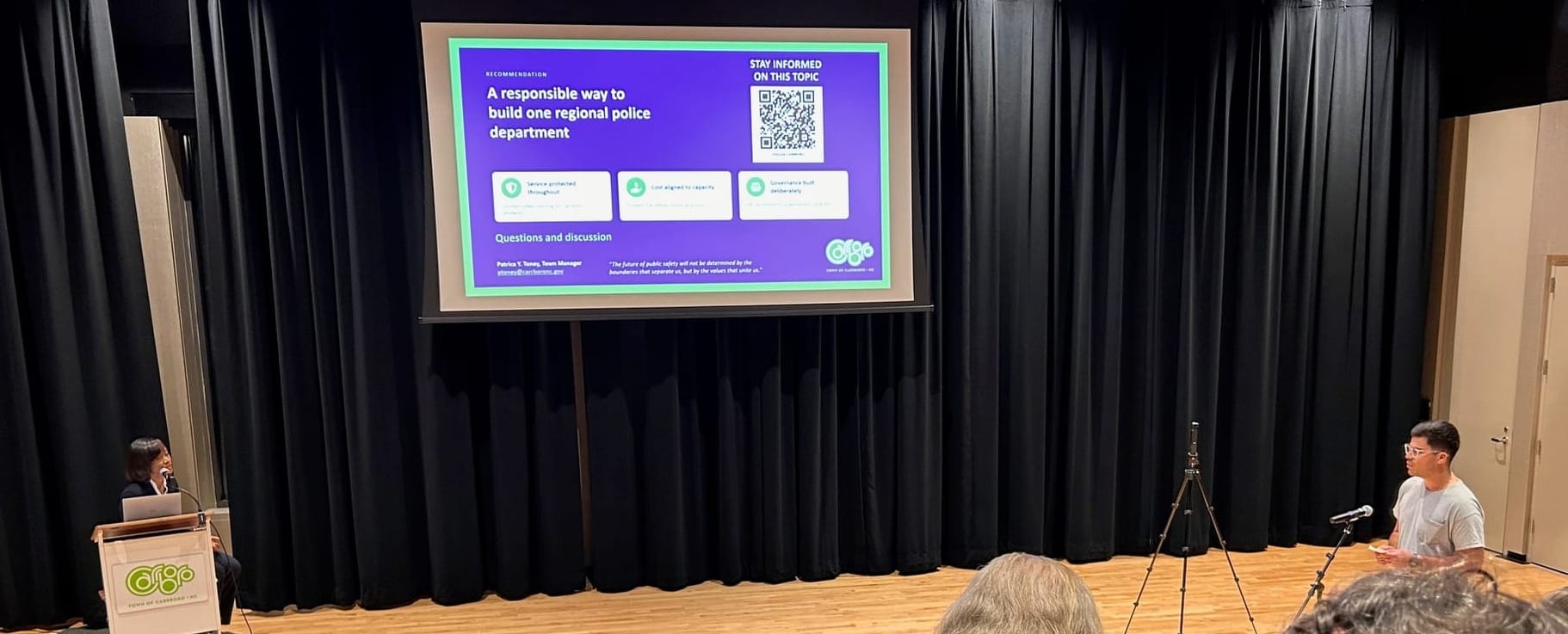
CARRBORO, N.C., Oct. 29, 2026 — Carrboro residents filled the Performance Room at the Drakeford Library Complex on Thursday evening to hear Town Manager Patrice Toney's plan to consolidate the Carrboro Police with the Chapel Hill Police Department. Many of the Carrboro residents who spoke said the proposal was moving too fast, had been kept from the public, and did not fit the town's character.
The forum was announced three days in advance and the room was full to capacity, with several people waiting outside for the chance to enter when someone exited. Toney opened by asking the audience to “please be open” and to “have courage to think differently about a new path forward and what this could look like for our Carrboro community.” She said residents can also leave questions and comments on the town’s Engage Carrboro website.
The Proposal
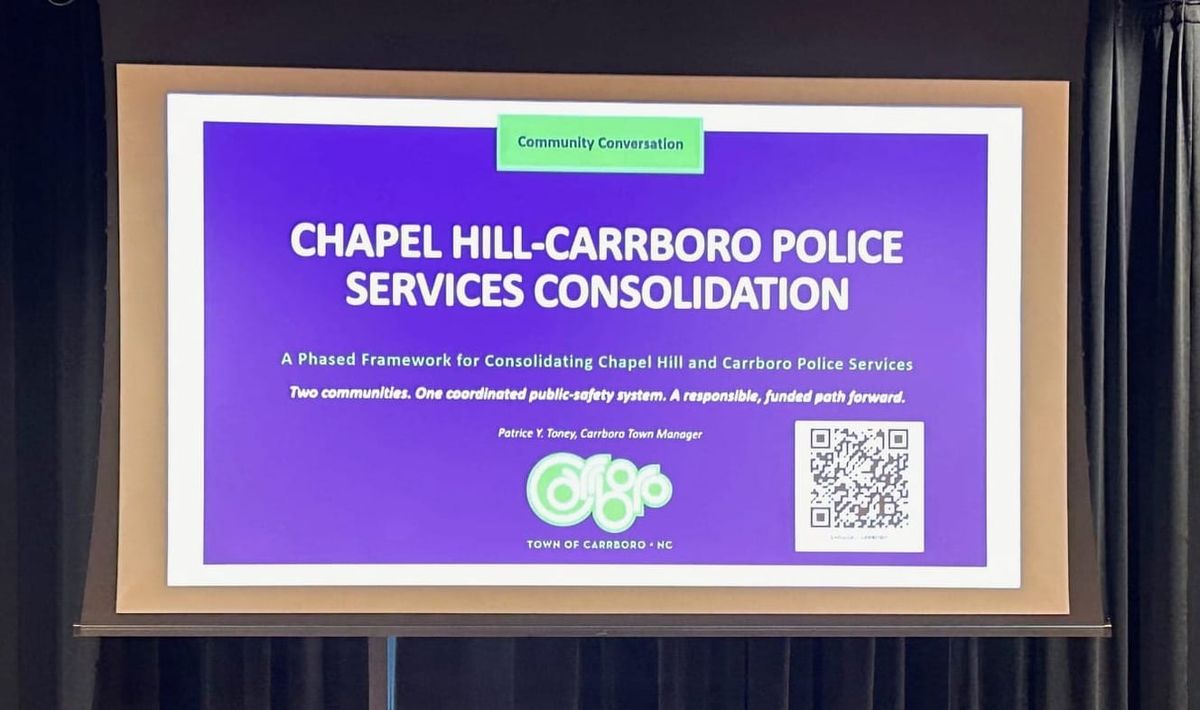
Toney's presentation, titled "Chapel Hill-Carrboro Police Services Consolidation: A Phased Framework," called for "two communities, one coordinated public-safety system."
She said two things made the timing urgent: Carrboro's police chief retired October 1, and the town's budget is under growing strain. Public safety makes up 27 percent of the town budget, and Toney said costs such as fuel keep rising while revenue has not kept up.
Under the proposed timeline, the first group of Carrboro officers would begin working in a shared space with Chapel Hill as early as December. She is scheduled to present the plan to the Carrboro Town Council on November 10. A permanent arrangement through a local act would take 18 to 24 months.
Toney described the plan as "a phased model, not an all-at-once merger." Carrboro staff would first move into Chapel Hill's police building, which she said has better facilities and more capacity. Officers would then move over in cohorts of five, each lasting four months, with no more than 10 officers moving in a single fiscal year. Every Carrboro officer would have to meet Chapel Hill's hiring and training standards, and officers would get a raise after completing that training. Carrboro would pay for each step as it happens instead of taking on the full cost at once.
"There's no plan for layoffs," Toney said. She added that the town would have a dedicated Carrboro assistant police chief to "preserve community identity."
She said residents would also get access to services Chapel Hill offers and Carrboro does not, including civilian crash investigators, CARE teams for calls better handled by a community-based response, a 24/7 crisis co-responder program that pairs behavioral health staff with officers, and a virtual reporting unit. She pointed to Chapel Hill Transit as an existing example of the two towns working together through a shared public service. She also noted that the towns already share a single 911 system run by Orange County and have mutual-aid agreements in place.
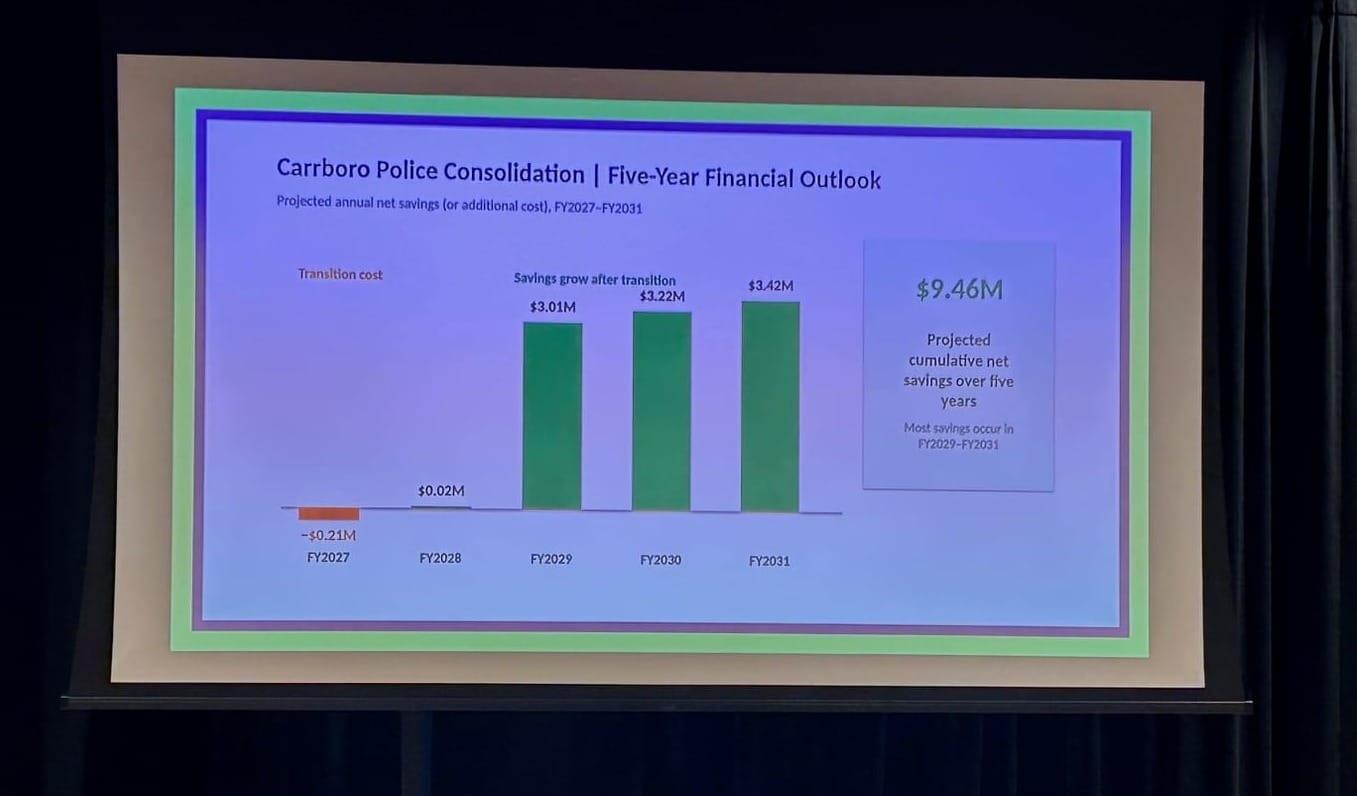
The Town projects the plan would cost about $210,000 in the 2027 fiscal year because of higher salaries. It would roughly break even in 2028, at about $20,000 in savings. Savings would then reach $3.01 million in 2029, $3.22 million in 2030 and $3.42 million in 2031. Toney said Carrboro's police budget is about $5.5 million a year, and the plan would save about $3 million a year once fully in place. Real savings would not begin until the third year.
"Too rushed for this town"
Amanda Ashley, a longtime Carrboro resident, was the first to speak. "All this process is being rushed, way too quickly," Ashley said. "I just found out about this idea last week, and now you're having proposals to make decisions by the end of this year. That's too rushed for this town."
Ashley, who identifies as an organizer with the Occupy movement, recalled that when protesters took over an abandoned car dealership on Franklin St., Chapel Hill police sent a SWAT team. When protesters occupied an abandoned building in Carrboro, however, the Town's police "offered us ice cream and pizza."
"Carrboro's spirit I do not see reflected in this," Ashley said. "I hope we can put this to bed."
In response, Toney said policing has changed over time. She said Chapel Hill's police chief, who could not attend, is committed to community policing.
Questions About How The Plan Came Out
Several speakers asked why residents were only now hearing about an idea that Toney had been developing since March.
Matthew Patrick Clements, who is running for House District 56, apologized "to the police officers in Carrboro who are learning about this in this manner." He told Toney to "have some respect for the community" and added, "I look forward to being around for your last day."
"I'm planning on sticking around," Toney replied. She said information about the plan "got out behind me" and that there was "no intention" for it to happen that way. "I, myself, apologized to the Police for the way this was rolled out," she said. "They should not have heard about this on social media or whispers of some sort."
Another resident came to the mic to ask what would happen if the merger did not work. Toney said the alternative would be to hire a new police chief, which she said would mean raising property taxes.
Mayor Barbara Foushee briefly addressed the audience: "October 6 was the first time that we as a Council saw what the Town Manager has been thinking about," she said. When resident David Beck asked whether the Council had directed Toney to develop the plan, the mayor said, "She wasn't directed by me."
Beck, who has lived in Carrboro since 1995, said he was shocked the idea was so far along. "Where's the democracy in this?" he asked. "Without a revolt, it's going through. This is the revolt."
Toney said that part of her job is to look for efficiencies. "We're sorry that it got out this way," she said. "We're here now and we want to get your feedback." Later she added, "We can't put the toothpaste back in the toothpaste bottle," and said she knows the Town needs to rebuild trust.
Doubts About Savings
Diane Robertson, who has lived in Carrboro for 32 years and said she is not afraid of change, called the timing of the forum, so close to a vote, "disrespectful." She said the meeting at the Drakeford Building "feels like a check-the-box exercise." She agreed the Town's money problems are real but said the plan "isn't passing the smell test."
Jackie Allen said police are the wrong place to cut. She listed police, fire and rescue, and solid waste as the town's most important services. She asked whether Carrboro officers have a financial reason to support the merger since they would be paid more. She said Carrboro should raise its own officers' pay to keep them from leaving after the town trains them. Allen also asked how the plan would affect responses to mental health crises and domestic violence calls.
Another resident, who said they had lived in Carrboro for 33 years, said Chapel Hill's police station is about 15 minutes away, which would mean paying officers for a half-hour round trip, plus fuel, every time they come to Carrboro. "Carrboro Police serve me," the resident said. "The value of having police cars downtown and a police presence can't be underestimated." When the resident asked how long Toney had lived in Carrboro, she said two-and-a-half years.
Asked whether there were other options besides a merger or a tax increase, Toney said the town has already frozen and eliminated positions without raising taxes. "Our entire work force is underpaid," she said. "We added a livable wage this year, and it's still not livable." She asked residents to look at the budget and take part in the process. "If we increase pay, where is the revenue coming from?"
"A Purge, Not A Merge"
Randee Haven-O'Donnell, who served 21 years on Carrboro's Town Council, gave some of the sharpest criticism of the night. "This is very hard for me," she said. "This is a purge, not a merge."
She said mergers have come up for discussion since the 1980s and have always been "a non-starter." She said the Carrboro Police Department regularly gets high marks in the town's community surveys, and that no Carrboro officers have left for Chapel Hill even though they could earn more there. She said the department has built "a Carrboro hometown brand of public safety" over three decades. "They know our schools, businesses, neighborhoods, lives," she said.
Haven-O'Donnell made four requests: drop the plan; put any municipal merger to voters in a 2027 referendum; hire a neutral consultant to review the town's budget; and create a community safety advisory board.
The owner of Krave, the alcohol-free bar on West Main Street, Elizabeth Gardner said she relies on police so her staff are safe when they close at night and her customers are protected from heckling. "Has there been any consideration about what the removal of the police will do to local businesses?" she asked.
Another speaker asked whether other towns have merged police departments. Toney named Charlotte-Mecklenburg but acknowledged that joining administrations between towns of this size "would be unique." Chapel Hill is about three times Carrboro's size.
Asked what the plan would mean for Carrboro's services, Toney said the town's costs usually rise about $3 million a year. She said the merger savings would let Carrboro keep its current level of services without having to raise more revenue.
Despite the vociferous opposition to the proposal by many Carrboro residents who came up to the mic to ask questions and give feedback, and occasional grumbling from the audience at large, Toney maintained her composure and defended the proposal while reiterating that it is "not a done deal."
As of right now, the Town Council is expected to take up the proposal in November. If this meeting was any indication, this issue has raised a firestorm of controversy and will be attracting a lot more scrutiny.