
A conversation with Sheriff Charles Blackwood, who is running for re-election in Orange County
John Rees of The Triangle Blog Blog joined us to talk about the role of Sheriff, working with communities, working with ICE, and more.
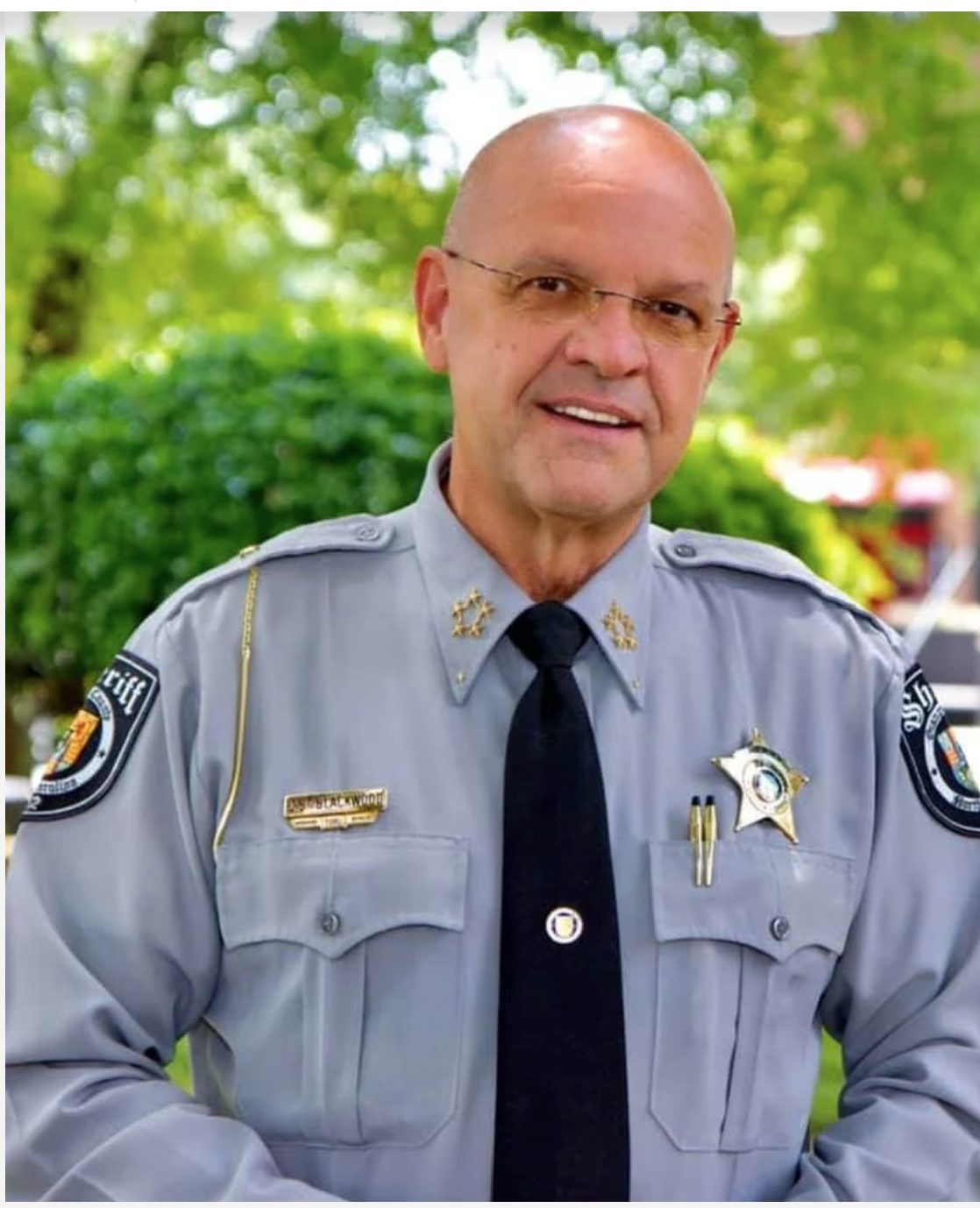
This summarized narrative was generated by AI from the transcript of the interview that aired on The Carrborean Radio Hour on WCOM 103.5 (wcomfm.org) February 18.
How long have you been Sheriff and what’s your background?
Sheriff Charles Blackwood has been Sheriff of Orange County for 11 years and has worked with the Sheriff’s Office for about 45 years. He started in 1980, taking his first shift on December 16 of that year. He grew up on a fifth‑generation family farm just south of Chapel Hill, in an area known as Flint Rock Knoll Farms. His first paying job was at Andrews-Riggsbee Hardware, on the grounds where the Drakeford Building (that now houses the radio station) stands. That experience gave him hands‑on problem‑solving skills that he still relies on, and he jokes that his wife never has to “call the guy,” because he’s the one who can fix things.
How does the Orange County Sheriff’s Office operate in Carrboro and how is jurisdiction shared with the Carrboro Police Department?
Blackwood explained that the Orange County Sheriff’s Office has full jurisdiction across the entire county—both incorporated and unincorporated areas—but in practice they try not to duplicate services where municipalities have their own police departments, such as Carrboro, Chapel Hill, Hillsborough, and others. Municipal police do not have authority to serve civil process; that responsibility rests solely with the sheriff, with papers issued by the courts. He emphasizes that his agency works very closely with local departments and that they routinely back each other up, for example when Carrboro officers were all tied up on a hit‑and‑run, vehicle pursuit, and DWI, sheriff’s deputies came into town to handle calls at the department. He also stresses the distinction between a “Sheriff’s Office” and a county department, noting that the sheriff is an elected constitutional officer, accountable directly to the people, even though the office cooperates with county government.
Does the Sheriff’s Office cooperate with ICE and how do you protect residents from ICE operations?
Blackwood describes cooperation with federal agencies as nuanced. He notes that Homeland Security encompasses many components, including airport security, Secret Service, and Immigration and Customs Enforcement (ICE). When ICE or other federal partners present valid judicial warrants and clear information, his office can and does work with them. He gives an example where ICE sought to apprehend an individual living in a predominantly Hispanic mobile home park in Carrboro; rather than allowing an operation that could disrupt the entire community, the sheriff’s office helped arrange a traffic stop on Highway 54 so ICE could make the arrest with minimal disruption. At the same time, he emphasizes that his primary commitment is to the people of Orange County, not to carrying out the federal government’s broader immigration agenda, and he draws a line at actions he regards as unconstitutional such as detainers.
Blackwood is clear that he does not voluntarily honor ICE detainers because he believes they are unconstitutional. A detainer, he explains, is not a warrant signed by a judge; it is a document completed by an ICE agent asking the sheriff to hold someone beyond the point when they would otherwise be released. From his perspective, doing so amounts to turning a federal administrative request into a state‑level hold without due process. He notes that legislators in Raleigh have pushed measures such as House Bill 10 and House Bill 318 that frame honoring detainers as “cooperating with ICE,” but he argues that sheriffs already cooperate extensively with federal partners through task forces and joint operations without performing unconstitutional holds. He mentions that there has been discussion of seeking a declaratory judgment from the courts to clarify how to resolve conflicts between such state mandates and constitutional protections.
How can the public learn what your office is doing, especially around ICE operations?
Blackwood emphasizes accessibility and transparency as core principles. He writes a monthly column called “The Lowdown” in The News of Orange, where he tries to explain current concerns about law enforcement and “pull back the curtain” on how the Sheriff’s Office operates. In the lobby of his office, there are signs stating that if someone has been waiting more than 15 minutes, they should call a posted cell phone number—his own. He carries that phone himself and says he answers calls and texts, preferring a quick text asking if it’s a good time to talk so he can schedule a response if he is in the middle of something. He stresses that he views the office as belonging to the public and describes himself as a problem solver whose job is to listen to community concerns and respond.
Why do we elect sheriffs when police chiefs are appointed?
In response to this question, Blackwood traces the office of sheriff back to its historical and even biblical roots. The term comes from “shire reeve,” a figure responsible for protecting the people of a shire. The basic idea, he says, is that members of a community should select the person who will protect them and have a say in how they are protected. In North Carolina, with 100 counties and 100 sheriffs, it is normal for different sheriffs to operate differently because they are responding to their own communities’ expectations. He argues that electing sheriffs ensures they are directly accountable to the public, rather than only to a city manager or council, and he frames his own record as one of long service, local roots, and repeated selection by Orange County voters.
How do you frame your reelection and your experience compared with your opponent?
Blackwood notes that he has been elected three times, once unopposed, and is now seeking a fourth term. He argues that in complex and sensitive roles—whether it’s a surgeon operating on a heart or a contractor building a house—people typically want someone who has extensive experience rather than a newcomer who has never “been in the operating room.” He presents his institutional knowledge of Orange County and its communities as a significant asset, and he suggests that replacing an experienced local sheriff with someone who has not lived in the county raises serious concerns about continuity, community understanding, and public safety.
How do you decide when to adopt new surveillance technologies like drones or license plate readers, given privacy concerns?
Blackwood says that the COVID-19 pandemic forced many organizations, including law enforcement, to embrace new technologies that enabled them to continue operating effectively. He acknowledges that tools such as license plate readers and other camera systems can be powerful aids in public safety—for example, quickly locating a vehicle in a child abduction case—but that they also raise important questions about data retention, ownership, and civil liberties. His approach is to start from community expectations: he believes the Sheriff’s Office must protect people in the way they want to be protected, which means having frank conversations about what they are willing to “give” in terms of surveillance in order to gain safety. He points to Flock cameras as an example and references Hillsborough’s experience, where town leaders initially approved the cameras, then backed away after public concerns emerged. In his view, it is essential to define clear “guardrails” up front—how long data are kept, who can use it, and for what purposes—to reassure the public before implementing such technology.
Do you support expanding co‑responder models that pair social workers with deputies for mental health calls?
Blackwood is strongly supportive of co‑responder approaches and says he has been interested in them for nearly a decade. Around nine years ago, his office studied a model from Washington State in which clinical social workers rode with patrol officers. They even sent two deputies for specialized training and equipped them for that role, but were unable to recruit clinical social workers willing to ride in patrol cars for the pay the office could offer, especially given the chaotic, non‑clinical conditions of many calls. He is very encouraged by Chapel Hill’s current “care team” model, in which specialized teams handle certain behavioral health calls, and he expects to participate in a countywide expansion through a consortium including the Criminal Justice Resource Department and local police agencies. He envisions scenarios where law enforcement responds first to stabilize a scene, then steps back to let social workers engage, while remaining nearby if things escalate.
Will such mental health and care‑team approaches work equally well in urban and rural parts of the county?
Blackwood says he has been informally evaluating calls as they come over the radio, asking himself which ones could be handled by a care team instead of law enforcement. He observes that in denser urban areas like Franklin Street and Weaver Street, more calls involve circumstances that could be safely addressed by care teams, while in rural parts of the county there tend to be more situations involving weapons, family violence, or immediate threats where a rapid law‑enforcement response is necessary. He still believes that having care teams available will change officer behavior over time—if the resource exists, officers will increasingly request them on appropriate calls. For him, the key is building a system where non‑police responders can take the lead when it is safe and effective, while law enforcement handles higher‑risk situations.
What training do deputies receive to distinguish mental health crises from criminal behavior?
Blackwood highlights Crisis Intervention Training (CIT) as the cornerstone of their approach. He recounts that CIT emerged after a case in which an individual on the autism spectrum was shot by police, and a judge who was the person’s parent demanded reforms that would help officers recognize and respond appropriately to developmental and mental health conditions. CIT exposes officers to a range of such conditions and teaches de‑escalation strategies. In Orange County, nearly all personnel, including some administrative staff, have gone through CIT, and there is additional “first aid” mental health training tailored to detention officers working in the jail. Drawing on his service on the state’s mandatory in‑service training committee, he explains that there was debate about whether to introduce CIT in basic law enforcement training for brand‑new recruits, but ultimately it was included because of its importance, even if some of the content makes more sense after officers gain field experience. He supports ongoing refresher courses and is pressing his colleagues to keep mental health training at the forefront of statewide standards.
How do you work with the District Attorney to increase pre‑arrest diversion and avoid using jail as a mental health facility or a debtor’s prison?
Blackwood says that diversion has been a focus for many years and describes several layers of effort. For juveniles, there is a diversion court model in which youth and their parents go through what feels like a real court experience, only to have the judge step out of character at the end and explain that, while the proceeding was staged, their situation is serious and they are being offered a diversion path instead of a criminal record. For adults, the OC‑PAD (Orange County Pre‑Arrest Diversion) program was developed collaboratively with the Criminal Justice Resource Department and the District Attorney’s office to redirect certain lower‑level offenses out of the traditional system. His view is that both young people and adults can exercise poor judgment without deserving lifelong consequences, and that it often makes more sense to avoid creating a record in the first place than to prosecute someone and later expunge it at significant cost. He praises the Criminal Justice Resource Department as one of his strongest partners and supports thoughtful expansion of diversion within agreed‑upon criteria.
Are there independent audits of jail conditions and are the results accessible to the public?
Blackwood outlines a series of formal and informal oversight mechanisms. The North Carolina Department of Health and Human Services conducts regular jail inspections, often twice a year, and those reports are provided to the District Attorney and County Commissioners. Every time a grand jury is empaneled, its members tour the jail, meaning there are generally two such visits a year as well. In addition, fire inspectors and health inspectors review the facility. All these reports are public records that residents can request. He describes how, when a county commissioner recently relayed a rumor about raw sewage leaking in the jail, he immediately called his staff and learned that the concern stemmed from odors coming from floor drains in an area under maintenance, not from sewage itself; the fix was to plug the drains so gases could not escape. He encourages family members of those in custody and other community members to contact him directly with concerns and characterizes the jail as a microcosm of the broader community where problems can arise but must be addressed promptly.
What is your policy on "duty to intervene" when an officer uses excessive force and how do you enforce it?
Blackwood cites Senate Bill 300, a bipartisan reform bill, as a major driver behind explicit duty‑to‑intervene requirements in North Carolina. In his office, he says, the concept is not just on paper but constantly reinforced. At every daily briefing, training session, and operational planning meeting, the first thing on the screen is a reminder about duty to intervene and use of force, followed by a detailed discussion led by whoever is in charge. Deputies are reminded that they must step in if they see excessive or inappropriate force, regardless of whether it is being used by a colleague, another local agency, the State Highway Patrol, ICE, or any other law enforcement partner. For him, duty to intervene also includes preventing situations from escalating—for example, at the jail, supervisors may have their own staff take custody of a highly agitated arrestee from another agency so that the original officers can step back and the situation can be calmed. Violations can lead to reprimand and other discipline. He frames these policies as part of a broader effort to ensure that incidents like the Rodney King beating do not happen in Orange County.
What are your favorite things to do in Carrboro, and how are you personally connected to the community?
Blackwood answers this question by weaving together personal history and local culture. He recalls enjoying places like the former Hickory Tavern as family‑friendly gathering spots and continues to enjoy local restaurants for burritos, burgers, and wings in and around Carrboro. His wife has longstanding ties to the Chapel Hill–Carrboro restaurant and bar community: her mother is Linda of Linda’s Bar, and her father, Raymond Williams, ran RW’s and the Silver Bucket Oyster Bar, with his wife managing two of those establishments. Blackwood himself once worked as a bartender at Linda’s and as a DJ at Elliott’s Nest and Purdy’s. He says one of the things he values most is the area’s rich history combined with its willingness to evolve. Sitting in the radio studio housed on the grounds where his uncle's hardware store stood, where he worked as a teenager, he reflects on how Carrboro and Chapel Hill have changed, but also how people and stories endure, and he expresses pride in being deeply rooted in the community he now serves as sheriff.