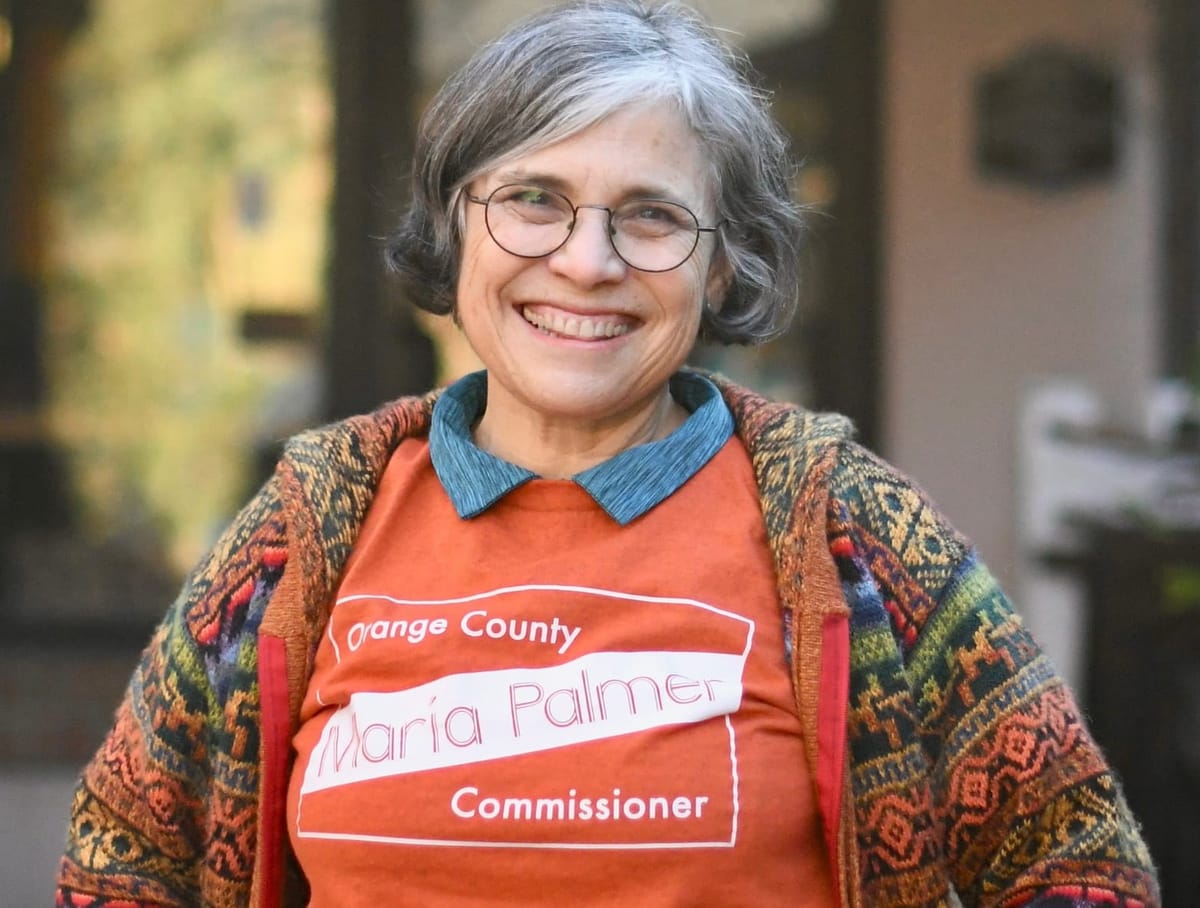
A conversation with María Palmer, candidate for Orange County Board of Commissioners representing District 1
John Rees of The Triangle Blog Blog joined us to talk about her candidacy, the role of County Commissioner, universal preschool, and more.
This summarized narrative was generated by AI from the transcript of the interview that aired on The Carrborean Radio Hour on WCOM 103.5 (wcomfm.org) February 9.
Tell us about your background and your history with public service.
I grew up in Peru in a family where public service and journalism were everyday life—my father and brothers are journalists, my grandmother was a volunteer consul during WWII, and my mother preserved historic buildings. My own first public service was at age 15, representing the Girl Scouts of Peru in an earthquake relief campaign. Since then, I’ve carried that tradition into work on Chapel Hill Town Council, local commissions, and community organizing.
What drives your public service?
I was raised on the idea that “to whom much is given, much is required,” and I’ve had educational and professional opportunities that many immigrants can’t access. My focus is on connecting existing organizations—like the League of Women Voters and community colleges—with people who are hungry for opportunity. One of the most rewarding examples was a career day we organized that helped a young woman become a nurse and UNC graduate.
For a Carrboro resident, what does a County Commissioner actually do, and why does it matter?
County Commissioners decide how your property is valued, how much tax you pay, and how those dollars are spent. They also control where and what can be built, and they fund health, recreation, and many everyday services. I see the county budget as a moral document—it shows what we really value as a community.
How do you think about land use and the rural buffer?
The rural buffer is a jewel, but we need to be honest that if we don’t plan carefully, it will turn into a landscape of very expensive homes rather than working farms and accessible green space. Orange County is still mostly undeveloped, and I think we can make small, strategic adjustments—especially where OWASA can serve denser housing—to address the housing crisis while protecting agriculture and forests. To me, preserving local agriculture and farmers’ markets is a key part of climate responsibility and community identity.
What are your concerns about the current property tax assessment process?
The recent tax revaluation repeats serious problems we saw four years ago, with Black neighborhoods and low‑income areas systematically over‑assessed. Through Justice United, we’ve shown the County the data and maps, but the official response has leaned too much on formulas and not enough on the lived impact. I’m running because I believe we need someone on the inside pushing for fair assessments, better training and hiring, and real safeguards against racial and economic bias.
What is the county’s role in schools and what are your priorities for education?
The county doesn’t run the schools day‑to‑day, but it does provide the funding, and commissioners should be strong advocates for our students and educators in Raleigh. As a former teacher and principal with a doctorate in Educational Leadership, I’ve seen firsthand how state cuts to teacher assistants and supports harm kids and teachers. I want the county to invest creatively in education and early childhood, including moving toward universal preschool.
Where do you stand on school closures?
I’m very cautious about closing schools, because once they’re gone it’s extremely hard and expensive to get that capacity back when we need it. I’d rather see us refurbish and repurpose school buildings for early childhood centers, child care for educators, and training pipelines for future childcare workers. We may not be able to avoid every closure, but I believe we should exhaust creative partnerships and funding options first.
What are the top issues you think Carrboro residents should care about in this race?
I’d highlight climate change and smart growth, housing affordability, fair and equitable tax assessments, and strong support for public schools and early childhood. I also think it matters to have a commissioner who consistently asks how decisions affect working families, not just people who will be fine no matter what. My friends joke that I’m the “people’s champion,” and that’s the lens I bring to county government.
What are some of your favorite things to do in Carrboro?
I love sitting outside at Weaver Street Market with my grandkids, seeing friends and neighbors, and enjoying local food. The Carrboro Farmers’ Market, neighborhood walks with friends and their dogs, and the town’s festivals and outdoor Zumba classes are some of my favorite parts of life here. Carrboro’s walkability and sense of community are exactly what I want to help protect and strengthen at the county level.